










It's Monday morning. You've got a client call in 20 minutes, you're jumping between six different tabs trying to find a note from a conversation two weeks ago, your project manager is pinging you in Slack, your account lead just emailed asking where a proposal stands, and somewhere in all of that, there's a tool you're paying $89 a month for that nobody on your team has opened since March.
This is what a bloated, disconnected agency tech stack feels like from the inside. And honestly? Most agencies are living in it right now — and just accepting it as normal.
The average agency runs somewhere between 15 and 22 tools, with client data scattered across five different places and the team constantly jumping between tabs just to get basic context on a project. More tools didn't fix the chaos. In a lot of cases, more tools became the chaos.
So here's what we're not going to do: hand you another overwhelming list of 40 platforms and wish you luck. What we are going to do is walk you through the agency tech stack framework that actually works in 2026 — the one built around what your agency needs to do, not just what software exists. We'll point you toward the tools worth considering in each category, give you our honest take on what most agencies actually need, and help you figure out the right fit for your team.
Key takeaways
Before we dive in, here's the short version for the skimmers (we see you, and we respect it):
- More tools don't mean a better stack. The average agency runs 15-22 tools and still can't find the client note they need. Lean and connected beats big and bloated every time.
- Think in outcomes, not features. Before you buy anything, ask: what problem does this actually solve? If you can't answer that in one sentence, you probably don't need it.
- Your CRM is the foundation everything else builds on. For relationship-driven agencies, this is the most important tool decision you'll make — get it right and every other choice gets easier.
- At 10-plus people, disconnected tools are a real business problem. Your whole team needs to work from the same information. That doesn't happen by accident.
- AI is infrastructure now, not a side experiment. Get at least one AI tool properly integrated into your content and creative workflow — not just bookmarked for later.
- Best-of-breed beats single-vendor for most agencies — but only if your tools are actually connected to each other.
- Review your stack every quarter. The 30-day rule: if nobody's actively using it, cut it. No exceptions.
What is an agency tech stack, anyway?
Before we dive into the good stuff, let's get aligned — because "tech stack" gets thrown around a lot and means different things depending on who you ask. Your agency tech stack is every piece of software your team uses to run the business: finding new clients, winning work, delivering projects, measuring results, keeping your team from losing their minds. All of it, under one umbrella.
Simple concept. Genuinely tricky to get right — especially once your team starts growing.
Most agencies build their stack reactively — a client needs something, a tool gets added; a team complains about a process, another platform gets trialed. Over time, the agency tech stack becomes a graveyard of unused subscriptions, disconnected systems, and duplicated data. The agencies that operate smoothly treat their stack like infrastructure. Every tool has a job. Everything connects. And when something stops earning its place, it gets cut.
This matters even more once your agency hits the 10-plus person mark. You've got account managers, project leads, creatives, and ops people who all need to work from the same information — and if your tools aren't talking to each other, someone is always out of the loop. It's always right before an important client call. Always.
Here's the framework that actually works in 2026, organized by the six outcomes every agency tech stack needs to cover.
The 6 outcomes your agency tech stack needs to cover
We love a good framework and this one is really useful (or, at least, we think so anyway!).
Instead of thinking about your tech stack as a list of tools, think about it as a set of outcomes your agency needs to achieve. When you approach it this way, the tool decisions get a lot easier because you're always asking "does this actually help us achieve the outcome?" instead of "ooh, does this have a good free trial?" (We've all been there.)
Here are the six outcomes every agency tech stack needs to support, and our honest take on what fits best in each.
1. Awareness
You could be the best agency in your space — genuinely, objectively, the best — and it still won't matter if the right clients can't find you. Awareness is about showing up in search, staying present on social, and making sure your online presence reflects the caliber of agency you actually are. For a 10-plus person team, this is also about looking like the established, credible operation you've already built.
What this outcome actually needs:
- A way to show up in search (SEO tools and a CMS that makes publishing easy)
- A way to stay present on social without it consuming someone's entire week
- Analytics that tell you what's actually driving inbound — not just what looks good in a dashboard
The honest take: You don't need six platforms here. Most agencies run their entire awareness layer on three tools:
- One SEO tool (Semrush or Ahrefs are the two worth your time)
- One social scheduling tool that fits your team size (Buffer for simplicity, HeyOrca if you're managing multiple client accounts, Sprout Social if you need deeper analytics)
Pick one from each category. That's your awareness stack, done.
2. Relationship management and automation
TL;DR: Don't skip this one!
We'll be upfront: this is the most important part of the tech stack for your agency. If you get everything else slightly wrong but nail this one, you'll be fine. If you skip this one? You're going to feel it — in lost deals, dropped follow-ups, and account managers who genuinely don't know what was discussed on the last client call.
Your customer relationship management (CRM) platform is where everything lives — every client conversation, every deal in progress, every contact your team has ever touched. At an agency size of 10-plus people, it stops being optional and starts being the thing holding your agency together.
Then there's automation a.k.a. the tools handling repetitive follow-ups and workflow triggers so your team focuses on work that actually needs a human. This is where good agencies get efficient, and great agencies pull ahead.
What this outcome actually needs:
- A CRM your whole team will actually use (the fanciest CRM in the world is useless if nobody opens it)
- Pipeline management for deals and projects — because winning the client is only half the job
- Automation that handles follow-ups and workflow triggers in the background
- Proposals and contracts that connect to your CRM, not live separately from it
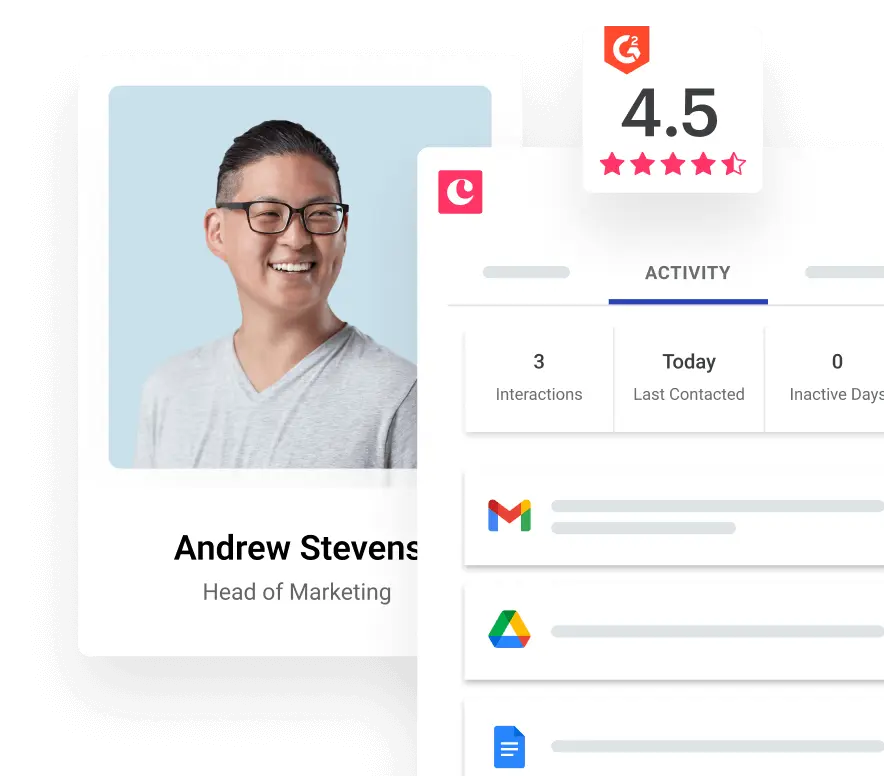
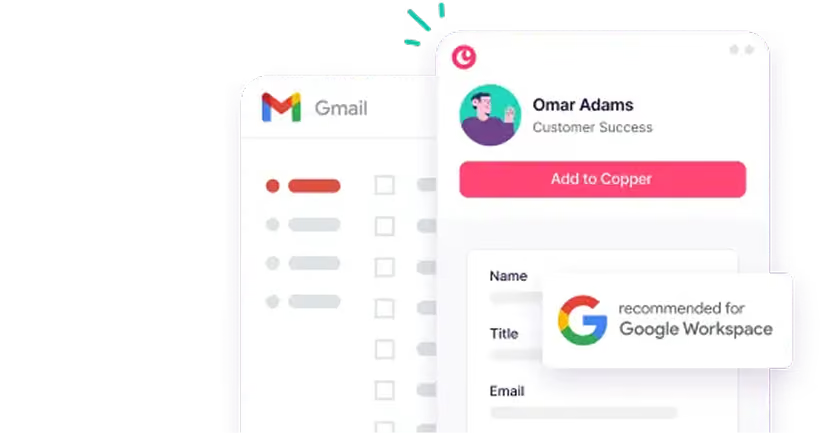
The honest take: If your agency runs on Google Workspace (and we know most do) Copper is the obvious choice here. It's the only customer relationship management (CRM) platform that's a Recommended for Google Workspace app, a Chrome Enterprise Partner, and a Google-backed company. It lives inside Gmail and Google Calendar rather than alongside them, which means your team logs calls, updates deals, and tracks relationships without leaving the tools they're already in.
For email marketing, Mailchimp handles most agencies' needs well. Get ActiveCampaign if you need more advanced automation. Use PandaDoc or DocuSign for proposals and contracts, both integrate directly with Copper.
The goal isn't more tools. It's fewer, better-connected ones — with your CRM as the hub everything flows through.
And if you want to see what that looks like in practice? Copper gives your agency a 14-day free trial — no credit card, no setup headaches, just your whole client relationship layer living inside Gmail where it belongs.
3. Content management
Your website is often the very first real impression a potential client gets of your agency, and if your CMS makes it painful to update a page or publish a blog post, it's quietly costing you — in search rankings, in credibility, and in the hours your team burns navigating around it. A good CMS is one your whole team can actually use, your content stays fresh, and your blog (which is doing real SEO heavy lifting for you, by the way) is easy to manage at scale without a developer on standby every time something needs changing.
What this outcome actually needs:
- An editing interface anyone on your team can use without filing a dev ticket
- SEO tools built in or easy to plug in
- Version control so nothing gets accidentally overwritten
- Performance and security that holds up as your traffic grows
The honest take: The three platforms worth your time as an agency in 2026 are:
- Webflow: Best for agencies that want pixel-perfect design control and strong SEO capabilities. It does have a bit more of a learning curve, but worth it for teams who care about design precision.
- Framer: The fastest way to get a visually stunning site live. It feels familiar if your team already lives in Figma, and real-time collaboration is genuinely great
- Squarespace: The no-fuss option. You get beautiful templates, everything included, and non-designers on your team can update it without breaking anything.
Pick the one that matches your team's technical comfort level and how much control you actually need. You don't need all three — you need one that works and that your team will actually use.
4. Creative production
No two agencies are the same here, and that's kind of the point. A 12-person digital agency and a 15-person creative studio have almost nothing in common in this category — and anyone who gives you a one-size-fits-all creative stack recommendation is guessing. What matters is that your tools are built for the actual work you produce, support real-time collaboration across your team, and — in 2026 — include AI features that genuinely speed things up rather than just existing for the marketing copy.
What this outcome actually needs:
- Tools purpose-built for your specific type of output
- Real-time collaboration so your team isn't emailing file versions back and forth
- At least one AI tool actually integrated into the workflow — not just sitting in a tab someone opens twice a month
The honest take: Figma for UI/UX (it's the industry standard, full stop) and Canva as the accessible option for team members who need polished assets without being designers. For AI, pick one and actually build it into how your team works. Agencies that have adapted to AI-powered creative workflows are seeing measurably higher conversion rates and engagement compared to those still working without it. The experiment phase is over, it's infrastructure now.
If you're a commercial production company, Timmy.io is worth a look — it's a production OS built for producers that handles budgeting, scheduling, crew, and project status all in one place.
Related: We curated a list of the best content marketing AI tools for agencies.
5. Intelligence and analysis
Here's a truth most agencies don't love hearing: if you can't clearly show a client what they're getting for their investment, you're always one bad month away from losing them.
Analytics isn't just a client retention play, you also need visibility into your own agency's performance. What's driving inbound, where deals are stalling, whether the business is actually growing the way it feels like it is. Good analytics tools make both of those things happen without your team spending half their week pulling reports manually.
What this outcome actually needs:
- Website analytics that show you what's working
- Client reporting that's easy to generate, white-labeled, and readable by non-marketers
- Pipeline and team activity reporting so you have eyes on the business, not just client accounts
The honest take: Use Google Analytics 4 for your website (you're probably on Google Workspace, anyway!) It's free, powerful, and the baseline everything else connects to. Looker Studio is also a solid free option if your data lives mostly in Google's ecosystem. And if your CRM is Copper, your pipeline and team activity reports are already built in (yes, that means no separate tool needed for that layer). You don't need a separate analytics tool for every channel. You need one reporting layer that pulls it all together.
6. Collaboration and productivity
At five people, staying aligned is easy. At 10-plus, it's a deliberate effort — and the difference between agencies that feel like well-oiled machines and ones that feel like organized chaos usually comes down to this layer of the stack. When your collaboration tools work, your team spends time on client work. When they don't, your team spends time managing the tools themselves, which is nobody's idea of a good Tuesday.
Research shows 58% of professional services teams are juggling three to five tools just to manage their work — and 57% end up spending more time on status updates and reporting than on actual delivery. The right collaboration layer fixes that by giving everyone one place to see what's happening, what's theirs to action, and what's coming up next.
What this outcome actually needs:
- Team messaging that's organized by channel, not one chaotic group chat
- Project management with clear ownership and deadlines everyone actually updates
- Document storage and co-editing the whole team can access
- Time tracking for billable hours — non-negotiable once you're managing multiple client accounts
- Something that scales without needing a total rebuild when you hit 25 people
The honest take: Slack for communication (it's where your team will actually live), Google Workspace for documents and storage (especially powerful if you're using Copper, since it all stays natively connected), and one project management tool that fits how your team works. For automation between tools, Zapier handles most agency workflows well. Most agencies don't need all of these — pick the ones that solve your actual problems and leave the rest.
Best-of-breed vs. single-vendor: What actually makes sense for your agency?
Here's a debate that comes up in every agency ops conversation eventually, and we're going to give you the honest version rather than the diplomatic one. When building the tech stack for your agency, you've got two paths:
- hand-pick each tool yourself (best-of-breed)
- or go with one platform that tries to cover everything (single-vendor).
Both are legitimate approaches. Neither is perfect.The real question isn't which model is better in theory — it's which one fits your agency right now, given your team size, your budget, and how much change management you have the bandwidth to take on.
Best-of-breed means building a custom stack, one tool at a time
Pros:
- Roll things out gradually without blowing your whole software budget upfront
- Each tool is genuinely best-in-class for its specific job
- Easy to swap something out when it stops working, without disrupting everything else
Cons:
- You own the integration work — and if tools don't talk to each other, you've just built expensive silos
- More vendors, more renewals, more support conversations when things break
Single-vendor means one platform covering multiple outcomes
Pros:
- Pre-integrated from day one with no custom integration work
- One contract, one support contact, faster team onboarding
- Simpler to manage as the team grows
Cons:
- Usually more expensive and bundled with features you'll never actually use
- Migrating your whole team at once is a real change management project — don't underestimate it
Our honest take: For most agencies in the 10-to-50 person range, best-of-breed wins (but only if your tools are properly connected!). A best-of-breed stack where nothing integrates is just organized chaos with a higher price tag.
The most effective agencies in 2026 are building connected stacks where data moves automatically between tools — a new lead triggers a CRM record, which creates a project task, which notifies the right person in Slack. The number of tools matters a lot less than whether they actually work together.
How to build the right tech stack for your agency and the questions to ask
Okay, so you've got the framework... now how do you actually put it into practice without getting overwhelmed? Good news: this part is simpler than it sounds. It really just comes down to five things, done in the right order.
The temptation when building (or rebuilding) an agency tech stack is to try to solve everything at once. Resist it. The agencies that build great stacks do it methodically — one layer at a time, always starting from what they actually need right now, not what they might need someday.
1. Start with outcomes, not tools
Write down what you're trying to achieve before you look at a single product page. "Better client communication" is an outcome. "Slack" is a tool. Work backwards from what you actually need. That's how you avoid buying things that sound good in a demo but collect dust six months later.
2. Prioritize by what's hurting most right now
You don't have to solve everything at once. Rank your outcomes by what's costing you the most — lost deals, missed follow-ups, project delays, client churn — and start there. If you haven't actively used a tool in 30 days, cancel it. You can always come back to it.
3. Pick your foundation first, then build around it
For most relationship-driven agencies, the foundation is a CRM. Your CRM is where all client data should live, with project management as your delivery layer, financial tools as your reporting layer, and automation connecting everything together. Get the foundation right and every other decision gets easier — because you're always asking "does this connect to our CRM?" before you buy anything new.
4. Check integrations before you commit
A tool that doesn't connect to the rest of your stack isn't saving time — it's creating a new silo and another login for your team to forget about. Before you commit to anything new, confirm the integration actually works the way you need it to. Ask to see it in a demo, not just on a features page.
5. Review your stack quarterly
Add tools when the business case is clear, not because the demo was impressive or another agency mentioned it in a LinkedIn comment. And review what you've got every quarter. The 30-day rule applies across the board: if your team isn't actively using it, cut it. What solved a real problem six months ago might be totally redundant now that you've grown.
TL;DR Our honest recommendations for a 10-plus person agency
We know you're busy. So here's the short version: the best agency tech stack isn't the most comprehensive one. It's the leanest one that actually covers your six core outcomes, connects properly, and that your team genuinely uses every single day.
If we were building the tech stack for a 10-plus person agency from scratch in 2026, here's where we'd start:
- CRM (your foundation): Copper — especially if you're on Google Workspace; it's where client relationships live and where everything else should connect back to
- Awareness: One SEO tool (Semrush or Ahrefs), one social scheduling tool (Buffer, HeyOrca, or Sprout Social depending on your team size)
- Content management: Framer, Squarespace, or Webflow — pick one, commit to it
- Creative production: Adobe Creative Cloud or Figma for your core work, Canva for the rest of the team, and one AI content tool your team actually integrates into their workflow (more on that here [link])
- Analytics: Google Analytics 4 for your site, AgencyAnalytics or Looker Studio for client reporting, and Copper's built-in reports for pipeline visibility
- Collaboration: Slack, Google Workspace, and one project management tool (Copper can manage projects after deals are won, too!)
- Automation: Zapier to connect everything, Make if your workflows get complex
That's it. Not 22 tools. Not a different platform for every problem. Just a lean, connected stack built around what your agency actually needs — with room to grow as you do.
Start with your foundation. Connect everything to it. Cut what doesn't earn its place. Your team will thank you, your clients will feel the difference, and you'll stop paying for software that nobody uses.
And if you're still figuring out what that foundation looks like? Copper is a great place to start. It's the CRM built for agencies on Google Workspace — lives right inside Gmail, takes days to set up, and comes with a 14-day free trial so you can see how it fits before you commit to anything.