










Running a service business is a very specific kind of organized chaos.
You close a client, kick things off, spin up a shared doc, maybe even a Slack channel with an overly confident name. Everyone’s aligned. It feels clean.
A few months later, someone’s asking whether that deliverable was in scope, someone else is searching Gmail for “final proposal FINAL,” and you’re realizing your entire operation depends on context living in places it probably shouldn’t.
That’s why finding the best CRM for service based business isn’t about squeezing a few extra percentage points out of your close rate. It’s about protecting relationships once the deal is signed. It’s about making sure sales, delivery, and renewals are connected instead of floating in separate systems.
Because service businesses don’t grow on transactions. They grow on trust sustained over time — and that requires infrastructure behind the scenes.
Let’s talk about what that actually looks like in 2026.
What is a CRM for service businesses
CRM stands for customer relationship management software. At its core, it helps you track contacts, conversations, and deals.
That’s the basic definition.
For service businesses, though, a CRM isn’t just a pipeline tracker. It’s the system that manages the entire client lifecycle (from first inquiry to signed contract to onboarding to delivery to renewal). Yeah, we know, it’s a lot!
Product companies optimize for transactions. Service companies optimize for relationships. That difference matters more than most people realize.
When you’re running a marketing or PR agency, a consulting or advisory firm, or another professional services firm, “closed-won” isn’t the end of the journey. It’s the beginning of months (or years) of collaboration. Your CRM needs to support that long arc, and not just the moment of conversion.
The best CRM for service based small business keeps sales conversations, project milestones, account notes, renewal reminders, and revenue data connected in one place. Not scattered across inboxes and tools you have to mentally stitch together every Monday morning between your three cups of coffee and energy bar.
Why service companies need a purpose-built CRM
There’s a common moment where things start feeling harder than they should.
Sales closes a deal and moves on. Delivery picks it up and tries to piece together what was promised. The client assumes your team’s fully aligned. Leadership wants revenue numbers that match reality.
Meanwhile, your team’s bouncing between Gmail, Slack, spreadsheets, and a project board that’s missing context.
Service businesses don’t run on one-time purchases. You’re managing long-term work. Scopes shift. Timelines evolve. Renewals sneak up. Your revenue depends on keeping relationships steady over time, not just closing the deal.
When your CRM isn’t built for that, information gets scattered. Sales notes live in one place. Project updates live somewhere else. Renewal dates live in someone’s memory, which isn’t exactly a reliable system.
A purpose-built CRM pulls it all together. It gives you one shared timeline per client, connects pipeline stages to onboarding, and keeps context visible for everyone on the team.
That visibility makes your business easier to run. Less scrambling. Fewer recap meetings. More confidence in every client conversation.
And that’s what actually supports growth.
Related: Evaluating your CRM: How to set the right criteria with a detailed checklist
Must-have CRM features for service providers
Not every CRM software is built for service workflows. Some are amazing at moving deals. Fewer are great at sustaining relationships.
If you’re evaluating the best CRM for service based business, here’s what actually matters.
Contact and deal tracking in one timeline
Your CRM system should show the full client story in chronological order:
- Sales emails
- Discovery calls
- Proposals
- Signed contracts
- Onboarding notes
- Project updates
- Renewal conversations
When someone opens a contact or company record, they shouldn’t feel like they’re solving a mystery. No digging through inboxes. No hopping between tools. No asking, “Does anyone remember what we told them?”
Everything should be right there in one clean, chronological timeline. It might sound like a small thing, but the first time you don’t have to scramble for context before a client call, you’ll realize it’s not small at all.
This is where it really shines during handoffs. Sales doesn’t have to book a 45-minute “let me explain everything” meeting, instead you just have to look at the sales process. Delivery can open the record, scroll through the full story, and get moving with confidence.
Project and task management after the sale
Closing the deal isn’t the hard part. Delivering consistently is.
A service-friendly CRM should allow you to trigger onboarding tasks automatically when a deal moves to “Won.” It should support customizable pipelines that reflect both sales and fulfillment stages. It should let you assign tasks, track milestones, and keep accountability visible.
This bridge between sales and service is where many CRMs fall short. They assume the job ends at revenue. Service businesses know that’s when the real work begins.
The best CRM for service based business connects pipeline changes to operational action. No manual copying. No forgotten handoffs. Just clean transitions.
Automated follow-ups and reminders
You absolutely intend to follow up before renewals. You plan to schedule quarterly check-ins. You tell yourself you’ll send that proactive “How’s everything going?” email before the client has to ask.
And then the week fills up.
“Meaning to” is not the same thing as “done,” especially when you’re juggling active projects and new proposals at the same time.
This is where a strong CRM system quietly saves you. Pipeline email automations triggered by stage changes can send onboarding or follow-up emails the moment something moves forward. Renewal reminders can pop up well before a contract expires. Check-ins can be scheduled in advance instead of living on a sticky note somewhere on your desk.
Automation doesn’t make your relationships robotic. It makes them consistent. And consistency is what makes clients feel taken care of instead of forgotten.
Mobile access between client meetings
At this point, “the office” could be a client’s conference room, a coworking space, or gate B12 while your flight’s delayed.
So if your CRM only really functions when someone’s sitting at a desk with three monitors, that’s a problem.
Account leads are walking out of client meetings with details that need to be captured while they’re still fresh. Partners are taking calls between sessions and promising next steps before they’re back at their desk.
They need instant access to client history and a fast way to log notes on the spot.
Because we all know what “I’ll update the CRM later” actually means. It means you won’t. Or you’ll half-remember. Or you’ll confidently log something that’s… almost accurate.
Memory’s great for birthdays. It’s not great for scope details.
A CRM platform with strong mobile access keeps everything current, even when your team’s scattered across cities and time zones. Updates happen in the moment. Context stays fresh. And no one has to reconstruct a conversation from vibes and vague recollections.
That’s not just convenient. That’s how you keep a distributed team feeling connected and your client experience feeling seamless.
Google Workspace integration and email sync
If your team lives in Gmail, your CRM system shouldn’t feel like a separate app you visit when you’re feeling disciplined. It should feel like it’s already there.
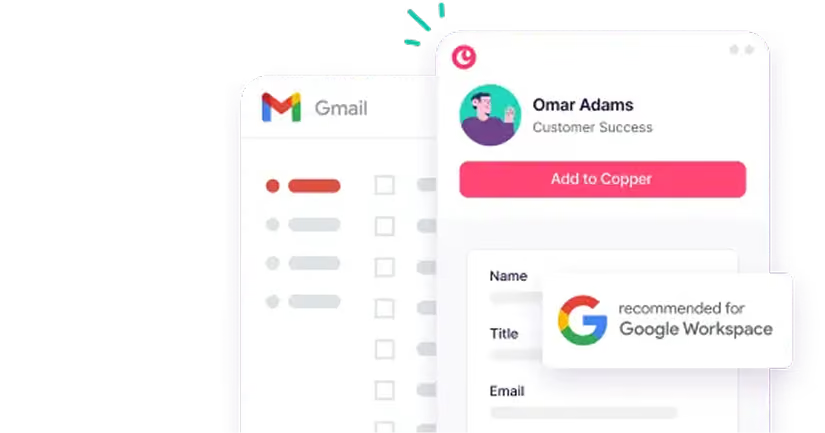
Deep Google Workspace integration means your emails automatically sync to contact records, meetings attach themselves to deals, and Google Docs link up without you downloading, re-uploading, or playing “where did I save that?”
You shouldn’t have to manually log conversations just to prove they happened. That’s admin work no one signed up for.
And here’s the underrated truth: the easier a CRM is to use, the more your team will actually use it.
Lower friction leads to higher adoption. Higher adoption leads to cleaner data. Cleaner data leads to better decisions. That’s the chain reaction you want.
Customizable reporting and revenue forecasts
Service revenue isn’t simple: You’ve got recurring contracts, one-off projects, scope expansions, retainers, renewals, and that one client who always asks for “just one more thing.” Looking at closed deals alone doesn’t tell you the full story.
You need visibility into what’s active, what’s renewing, what’s profitable, and what’s coming down the sales pipeline next quarter.
Customizable dashboards let you track the metrics that actually matter to service businesses:
- Not just how many deals closed, but how much revenue is currently in motion.
- Not just leads generated, but renewals secured.
- Not just pipeline value, but projected workload and capacity.
When your CRM becomes your forecasting engine, decisions stop feeling reactive. You’re not hiring based on vibes. You’re not greenlighting big expenses because “it feels like we’re busy.” You’re looking at real numbers that reflect how service businesses actually operate.
And that shift changes everything.
The 7 best CRMs for service-based businesses
Not all CRMs are built with service businesses in mind.
Some are fantastic at helping you close a deal and then… kind of disappear. Others understand that in a service company, the real complexity starts after the contract’s signed.
To narrow this down to the best CRM for service based business in 2026, we looked at what actually matters for service teams: Google Workspace integration, project and onboarding support, automation that reduces admin work, reporting that reflects recurring revenue, and overall fit for long-term client relationships.
Here are the platforms that stand out and who they’re really best for.
1. Copper
Best for agencies, consulting and advisory firms, and professional services teams on Google Workspace.
If your team lives in Gmail, Copper feels like it was built by someone who understands your daily workflow. Well, because it was.
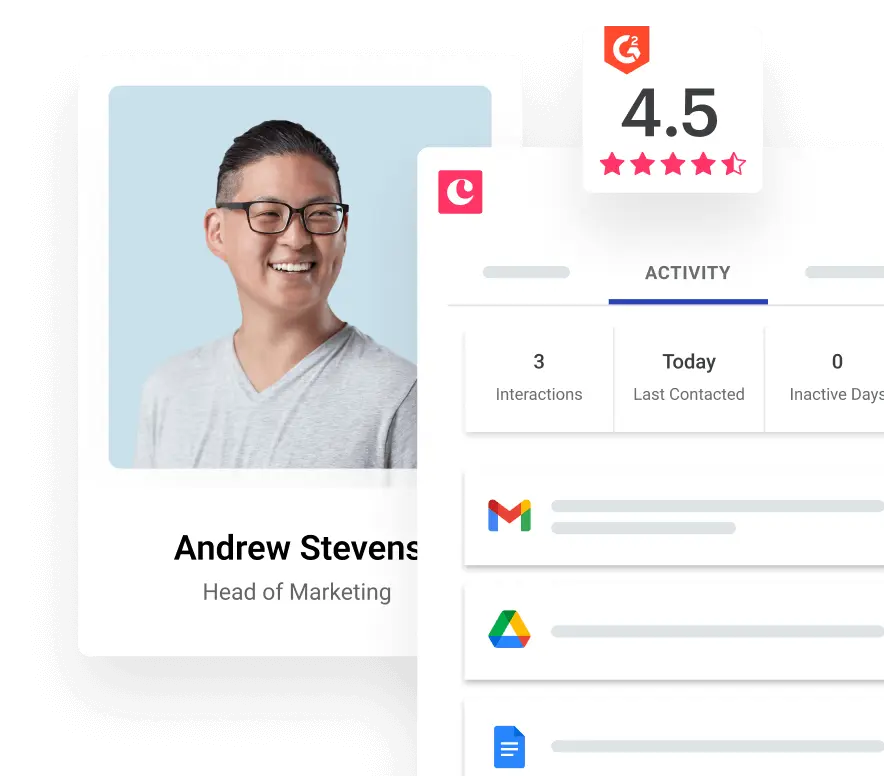
Copper integrates natively with Google Workspace, so emails, meetings, and files sync automatically. You’re not copying and pasting notes into a separate system at the end of the day. You’re managing deals, onboarding, and client history directly inside Gmail.
You can build customizable pipelines for both sales and onboarding, which is huge for service businesses that need that bridge between closing and delivering. When a deal changes stage, pipeline email automations can trigger instantly. Website forms route new inquiries straight into the right pipeline. And because Copper integrates with hundreds of other apps, you’re not locked into some rigid ecosystem. It also has a mobile app — so you can keep tabs and make updates, all on the go.
For agencies, consultancies, and professional services firms, Copper keeps the full client lifecycle in one place — first touch to renewal — without adding friction to your team’s day.
It offers tiered pricing plans so you can scale features as you grow. And because it works where your team already works, adoption feels natural instead of forced. That might not sound flashy, but for busy service teams, it’s everything.
2. HubSpot
Best free CRM with strong service tools.
HubSpot CRM is popular for a reason. Its free option offers solid contact management, deal tracking, and basic automation without upfront cost.
For smaller service teams, it’s a strong starting point. But as your needs grow — advanced reporting, automation depth, custom workflows — you’ll likely move into paid tiers. Costs can climb quickly depending on usage.
Still, it’s one of the most accessible entry points into structured CRM usage.
3. monday CRM
Best for customizable workflows.
monday CRM stands out for visual pipeline boards and flexible workflow design. Service businesses can tailor dashboards to reflect internal processes, making it attractive for teams with unique operational structures.
The trade-off is setup time. With flexibility comes configuration. If you’re willing to invest in customization, it can become a powerful internal hub.
4. Zoho CRM
Best budget option with AI features.
Zoho CRM offers competitive pricing and a wide range of customization options. Its AI assistant, Zia, provides predictive insights and workflow suggestions.
For cost-conscious service teams that want advanced features, Zoho’s appealing. The interface can feel more complex, though, especially for teams prioritizing simplicity.
5. OnePageCRM
Best for solo founders or very small teams that want a simple, action-focused CRM.
OnePageCRM keeps things focused. It’s built for small teams and solo operators who need to manage contacts, track deals, and stay consistent with follow-ups — without navigating a maze of features.
Everything is designed to be quick to pick up and easy to maintain. You can get set up in minutes, manage emails directly in the CRM, and keep your pipeline moving with simple automation and clear next steps.
It’s a strong option if you care about speed, simplicity, and keeping costs low.
6. Streak
Best for Gmail-based workflows.
Streak operates entirely within Gmail, making it appealing for lightweight pipeline tracking. It’s simple, email-centric, and easy to start with.
However, deeper project management and reporting features are limited compared to more comprehensive CRMs.
Related: 4 Streak CRM Alternatives
7. GoHighLevel
Best for agencies that resell white-label marketing automation.
GoHighLevel offers white-label CRM capabilities and strong marketing automation tools. Agencies can manage client accounts and even resell CRM access as part of their service offering.
It’s marketing-heavy by design, which makes it ideal for certain agencies but less focused on broader service workflows.
How to choose the right service business CRM
Choosing the best CRM for service based business isn’t about picking the tool with the flashiest homepage or the longest feature comparison chart.
It’s about alignment.
If your CRM doesn’t match how your service business actually runs, your team will quietly ignore it. And a powerful system that no one uses is just expensive decoration.
So before you commit, here’s how to think about it like an operator, not just a buyer.
1. Map your client journey from lead to renewal
Before you even open a pricing page, map your reality.
Walk through your client journey step by step:
- Inquiry comes in
- Discovery call happens
- Proposal gets sent
- Contract’s signed
- Onboarding kicks off
- Delivery begins
- Reporting and check-ins happen
- Renewal conversation starts
Now here’s where it gets interesting. Once you do that, you need to ask yourself how to better streamline the workflow:
- Where do handoffs feel clunky?
- Where do you repeat information?
- Where does something occasionally slip?
- Where do renewals feel reactive instead of planned?
Those friction points are your clues.
If onboarding always needs a recap meeting because context lives in email, your CRM needs stronger shared timelines. If renewals sneak up on you, automation needs to be non-negotiable. If scope changes get messy, you need clearer visibility across teams.
Your CRM should support how you actually operate… and not how a software company thinks you should operate.
2. List must-have integrations and automations
Next, look at your current tech stack.
You’re probably using some mix of Gmail or Google Workspace, accounting software like QuickBooks or Xero, a project management tool, maybe some email marketing automation.
Your CRM doesn’t need to replace all of it. It needs to connect to it cleanly.
Because the second your team has to copy information from one tool to another, friction shows up. And friction turns into “I’ll update it later.” And “I’ll update it later” turns into incomplete data.
You want things like:
- Follow-ups triggered when deals move stages
- Renewal reminders before contracts expire
- Tasks automatically created when a deal closes
Automation should reduce mental load. If it feels like you’re building a robot army just to send an email, it’s too complicated.
3. Set a realistic budget and adoption timeline
The subscription cost is the obvious number. It’s not the only number. You also need to consider:
- Time to migrate your data
- Time to set up pipelines and workflows
- Time to train your team
- Time for people to actually build the habit
Most service teams can migrate in a few weeks. Adoption is the real timeline.
If the system feels intuitive, your team will lean in. If it feels like homework, they’ll resist — politely at first, then passively.
And here’s the part people don’t say out loud: even the best CRM for service based business won’t deliver value if it’s only half-used.
Usability isn’t a “nice to have.” It’s the whole game.
4. Test usability with your delivery team
Sales absolutely deserves a voice in the decision since they’re working the pipeline every day, but your delivery team is the one living in the system long after the deal closes, so their experience matters just as much.
Bring in your project managers, account leads, and client-facing staff and let them actually use the CRM. Have them click through onboarding stages, log updates, move deals forward, and interact with it the way they would during a real week of work. Then ask them one honest question: does this make your job easier or harder?
Their reaction will tell you more than some feature comparison chart ever could.
If your delivery team doesn’t buy in, the system won’t stick, and when it doesn’t stick, your team will quietly drift back to spreadsheets, Slack threads, and “temporary” tracking docs that somehow become permanent (oh no…).
The right CRM should feel like a relief, like things are finally connected and handoffs don’t require a separate meeting just to explain what happened.
When it feels smoother instead of heavier, that’s when you know it fits. And fit will always outperform hype.
Ready to build stronger client relationships? Try Copper free
At the end of the day, the best CRM for service based business depends on how your team works.
If you live in Google Workspace and want seamless Gmail integration, customizable pipelines, website forms that sort inquiries automatically, and pipeline email automations triggered by stage changes, Copper’s built for that environment.
It keeps sales and service aligned on one shared timeline. It reduces manual updates. It connects conversations to action.
You can try Copper free for 14 days and see how it fits into your workflow!
Because strong client relationships don’t just happen. They’re supported by systems that make consistency easier (and consistency is what clients remember).