











At some point in every growing company’s life, someone says it: “Should we just build our own customer relationship management (CRM) platform?”
Maybe it happens after trying a few platforms that almost work but not quite. Maybe your sales team has very specific workflows. Or maybe someone on the engineering team casually says, “Honestly… we could probably build your own CRM.”
And suddenly it feels like a great idea. Who doesn’t love total control, perfect workflows, and no paying for features you don’t use?
But here’s the thing that needs to be gently pointed out: deciding to build your own CRM is less like installing software and more like launching an entirely new product inside your company. And once you start, you own it forever.
So, before committing to the DIY route, let’s break down what building a CRM actually involves — and the challenges that tend to sneak up on teams mid-project.
What it means to build your own CRM
When companies talk about wanting to build your own CRM, they usually mean creating software tailored specifically to their business instead of using an off-the-shelf CRM platform.
That can look a few different ways depending on the team and resources involved.
Some companies truly build from scratch. Their developers design the database, the user interface, the pipelines, the automation logic — read: everything. This gives full control, but it also means every feature, update, and bug fix is now your responsibility.
Others use no-code or low-code tools to assemble a CRM-like system using visual builders. This can speed things up, but these tools still require thoughtful design and maintenance if the system becomes central to your operations.
And then there’s the middle path: using a customizable CRM platform and tailoring it to your workflows. Many teams start researching how to build your own CRM only to realize modern CRMs already allow deep customization.
The difference is that those platforms handle the hard stuff (security, infrastructure, integrations) so your team doesn’t have to reinvent the wheel.
Why teams try to create their own CRM system
So why do smart, very capable teams start seriously considering building their own CRM? Your CRM technically works. But also? It’s annoying… constantly.
Your team’s doing little workarounds everywhere. Your pipeline doesn’t quite reflect reality. Your reports feel… off. And integrations? Hanging on by a thread.
And then someone says it: “Wait… what if we just built our own?”
And suddenly it sounds kind of perfect.
Because imagine a system that actually fits your business (finally; pipelines that mirror how your team really sells; everything connecting the way it’s supposed to; and no extra fluff and stuff you don’t need.
Of course that’s appealing. It should be.
- You want something tailored, not templated: Your business isn’t generic, so why should your CRM be?
- You want to streamline your workflows to feel natural: Not like you’re constantly adjusting how you work to fit a tool
- You want your tools to actually talk to each other: Without duct tape solutions
- You want more control over cost and complexity: Because subscriptions add up
Honestly? The logic is solid. No notes.
But this is also the exact moment where things start to look a lot simpler than they really are…
Quick overview of how to build a CRM system
Okay, so you’re really considering it. You might actually build your own CRM solution.
Let’s walk through what that step-by-step actually looks like — because it’s not just “we’ll throw something together real quick.” It’s a full process, and every moment matters more than you think.
1. Define goals and user stories
Before anything gets built, you need clarity. Not vague goals, real ones.
What is this CRM supposed to do? Who’s using it? And how do they actually work day to day?
Because your sales team, leadership, and ops team? They all want completely different things. Sales cares about pipelines and follow-ups. Leadership wants forecasting. Ops wants clean, reliable data.
If you don’t map this out early, you’ll feel it later.
2. Choose a tech stack or no-code custom CRM software builder
Now comes the big fork in the road: Are you building from scratch with a software development team? Or using a no-code CRM builder to speed things up?
You’ll likely explore everything from traditional development stacks to tools like Google Sheets, ERP systems, or other providers that can be stitched together.
Each option comes with tradeoffs — especially when it comes to data security, flexibility, and how much you’ll need to iterate later.
3. Design the data model and CRM system design
This is where things get… real.
You’re designing how your entire business runs behind the scenes:
- how contacts connect to companies
- how deals move through pipelines
- how forecasting is calculated
- how notifications and automations get triggered
It’s not just structure, it’s the logic that powers everything. And if this part isn’t solid? Everything downstream gets messy.
4. Build a focused MVP
Here’s where a lot of teams go wrong: they try to build everything at once. Don’t. Start small… really small. Your MVP should focus on the essentials:
- contact and company management
- deal pipeline tracking
- activity logging
- basic reporting
Because the fastest way to stall a project is feature creep. You can always expand later — you just need something usable first.
5. Integrate email, calendar, and files
Now you connect the dots. Your CRM solution doesn’t live in isolation, it needs to work with the tools your team already relies on. Email, calendar, file storage, maybe even marketing automation or lead capture tools.
And this is where complexity starts to sneak in.
Things like data syncing, duplicate customer data records, and timing issues, all needs to be thought through upfront.
6. Test, iterate, and launch
Finally, you test it in the real world. Start with a small group (maybe it’s your sales reps). Let them use it for functionality and ease of work. Watch where things break, where things feel clunky, where workflows don’t quite hold up.
Then you iterate. And iterate again. Because spoiler: your first version won’t be your final version.
True cost and timeline of custom CRM development
This is the moment where most teams go: “Wait… we didn’t account for that.”
Yes, you need developers. But that’s just the starting line.
When you build your own CRM, you’re committing to multiple layers of cost — and not just upfront, but ongoing:
- Development phase: Initial coding, UI design, database architecture, and testing
- Infrastructure: Hosting environments, data security systems, backups, monitoring
- Maintenance: Bug fixes, feature updates, integration upkeep
- Training: Onboarding your team, documentation, ongoing support
And here’s the part that catches people off guard:
These costs don’t stop after launch.
Software is never “done.” So when you build your own CRM system, you’re not just building a tool — you’re taking on a long-term product.
5 Major challenges that derail custom CRM projects
This is where things start to shift. Because most teams don’t run into issues from lack of effort — they run into the same patterns that quietly build up over time.
What looks manageable at the start often becomes much more complex once the work is underway.
1. High upfront and hidden costs
At the beginning, the numbers can feel reasonable. You scope the project, estimate development time, and it seems like a solid investment.
But as things progress, new needs surface. Integrations turn out to be more complex than expected. Teams ask for additional features that suddenly feel “essential.”
And just like that, the scope expands.
What started as a controlled build can quickly turn into a growing investment — both in time and budget — with no clear stopping point.
2. Long development and iteration cycles
CRMs don’t exist in a vacuum, they touch almost every part of your business.
Sales teams want better pipeline visibility. Leadership wants more accurate forecasting. Marketing needs automation. Operations depends on clean integrations.
Each of these requests is valid. But each one adds time.
And because everything is interconnected, even small changes can create ripple effects. Testing takes longer. Iteration cycles stretch out.
What was expected to take a few months can easily turn into a much longer timeline.
3. Ongoing maintenance and support burden
Launching your CRM isn’t the finish line — it’s the handoff.
From that point on, your team is responsible for keeping everything running smoothly:
- data security updates
- infrastructure stability
- bug fixes
- feature improvements
- integration maintenance
And this work doesn’t slow down. If anything, it increases as more teams rely on the system.
If you didn’t plan for ongoing ownership from the start, this responsibility can quickly become overwhelming.
4. User adoption and training hurdles
Even the most thoughtfully built system won’t deliver value if people don’t use it consistently.
And with a custom CRM, there’s no built-in support system, no standard onboarding, and no external resources to lean on.
Everything (from documentation to training to troubleshooting) has to be created internally.
That also means the user experience matters a lot more than teams expect.
If workflows feel clunky or unintuitive, people will look for easier options. Spreadsheets, side tools, or manual processes tend to creep back in — which defeats the purpose of building the system in the first place.
5. Integration and data migration headaches
This is often the most underestimated part of the entire process.
Migrating historical data sounds straightforward, but mapping it correctly, cleaning it, and ensuring consistency takes time.
Then there’s syncing data across tools — email, calendars, ERP systems, marketing automation platforms, reporting tools.
Each connection introduces complexity. Each sync point creates potential for errors or delays.
Teams often start building a CRM to simplify their operations.
But without careful planning, integrations can end up adding more layers instead of removing them.
Related: Top 10 CRM issues businesses face and how to solve them
Build vs. buy when a customizable CRM beats DIY
Here’s the question hiding underneath all of this: do you actually need to build your own CRM… or do you just need one that bends to your business?
Because those are two very different things.
A lot of teams start down the path of building, only to realize they weren’t chasing control for the sake of it — they were trying to fix rigidity. They wanted something that fits, adapts, and doesn’t require constant workarounds.
That’s where the decision gets clearer.
- Choose a customizable CRM when: You want to get up and running quickly, rely on a system that’s already stable, and avoid managing infrastructure, security, and integrations yourself
- Build custom when: Your workflows are highly specialized and you have the time, budget, and development team to support it long term
For most teams, the better option ends up being customization — not reinvention.
You still get flexibility. You still get control over how your system works. You just don’t have to build (and maintain) the entire thing from scratch.
Customize without coding inside Google Workspace with Copper
Okay — so if you’ve made it this far, you can probably see it.
The answer isn’t automatically “build your own CRM.” Because when you zoom out, the question becomes: why go through all that effort if what you really need is a system that fits your business needs?
If the goal is a system that actually fits your workflows, connects your tools, and gives you control… you don’t have to start from scratch to get there. That’s exactly where something like Copper comes in.
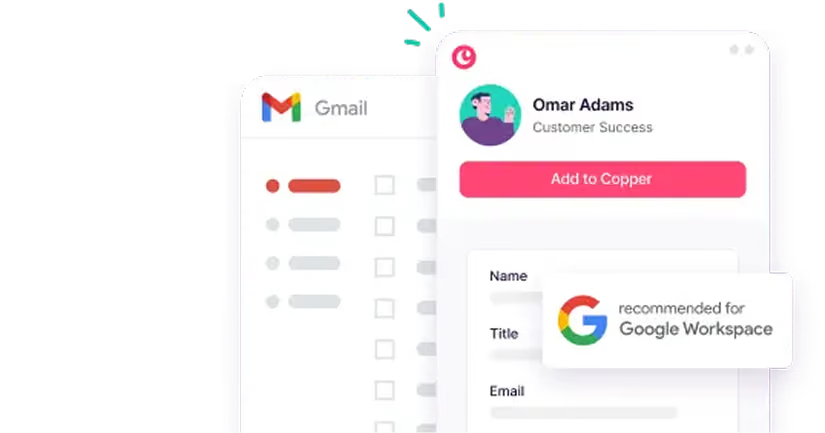
Copper is built to work inside Google Workspace, which means your team can manage customer relationships right where they already spend their time. Your emails in Gmail connect directly to contacts and deals. Calendar events automatically become part of your activity history. Everything stays organized without extra effort on your end.
And when it comes to customization, you’re not stuck with a rigid setup.
You can shape the system to match how your business actually runs:
- Build customizable pipelines that reflect your real sales process
- Trigger pipeline email automations when deals move stages
- Capture leads through website forms that automatically sort inquiries
- Add custom fields to track exactly what matters
- Create dashboards that give you visibility into performance, pipeline health, and forecasting
- Connect with hundreds of tools through integrations
So instead of building and maintaining your own CRM system, you’re starting with something that already works and making it your own.
Try Copper free and see how easily it adapts to your workflow.