










If you’re in the construction industry, what does your Construction Project Management (CPM) software stack look like right now?
Software built specifically for managing your construction projects can help you monitor costs, price projects, and make detailed projections on how much profit you should be bringing in. If you need it to, CPM software can also help you keep in touch with contractors, monitor the progress of a project, and keep all your contracts in one place.
But every construction company has different needs, so finding the right CPM tool to fit your business can be a tough task. Here’s the best software out there for everything from civil construction companies to small contractors—so you can spend more time building and less time worrying about the back office.
Key takeways
- Construction project management software helps monitor costs, price projects, track progress, and manage contractors.
- When selecting CPM software, evaluate industry reputation, mobile accessibility for job sites, integration capabilities with existing tools, and whether the vendor provides training and support.
- A CRM like Copper can complement traditional CPM software by tracking project information from initial consultation through completion, enabling better budget forecasting and relationship management.
What to look for in your construction project management software
Investing in CPM software is an expensive commitment, so you need to make sure that you’re picking the best software for your needs.
There are a few key elements CPM software needs to have before you consider investing in it for your company. Ask yourself questions like, “Will this software make work easier for my company?” and “Will it help us with real-time project management?”
Success in construction is all about keeping on track with projects and delivering them on time, so if the software you’re looking at doesn’t have these capabilities at a minimum, keep shopping around.
Some other key questions to ask when choosing CPM software are:
- What is its reputation in the industry?
- Does it offer integrations with other products and software your company already uses?
- Does the software have the tools to improve tracking and accountability on projects?
- Can my employees access the software from their cell phones on the job site?
- Will the software’s company provide training—or will you be thrown in the deep end?
That’s a lot of questions to ask, but picking the right software from the start will save you a lot of time and money down the line.
1. Procore
Pricing: Custom pricing based on needs
Free trial? Yes, Procore offers a demo
Best for: Juggling multiple construction projects
Procore is a cloud-based CPM software designed specifically for companies that need to juggle multiple projects at once.
Because it's built with bigger companies in mind, you can have an unlimited amount of collaborators using the software at all times. This means a larger project that involves a lot of contractors and workers will be easier to keep track of, as everyone involved will be able to report on their progress.
The software has features like daily logs, punch lists, timesheets, drawings, inspections, timesheets, and cost management. You can also manage invoices from your dashboard and produce RFIs (Requests for Information).
The software is constantly being updated to make it more efficient, and even for the largest construction companies, the vast feature list should be enough to keep all your ducks in a row.
2. Eclipse
Pricing: Custom pricing based on needs
Free trial? Yes
Best for: Pricing out construction projects
Eclipse is a browser-based CPM software that gives you a birds-eye view of an entire project so you can price it out correctly. There’s nothing worse than getting halfway into a big project and realizing you won’t actually make a profit when you hand the completed project over.
The software’s main features are job costings and project analytics, but you can also use it to design templates, store information about business partners, and control cash flow.
From the software, you can control all your accounts payable and receivable, and keep a general ledger of any past, current, or future projects. You can also price jobs in multiple currencies—which is super handy if your business works internationally—along with writing financial reports from the dashboard.
Plus, the software is customizable to any business, with plenty of optional features.
3. Copper
Pricing: Starts at $19/month
Free trial? Yes
Best for: Managing all your relationships
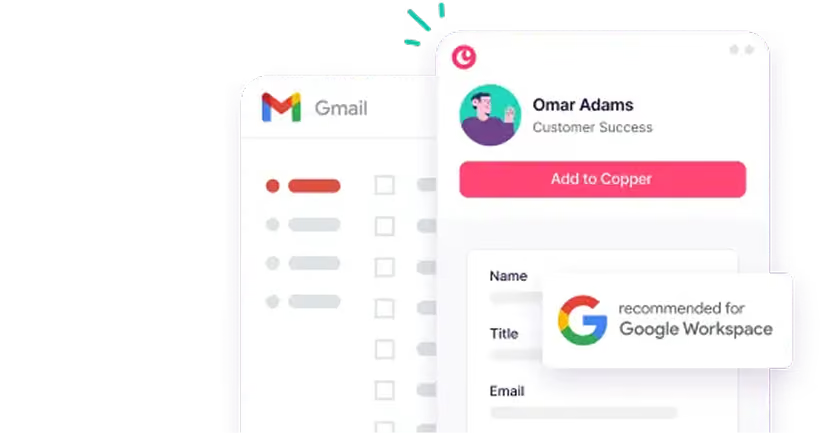
Though it’s not like traditional CPM software, Copper can do many of the tasks CPM software does, plus many that it doesn’t. For example, if your crew is already familiar with Gmail, Google Calendar, and other G Suite apps, this would be a software option that’s super easy to pick up.
The interface is designed to look just like Gmail, it automatically syncs across different devices so you don’t have to update each one manually, and it automates many tedious tasks (like meeting scheduling):
Typical construction projects have a lot of moving parts, from conception to construction. It’s important to keep on top of all the moving pieces with minimal effort.
This is especially true for budgets and forecasts, which are key to making your business work.
A CRM can track every piece of information from a project’s initial consultation to when you hand over the finished project. This gives you a detailed insight into if you priced the project correctly and will help you make more informed projections.
4. GenieBelt
Pricing: Starting at $115 / month for a project
Free trial? Yes—limited forever-free plan available
Best for: Medium-sized construction companies
Not sure if your company is big enough to need CPM software?
GenieBelt is built for medium-sized construction companies. The software company says it’s a perfect fit for companies that have as few as five contractors and as many as 300.
Each time you start a new project, the system will build a full audit trail for everyone involved in the job. You just set up the permission level for each contractor, and everyone can stay informed and report on how the project is progressing.
The software also gives you the ability to keep an eye on how every project is doing in real time from the dashboard. You can see any updates your contractors post throughout the day:
Unlike other software on the list, it doesn’t have an accounting function for payroll and invoicing. But its back office does integrate with CRMs and has functions to record time, cost, work quality, and all your H&S from the same spot.
Your contractors can also download the software’s mobile app onto their phones so they can stay on top of projects from anywhere.
5. INAXUS
Pricing: Custom pricing based on needs
Free trial? Yes
Best for: Civil and infrastructure companies
INAXUS is geared towards construction companies that are involved in civil and infrastructure construction.
It’s mainly used in construction companies in Asia and the Middle East at the moment, but many larger companies in America and Europe are starting to look at INAXUS as a CPM software solution.
This is one of the few software picks on the list that offers an end-to-end solution for an entire project. Everything from the initial contract signing to the handover can be handled in the software’s dashboard. Contracts are created and automatically tracked by the software to keep things running smoothly.
Plus, the software has workflows with proper escalation matrix and approvals, so you can manage your projects efficiently right up until they’re signed off.
On top of that, the software has budget tracking, job costing, estimating, mobile access, incident reporting, as well as the option to integrate it into your CRM. Oh, and you can manage all of your subcontractors from the dashboard too.
6. Knowify
Pricing: Starts at $54 / month
Free trial? Yes
Best for: Commercial contractors
Most of the software on this list is geared toward large projects and construction companies, but Knowify is different because it’s built specifically for commercial subcontractors.
First off, it’s super mobile-friendly and designed to be easy for contractors on the move to stay in touch with their clients. You can submit and electronically sign change orders with Knowify’s contracts feature—and keep on top of all your maintenance and accounting tasks from the program’s dashboard.
Another perk: creating mobile timesheets is a snap—you can send them straight from your dashboard to your clients.
7. BuildTools
Pricing: Starting at $20 per user / month
Free trial? Yes, there’s a demo available
Best for: Managing the back office
BuildTools is a web-based CPM software that’s ideal for managing day-to-day back office tasks.
Although it’s designed for custom builders and remodelers rather than large construction companies, it’s versatile enough to fit with any company size as it can be customized to suit.
Once you’ve signed up, you can use it to manage your budgets, schedule subcontractors, and issue purchase orders. Anytime you update a project on the system, it’ll sync the change across the whole ecosystem to save you from having to making a ton of repetitive changes.
BuildTools also covers bid management, document management, budgeting, communications, purchase orders, and it can integrate with your accounting software to streamline all of your financial processes.
8. Pro DBX
Pricing: Starting at $19 per user / month
Free trial? Yes
Best for: Tidying up loose ends
If you’re juggling contractors, builders, and legal personnel on a construction project, it’s easy for things to get missed and loose ends to be forgotten about.
Pro DBX is kind of like Trello for the construction industry. The timeline look of the software will tell you exactly who is doing what task—and if you’re on track with the project’s timeline.
The big win about Pro DBX is that like Eclipse (mentioned earlier on this list), it makes it easy to see how all of your projects are doing at a glance. From managing contracts to keeping an inventory on the system to even tracking your building materials with GPS, Pro DBX keeps your organizational skills sharp. Payroll and timecards can also be managed from the financial section of the software, along with purchase orders.
Streamline your construction process to free up time for projects.
Construction is a complicated game. Your company has to juggle tight deadlines, contractors, and expectations—not to mention mega budgets and mind-numbing paperwork like H&S.
If you want to save yourself some time automating tasks or and make sure your deliverables are always going to be on time, the right software can get you there.
The tools on this list have thought of everything from projection reporting to drawing and timesheets. Adding a construction CRM into the mix streamlines your entire project's process from start to finish. Spend less time on the boring stuff—and more time putting money into your bottom line.