











Shopping for a CRM and thinking about HubSpot and Copper? Here's a closer look at how they compare.
If you're comparing Copper and HubSpot, you're probably trying to figure out which CRM actually fits the way your team works, not which one has the longest feature list.
Here's something worth knowing upfront: HubSpot started as an inbound marketing platform. Over the years, it expanded into sales, service, and operations tools. That's great if you're running a marketing department with complex campaign workflows. But if you're a professional services team like a marketing or PR agency, a consulting or advisory firm, or any relationship-driven business, you might find that HubSpot gives you a lot of tools you'll never touch, while making the ones you need harder to get to.
Copper was built differently. It's a CRM designed for teams that live in Google Workspace and manage client relationships every day. No marketing suite to navigate around. No features locked behind enterprise-tier pricing. Just a clean, intuitive tool that helps you track prospects, close deals, and deliver projects, all from the tools you're already using.
Let's break down how these two platforms compare so you can decide which one makes sense for your team.
Key takeaways
- Copper CRM offers transparent pricing without hidden costs, while HubSpot's free version has limited functionality and the company regularly removes features to push customers toward expensive upgrades.
- Copper focuses exclusively on CRM development and relationship-building for small businesses, whereas HubSpot started as a marketing automation platform and now prioritizes enterprise customers over small business needs.
- Copper provides complimentary onboarding and customer success management, while HubSpot requires customers to pay thousands for technical consultants or hire third-party implementation specialists.
- Copper integrates natively with Google Workspace and Gmail, making it the only CRM with "Recommended for Google Workspace" status and enabling teams to work directly from their inbox.
Why professional services teams outgrow HubSpot (even if they just started)
HubSpot is packed with features. That sounds like a good thing, until you realize most of them aren't built for how your team actually works.
If you're running an established marketing agency, consulting firm, or advisory firm, you probably don't need:
- A full-blown marketing automation suite with landing page builders and ad tracking.
- Multi-tier sales hierarchies designed for enterprise-scale organizations.
- Onboarding processes that require dedicated CRM administrators to set up and maintain.
That's exactly what one agency team found when they switched to HubSpot and came back to Copper: three days to onboard Copper, compared with three months on HubSpot.
What you do need is a way to track client conversations, manage your pipeline, and keep projects moving forward, without spending half your day navigating a platform built for a completely different kind of business.
That's the core tension with HubSpot. It tries to be everything for everyone, and as a result, the features that matter most to relationship-driven teams can get buried under layers of tools designed for large marketing departments.
Copper takes a different approach. Instead of giving you everything and hoping you find what's useful, it focuses on the tools professional services teams actually use every day and puts them right inside Gmail, Google Calendar, and Google Drive.
1. Copper doesn’t do hidden costs.
The HubSpot free CRM may seem cost-free — but “you get what you pay for.” The free version of HubSpot lacks or severely limits features (like limiting to one pipeline, or adding their HubSpot branding to outbound emails).
One reviewer remarked on the limited functionality of HubSpot, saying:
“Using HubSpot for sales … is a constant fight with the system. It is not intuitive and lacks an incredible amount of features. Features I never even considered being an option in a CRM until using HubSpot.”
HubSpot’s free, lower-cost plans, and significant discounts are designed to lure you in, but their strategy is to upsell you shortly after.
Copper solutions partner, Alex Bass, says, “many teams report that after the first year, once they've already invested in setting up the system — training their employees and mapping their processes to the software — they're hit with large renewal fees for the second year onward.”
Plus, HubSpot regularly changes their features as they launch new products, strategically pushing their customers to have to add back features they lost, so you end up paying more year over year. No business leader wants a nasty surprise when an important feature is taken away right when they’re getting ready to launch a new program or initiative
One reviewer lamented that “[Hubspot’s CRM] seems like a giant upsell to HubSpot's other services. During the setup process and when using it, you are bombarded with upgrade suggestions.”
Copper has all the CRM functions you need to build strong customer relationships and support ongoing sales efforts. Copper’s pricing is also transparent: What you see is what you get and we don’t charge for critical features after the fact. After all, long-term relationships with our customers are important to us — and nothing drives people away faster than continually asking for more money.
2. Copper is 100% focused on CRM, not enterprise marketing tools
At Copper, our goal is to give you a CRM that your team actually loves to adopt and use — so you can focus on growing your relationships — and your business.
We’re clear on our mission of helping small businesses build authentic and lasting relationships so they can win clients for life — and it shows in how we serve our customers. We’re proud to be the CRM for people who care about people.
As Alex Bass says, “If you're looking for a CRM that was built for relationships at the core, and team collaboration (internal/external) is important to you, Copper will be a great central hub for your team.”
Our team at Copper works to achieve this mission every day by providing an easy-to-learn CRM with a better experience. Think: automating data entry, simplifying your workflow, and providing an easy-to-use drag-and-drop pipeline — among many other features.
HubSpot began as a marketing automation system, and slowly built out their CRM, support, webpage and operations capabilities over time. Now, the company’s new goal is to take market share from Salesforce and position themselves as the ideal Enterprise solution. HubSpot is now focusing on features that enterprise companies need, while leaving their small business customers behind.
“As a small business sales manager, Professional and Enterprise HubSpot pricing are well outside what I’m prepared or able to pay, which means there’s elements of working around the functionality that I’m missing,” remarks one user.
So, in a head-to-head, Copper CRM vs HubSpot battle, Copper is a clear winner of customer relationships, which are our singular focus — not an afterthought or upsell.
3. We built a CRM that’s easy to implement, and we're here to help you
Every business employs different workflows and manages unique relationships. With versatility in mind, we’ve built a CRM that’s robust and flexible so you don’t have to invest additional time or resources into customizing and getting set up.
In other words, it’s ready to work for your unique workflow right out of the box.
With Copper, you can easily create multiple pipelines to manage each type of relationship, like prospects, vendors and partners. We also make it super simple to do things like automate all your repetitive tasks, set up email sequences, and view reports — no developer or costly consultant required.
Plus, Copper offers complimentary onboarding and dedicated CSMs for qualified customers. With HubSpot, you’ll need to invest thousands for a HubSpot Technical Consultant separately, or hire a third-party consultant.
4. Google Workspace integration that actually changes how you work
You want your team to actually use the CRM you've selected to help run your business and we do too. We understand that lack of adoption is one of the biggest challenges of getting any team or business to use a CRM. An easy-to-use CRM will always drive better adoption than one that's complicated and confusing. Enter Copper.
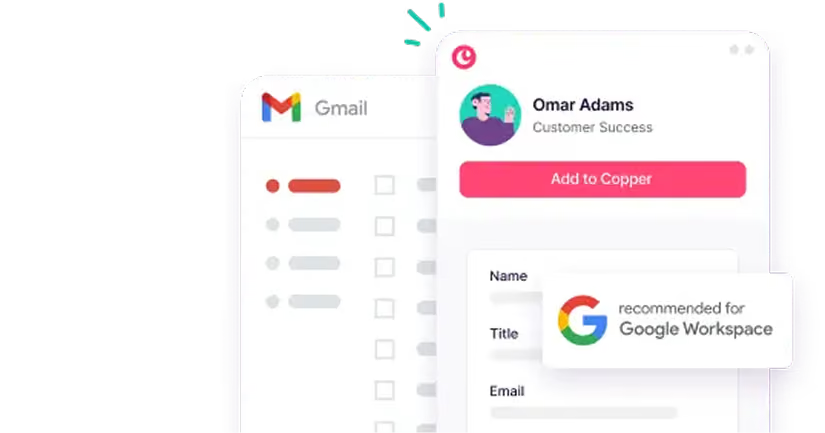
Most CRMs claim to integrate with Google Workspace. But there's a big difference between syncing your calendar and truly working inside the tools your team already uses. Copper is the only CRM that's a Recommended for Google Workspace app and the only one backed by Google Ventures. That's not just a badge. It means Copper appears directly in Gmail, Calendar, and Drive, so your team doesn't have to switch tabs to get CRM work done.
Here's what that looks like in practice:
- In Gmail: When a prospect or client emails you, Copper shows their full relationship history in a sidebar. Past conversations, deal status, associated projects, and any notes your team has added. You can update a deal stage or add a new contact without leaving your inbox.
- In Google Calendar: Meeting context shows up right where you're planning your day. You can see who you're meeting with, what deals are in play, and what happened in your last conversation, before you walk into the room.
- In Google Drive: Files are automatically connected to the right contacts and projects. No more digging through folders to find the proposal you sent three months ago.
- On LinkedIn: Copper's Chrome extension lets you add new contacts from LinkedIn profiles directly into your CRM, complete with the context you need.
For professional services teams, where relationships are built through conversations, not marketing funnels, this kind of integration isn't a nice-to-have. It's the difference between a CRM your team actually uses and one that collects dust after the first month.
Copper helps you build the client relationships that matter most
If you're building out a large-scale inbound marketing operation with dedicated teams for content, ads, and lead nurturing, HubSpot is a solid platform for that. It's powerful, it's well-known, and it has the tools to support complex marketing strategies.
But if you're running a professional services business your CRM needs are different. You're not managing thousands of anonymous leads through a marketing funnel. You're managing dozens or hundreds of real client relationships, and every one of them matters.
You need a CRM that:
- Lives where you already work (inside Gmail, Calendar, and Drive).
- Tracks conversations, deals, and projects without making you switch between five different tabs.
- Is simple enough that your whole team will actually use it, no onboarding specialist required.
- Scales with your business without suddenly locking essential features behind expensive tiers.
That's what Copper was built for. It's the CRM for teams that care about client relationships and want a tool that makes managing those relationships easier, not harder.
Try Copper for 14 days free and see how it fits into the way your team already works.”
Ready to take the next step with a CRM that won't throw unexpected costs at you?
Try Copper for 14 days free to see if it fits, no credit card needed.