











Choosing a customer relationship management (CRM) platform shouldn’t feel like speed dating with software. Yet somehow, that’s exactly what happens—quick demos, flashy features, and a whole lot of “this seems right.” Then three months later? Your team’s back in spreadsheets and side-eyeing the tool you just paid for.
That’s where a solid CRM evaluation comes in: A real, structured way to figure out what actually works for your business (and your sanity).
What CRM evaluation means and why it matters
What are we actually talking about when we say CRM evaluation?
A CRM evaluation is the process of carefully comparing different CRM systems based on how well they fit your business goals, your workflows, and your team’s day-to-day reality. And yes, that last part matters more than people think (because your team is the one who actually has to use this thing every single day).
Here’s the honest truth: most CRMs look great in a demo. Clean dashboards. Fancy automation. Big promises about “streamlining your workflow.” But a CRM evaluation is what separates “this looks nice” from “this actually works for us.”
When you take the time to do a proper evaluation, you start asking better questions. Not “does it have this feature?” but “will my team actually use this feature?” Not “is this powerful?” but “is this practical for how we work?”
And that shift changes everything.
Instead of choosing a CRM based on surface-level appeal, you’re choosing one based on fit. Fit with your processes, your team habits, your growth plans, and even your tech stack (because nothing slows you down faster than tools that don’t play nicely together).
A thoughtful CRM evaluation also saves you from one of the most painful business experiences: switching CRMs too soon. (If you’ve been through that once, you already know — it’s not just annoying, it’s disruptive.)
So really, this isn’t just about the right CRM software. An evaluation is about setting your business up with a system that supports how you sell, how you communicate, and how you grow (scalability is key!) — without adding chaos to the mix.
Signs your business needs a fresh CRM assessment
Sometimes you don’t wake up thinking, “Wow, today feels like a great day to start a CRM evaluation.” Usually, it sneaks up on you.
It starts with little things. Your team hesitates before opening the CRM. Someone says, “I’ll just track this in a spreadsheet for now.” A follow-up gets missed. A deal stalls because no one realized it needed attention.
Individually, these feel small. Together? They’re a system problem.
Here are a few of the clearest signs it’s time to revisit your CRM evaluation:
- Data scattered across tools: Client information stored in multiple places.
- Manual follow-up tracking: Missing opportunities due to forgotten tasks.
- Team collaboration issues: Difficulty sharing client updates.
And then there are the quieter signals (the ones people don’t always say out loud):
- Your team is using the CRM inconsistently—or avoiding it entirely
- You’ve built workarounds outside the system to “make things easier”
- Reporting takes way too long (or just doesn’t happen)
- You’ve grown, but your processes haven’t caught up
(That last one? Happens all the time.)
A CRM should reduce friction, not create it. If your current setup feels like extra work, your CRM evaluation isn’t just a “nice to have”—it’s the reset your systems need.
Essential CRM evaluation criteria: Features, security, and technical requirements
This is the part of your CRM evaluation where things get real. Like, this is where you stop being impressed by shiny dashboards and start asking, “Wait… will this actually make our lives easier?”
Because a CRM isn’t just a tool, it’s where your team lives day to day. It’s where deals move, relationships grow, and (let’s be honest) where things can fall apart if the system isn’t right.
So when you’re doing an evaluation of various CRM vendors, you want to look at the full picture: how your team works, how your data is protected, and whether this thing can actually grow with you (instead of becoming your next headache).
Contact and lead management
This is your foundation. If this part is messy, everything else will be too (no pressure, but also… a little pressure).
Your CRM should make it ridiculously easy to organize contacts and customer interactions, track leads, and see exactly where every opportunity stands. Think clean pipelines, clear stages, and zero confusion about what’s happening next.
And here’s the big one: data entry and search should feel effortless. If your team has to dig around or “figure out where things go,” they just won’t use it (and we do not blame them).
You want a system where:
- Adding a contact takes seconds
- Updating a deal feels natural
- Finding information is instant
(If it feels like admin work, it’s already losing.)
Sales and project automation
This is where your CRM starts doing the heavy lifting and honestly, it should.
During your CRM evaluation, pay close attention to how automation works. Because the goal isn’t just to “have automation,” it’s to remove as much manual work as possible.
The best CRMs let you:
- Trigger pipeline email automations when a deal moves stages
- Automatically assign tasks so nothing gets missed
- Set reminders that keep deals moving forward
It’s like giving your team a safety net (one that never forgets anything, unlike all of us after lunch).
And the impact? Fewer dropped balls, faster follow-ups, and way less time spent on repetitive tasks.
Email and workflow integrations
If your CRM doesn’t connect with the tools you already use, it’s going to feel like extra work. And we are not here for extra work.
A strong CRM evaluation should prioritize integrations that make everything feel seamless—especially email and calendar.
You want your CRM to:
- Sync with your inbox (hello, Gmail)
- Track conversations automatically
- Connect with your existing tools without friction
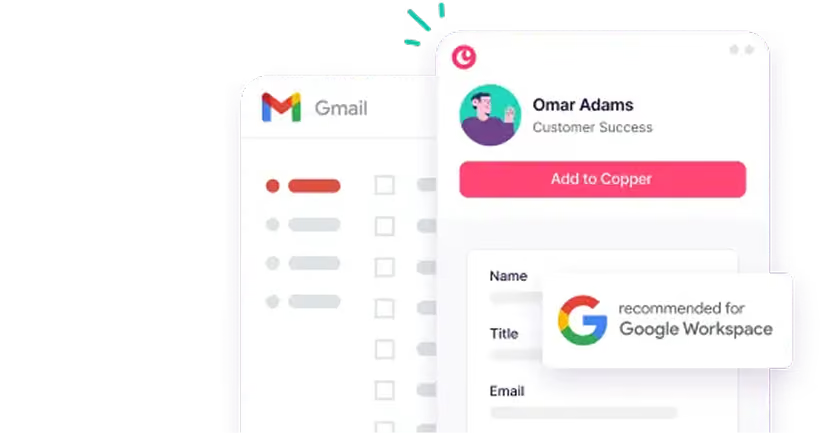
This is where Copper really shines, by the way. It lives inside Google Workspace, which means you can manage relationships right from Gmail, schedule things in Calendar, and keep everything connected (no tab chaos required).
(Once you experience this, going back feels… painful.)
Reporting and analytics
Let’s talk data—but make it actually useful.
During your CRM evaluation, don’t just ask “does it have reports?” Ask “will I actually use these reports?”
Because if it takes 20 clicks and a deep breath to understand your pipeline, it’s not helping.
You want reporting that gives you clarity on metrics right away:
- What’s happening in your pipeline
- Where deals are getting stuck
- How your team is performing
And ideally, you want that in dashboards that are easy to read, not something that feels like decoding a spreadsheet from 2007.
(We’re making decisions here, not solving puzzles.)
Usability and user adoption
Okay, this one? Sneaky important.
You can choose the most powerful CRM on the market, but if your team doesn’t use it, it doesn’t matter. At all.
During your CRM evaluation, pay attention to how the tool feels. Is it intuitive? Does it make sense right away? Or does it feel like something you’ll need to “get used to”?
Because “getting used to it” usually turns into “we’re not really using it.”
A great CRM should feel:
- Easy to navigate
- Quick to learn
- Natural for your team’s workflow
(If your team sighs during the demo… that’s your answer.)
Deployment options and hosting
Now for a slightly less glamorous — but still very important — part of your CRM evaluation.
You’ll typically be choosing between cloud-based systems and on-premise solutions. And for most teams today, cloud-based is the clear winner.
Why? Because it’s:
- Accessible from anywhere
- Easier to maintain
- Faster to implement
No servers, no heavy IT lift, no “why isn’t this working” moments tied to infrastructure.
(We love less maintenance energy.)
Data security and compliance
Okay, serious moment.
Your CRM holds sensitive client information. Names, emails, deal details, sometimes even financial data. So during your CRM evaluation, security isn’t optional—it’s essential.
You want to look for:
- Data encryption
- Reliable backup systems
- Compliance with industry standards
Because protecting your data isn’t just about avoiding issues—it’s about maintaining trust with your clients (and avoiding some very uncomfortable conversations).
Customization and extensibility
Your business is unique. Your CRM should reflect that. During your CRM evaluation, look at how flexible the system is. Can you customize pipelines? Add fields? Adjust workflows to match how your team actually operates?
Because the worst-case scenario is choosing a CRM that forces you to change everything just to make it work.
Customization means your CRM adapts to you and not the other way around.
(And that’s exactly how it should be.)
Native Google Workspace integration
We’re giving this its own moment because it matters that much.
If your team already lives in Google Workspace, your CRM evaluation should heavily prioritize tools that integrate natively with it.
That means:
- Working directly inside Gmail
- Syncing seamlessly with Google Calendar
- Connecting with Drive for documents and collaboration
Copper does this beautifully—it’s built for Google Workspace from the ground up. So instead of switching between tools, everything happens in one place.
And honestly? That kind of workflow continuity is what turns a CRM from “another tool” into something your team actually enjoys using.
(Yes, enjoy. It’s possible.)
Step-by-step process to evaluate a CRM from shortlist to final score
A CRM evaluation can spiral fast if you don’t have a game plan. One minute you’re “just browsing,” the next you’ve got 14 tabs open, three strong opinions from your team, and somehow… less clarity than when you started.
So instead of overcomplicating it, think of this as a series of grounded decisions. Each step should make things feel clearer, not heavier. Consider this your working CRM evaluation checklist, not a rigid framework but something you can actually follow without losing your mind.
Identify objectives and stakeholders
Start by getting honest about what’s not working.
Not the polite version. The real version.
Where are things breaking down? What’s taking too long? What’s getting missed that shouldn’t be missed? (There’s always something.)
Maybe deals are stalling and no one knows why. Maybe follow-ups depend on memory instead of a system. Maybe your team has quietly built side systems to compensate (which is a very loud signal, by the way).
A lot of this usually ties back to messy or incomplete customer data. If your information is scattered or unreliable, everything else slows down.
Once you’ve got that clarity, pull in the people who actually deal with these problems daily.
Sales will tell you where deals get stuck. Ops will point out where processes fall apart. Leadership will zoom out and connect it to growth. And don’t forget customer support, because they often see the downstream impact of broken systems before anyone else does.
If you skip this step, you’re basically choosing a new CRM in a vacuum… and that rarely ends well.
Document must-have and nice-to-have requirements
Time to turn all that chaos into something usable.
Not a giant wishlist. Not a “wouldn’t it be cool if…” moment. Just clarity on what actually matters.
Think of your must-haves as your non-negotiables. The things your team needs to function better, not just features that look good in a demo.
A few anchors to keep you grounded:
- Contact management should feel quick, not like admin work
- Integrations should simplify your day, not add more tabs
- Reporting should answer questions instantly, not require digging
- Customer support should be responsive and actually helpful when you need it
And depending on your workflow, this might also include things like marketing automations that help you stay consistent without adding manual work.
Everything else? Nice to have.
This becomes your filter. If a CRM doesn’t meet your must-haves, it’s out. No convincing yourself otherwise.
Build and research a vendor shortlist
Now you get to explore—but with boundaries.
It’s tempting to look at everything. Resist that urge. More options don’t make decisions easier, they just make them slower.
Keep your shortlist tight. Three to five strong options is more than enough.
As you research, stay anchored to your needs. It’s very easy to get pulled in by features that sound impressive but don’t actually solve your problems.
Keep asking:
- Does this make our workflow smoother?
- Does this handle our customer data cleanly and reliably?
- Does this remove friction or add it?
If you have to stretch to justify it, it’s probably not the one.
Request trials or demos and capture feedback
This is where things get real.
Demos are helpful, but hands-on use is where the truth comes out. You want to see how the CRM behaves in your world, not in a perfectly curated walkthrough.
Load in sample contacts. Test how customer data is stored, updated, and surfaced. Move deals through your pipeline. Try to replicate your actual process from start to finish.
And then listen closely to your team.
Not just what they say—but how they react.
Do they move through it easily? Do they hesitate? Do they say “this makes sense” or “wait… where do I click?”
(Those small reactions tell you everything.)
You’re not looking for perfection. You’re looking for ease.
Score vendors against weighted criteria
At this point, you’ll have opinions. Strong ones.
This step helps bring some structure to that so you’re not choosing based on vibes alone.
Take your must-haves and give them weight. The things that matter most to your business should carry the most influence.
Then compare each CRM against those criteria.
You’re not trying to find a perfect score. You’re looking for consistency.
Which tool keeps showing up as the best fit? Where are the trade-offs? Which one feels strongest overall?
It’s less about numbers and more about patterns.
Pilot, measure, and decide
You’re very close here, so don’t rush the final step.
If you can, run a small pilot. Let your team actually use the CRM in real conditions for a short period.
This is where everything either clicks… or doesn’t.
Pay attention to what happens naturally:
- Are follow-ups happening without reminders?
- Is the pipeline easier to understand?
- Are marketing automations actually saving time?
- Is your team using the system without being chased?
That last one is the big one.
If adoption feels easy, you’re in a good place. If it feels forced, something’s off.
And if it’s not the right fit? That’s still a win. Your CRM evaluation just saved you from choosing a new CRM you would’ve had to replace later (which is always more painful).
Common pitfalls to avoid in the CRM selection process
Even with a strong CRM evaluation, there are a few traps that are very easy to fall into. And the frustrating part? Most of them don’t show up until after you’ve already committed.
The goal here isn’t to scare you off. It’s to help you spot the issues early so your new CRM actually supports your business processes instead of quietly complicating them.
Overlooking total cost of ownership
It’s tempting to anchor on price. Totally fair. Budgets are real.
But a CRM evaluation that stops at the monthly subscription is only looking at half the picture.
The real cost of CRM tools shows up over time. It’s in how long it takes to implement, how much effort goes into customizing it, and how quickly your team can actually start using it confidently.
Think beyond the sticker price:
- How much time will setup take?
- Will you need to build custom templates or workflows from scratch?
- How much training will your team need before they feel comfortable?
And then there’s the hidden cost no one talks about enough: lost momentum.
If your team struggles to adopt the system or spends extra time working around it, that’s time taken away from selling, delivering, and improving customer satisfaction.
A slightly higher upfront investment in the right tool often ends up being the more efficient (and less painful) choice long term.
Ignoring end-user workflow fit
This one quietly causes the most damage.
A CRM can check every feature box and still fail if it doesn’t match how your team actually works day to day.
Your business processes already exist. Your team has rhythms, habits, and ways of getting things done. A CRM should support that, not force a complete reset.
When there’s a mismatch, it shows up quickly:
- People stop using the system consistently
- Work gets tracked outside the CRM
- Customer data becomes incomplete or outdated
(And now your “source of truth” isn’t very trustworthy.)
The best CRM tools feel intuitive right away. They align with how your team already operates, and they make those workflows smoother instead of more rigid.
If your team has to constantly adjust to the tool, adoption becomes a struggle. And when adoption drops, everything from reporting to customer satisfaction takes a hit.
Underestimating implementation effort
Choosing a CRM is one decision. Getting it up and running properly is a whole separate phase.
And this is where a lot of teams rush.
Implementation includes more than just turning the tool on. You’re setting up pipelines, organizing customer data, creating templates, configuring automations, and making sure everything reflects your actual business processes.
It takes intention.
When this step gets underestimated, you usually see:
- Messy or incomplete setups
- Confusing workflows that don’t quite match reality
- A slower ramp-up for your team
Which leads to hesitation, and then… low adoption.
A smooth rollout doesn’t happen by accident. It comes from planning ahead, giving your team time to adjust, and making sure the system is set up in a way that actually makes sense for how you work.
Because at the end of the day, the goal isn’t just to launch a new CRM. It’s to have one that your team uses confidently, consistently, and without second-guessing every step.
Next steps to turn evaluation insights into action
This is the moment where you stop researching and start moving.
You’ve done the CRM evaluation. You’ve seen what works, what doesn’t, and what actually fits your team. Now it’s about choosing the system that feels right in practice, not just in theory.
Go with the solution and the CRM features that made things easier during testing. The one your team didn’t hesitate to use. The one that didn’t require a full mental reset just to get started (that’s your biggest clue, by the way).
Then commit to it. Set it up properly. Build your pipelines. Turn on automation. Get your team inside it early so it becomes part of how work actually gets done—not just another tool sitting in the background.
If you want something that fits into your workflow without the friction, Copper’s built exactly for that. You get customizable pipelines across sales, onboarding, and delivery, automation triggered by stage changes, website forms that keep incoming leads organized, and seamless Google Workspace integration so everything lives where your team already works.
(Translation: less switching, less chasing, less “where is that info?”)
If you’re ready to put your CRM evaluation into motion, you can try Copper for 14 days free.
Because the real win isn’t choosing a CRM — it’s finally having a system your team actually uses.