












There's a moment every growing team hits with their CRM.
At first, it feels like a game-changer. Visibility! Organization! Forecasting! Then… slowly… it turns into something else. Updates get skipped, data quality or customer information gets messy, reports start feeling questionable, and then suddenly your "single source of truth" feels more like a group project nobody wants to touch.
That's the reality of CRM issues. Some teams call them CRM problems, others call them CRM challenges, but whatever you call them, they don't show up all at once. They creep in quietly, until they start affecting revenue, alignment, and momentum.
The upside? Every one of these CRM challenges is fixable. And once you fix them, your CRM stops being a passive database and starts becoming an active driver of growth.
Let's break down what's really going on and how to fix it without turning this into a six-month "CRM transformation initiative" (because no one has time for that).
Key takeaways
Most CRM problems come down to friction, not missing features. When the system creates more work than it saves, teams quietly route around it instead of using it.
The most common CRM challenges, poor adoption, dirty data, and disconnected tools, feed each other. Fix the friction at the source and the downstream symptoms, like unreliable reports, usually clear up on their own.
Not every CRM issue means you need a new platform. Switching only pays off when the system can't integrate with your core tools or requires constant workarounds; everything else is typically fixable in place.
Catching CRM problems early, through usage data, a quick data audit, or a five-minute team survey, is far cheaper than a six-month turnaround project later.
The single highest-leverage fix for most CRM challenges is removing manual data entry. When the system captures emails and meetings automatically, adoption and data quality improve together.
What are CRM issues and why they happen
CRM issues are the friction points that stop your system from doing what it’s meant to do: support relationships, streamline workflows, and give your team clarity.
Instead, you end up with a tool that technically exists… but isn’t actually helping.
And here’s the thing — most CRM issues aren’t caused by “bad teams” or lack of effort. They’re caused by misalignment. The CRM doesn’t match how your team naturally works, so people adapt… by avoiding it.
You’ll usually see that misalignment show up in a few familiar ways:
- The system feels like extra work instead of part of the workflow
- Data entry becomes inconsistent (or ignored altogether)
- Teams build side systems to compensate
(Yes, the spreadsheet always makes a comeback.)
At the core, CRM issues happen when the tool creates friction instead of removing it. Fix that, and everything else gets easier.
The 10 most common CRM problems hurting growth
Let’s walk through the CRM issues that show up most often — and how they quietly limit your team’s ability to move quickly and confidently, while address business needs.
1. Poor user adoption
Everything starts here.
If your team isn’t consistently using your CRM, nothing else matters. You can have the most powerful system in the world, but if it’s not part of daily work, it won’t deliver value.
Adoption tends to drop when the CRM feels like “extra work.” If logging a deal takes too long, if updating notes feels tedious, or if the benefit isn’t immediately clear, people will push it aside. Not intentionally — just naturally.
You’ll start to notice it in subtle ways. Deals get tracked in personal docs. Updates happen in conversations instead of the system. Leadership asks for manual reports because they don’t fully trust what they’re seeing.
Fixing this isn’t about forcing usage. It’s about removing friction.
The CRM needs to live where your team already works. That means fewer steps, fewer clicks, and less manual entry. When updating the CRM feels as natural as sending an email, adoption stops being a problem.
2. Inaccurate or outdated data
Bad data is one of the most damaging CRM issues — mainly because it doesn’t always look obvious at first.
Your system might appear full. Contacts exist. Deals are listed. Pipelines look active. But when you actually rely on that data, the cracks start to show.
Information is incomplete. Records are duplicated. Details are outdated. And suddenly, your team isn’t sure what’s accurate anymore.
That uncertainty spreads quickly. Forecasts feel unreliable. Reporting becomes something you double-check instead of trust. And once trust is gone, usage usually follows.
The fix here is consistency, not perfection.
Strong CRM data comes from a combination of automation and clear standards. When information is captured automatically — from emails, meetings, and interactions — it stays current without relying on manual updates. Pair that with a simple, repeatable approach to maintaining records, and your data becomes something your team can actually depend on.
3. Integration headaches
A CRM that doesn’t connect with your existing tools creates more work instead of less.
Instead of having a central system, your team ends up juggling information across platforms. Emails live in one place, meetings in another, notes somewhere else entirely. And the CRM becomes just one piece of a fragmented workflow.
Over time, this fragmentation slows everything down. Context gets lost. Updates fall through the cracks. And your team spends more time managing tools than actually moving deals forward.
The solution isn’t adding more integrations — it’s choosing better ones.
Your CRM should connect seamlessly with the tools your team already relies on, especially email and calendar. When those systems are aligned, information flows naturally. Updates happen automatically. And your CRM starts to feel like a central hub instead of an extra step.
4. Lack of user-friendliness
Even the most capable CRM will fail if it’s difficult to use.
When interfaces are confusing or workflows feel overly complicated, people hesitate. They second-guess their actions. They delay updates because they’re not sure they’re doing things correctly.
That hesitation adds up. It creates inconsistencies, errors, and eventually avoidance.
The best CRMs don’t require much explanation. They feel intuitive from the start. Actions are clear. Processes are straightforward. And users can move quickly without overthinking.
Improving usability often comes down to simplification. Streamlining pipelines, removing unnecessary fields, and focusing on the actions that actually matter can dramatically change how your team interacts with the system.
(If it feels easy, people will use it. If it doesn’t, they won’t — no matter how many features it has.)
5. Limited or excessive customization
Customization is often seen as a strength, but it can quickly become one of the more complex CRM issues.
When there isn’t enough flexibility, teams feel constrained. The system doesn’t reflect how they work, so they adapt around it. But when there’s too much flexibility, things can become chaotic. Pipelines vary wildly. Fields multiply. Reporting becomes inconsistent.
It’s a delicate balance.
The goal isn’t to customize everything. It’s to customize what matters. Your CRM should reflect your core workflow clearly and consistently, without adding unnecessary complexity.
When customization is intentional, it supports clarity. When it isn’t, it creates confusion.
6. Reporting you can’t trust
Reporting is where all CRM issues eventually surface.
If your data isn’t clean or your processes aren’t consistent, your reports will reflect that. And once your team starts questioning the numbers, confidence in the system drops quickly.
You’ll see it in small ways at first. A number gets questioned. A report gets double-checked. Someone pulls data manually “just to be safe.”
Then it becomes a habit.
Rebuilding trust in reporting requires going back to the source. Clean inputs. Consistent processes. Clear definitions of what each metric means. When those pieces are aligned, reporting becomes reliable again — and your CRM regains its authority.
7. Mobile and remote access gaps
Work doesn’t happen in one place anymore. Deals move forward in meetings, messages, and quick follow-ups that don’t always happen at a desk. If your CRM isn’t accessible in those moments, updates get delayed — or skipped entirely.
And when updates aren’t happening in real time, information loses its value.
A strong CRM supports your team wherever they are. It allows quick updates, easy access to context, and seamless interaction without requiring a full reset of how someone works.
When your system moves with your team, instead of waiting for them to come back to it, everything becomes more immediate and accurate.
8. Escalating cost of ownership
CRM pricing isn’t always straightforward.
What starts as a reasonable subscription can grow over time through add-ons, integrations, and the internal resources needed to maintain the system. Suddenly, you’re investing far more than expected — without seeing proportional value.
This is one of those CRM issues that builds quietly.
The key is understanding total cost, not just upfront pricing. That includes time spent on maintenance, complexity introduced by customization, and reliance on additional tools to fill gaps.
When your CRM is efficient and integrated, those hidden costs start to disappear.
9. Security and compliance worries
Customer data is one of your most valuable assets — and one of your biggest responsibilities.
When CRM systems aren’t properly managed, risks increase. Access controls might be inconsistent. Sensitive data could be exposed. Compliance requirements may not be fully met.
These issues don’t always show up immediately, but when they do, the impact is significant.
A reliable CRM should make security feel built-in, not bolted on. Clear permissions, strong data protection, and consistent oversight all contribute to a system your team can trust — not just for usability, but for safety as well.
10. Outgrowing your CRM vendor
Growth changes everything.
What worked when your team was a small business — scrappy, fast-moving, figuring things out as you go — can start to feel… tight as you scale. Like your CRM is trying to keep up, but it’s just a step behind (and you can feel it in the day-to-day).
At first, it’s little things. A function that almost does what you need, but not quite. A workflow that takes a few extra steps. Your customer support team digging around just to find the context they need.
Nothing dramatic — just enough friction to notice.
Then it builds.
Suddenly your team has workarounds for everything. Performance feels slower. Key functions feel limiting instead of helpful. And customer support starts feeling disconnected from sales because the system isn’t giving a full, shared view of the relationship.
(Not ideal — especially when you’re trying to grow beyond those small business growing pains.)
That’s usually the tipping point.
Because now your CRM isn’t supporting growth — it’s quietly getting in the way of it.
The right CRM should grow with you. It should flex as your needs evolve, support both sales and customer support without things getting messy, and give you the functions you actually need — without making your team jump through hoops to use them. How to diagnose customer relationship management issues fast
Most CRM issues don’t announce themselves loudly. They show up in small ways first — a missed update here, a confusing report there, a teammate saying, “Wait… where do I log this again?”
The trick is catching those signals early, before they snowball into bigger problems that slow your entire team down.
You don’t need a full audit or a six-week deep dive (no one has time for that). You just need to look in the right places — and ask the right questions.
Here’s where to start.
Check user-activity metrics
If your CRM had a “heartbeat,” this would be it.
User activity tells you whether your CRM system is actually being used — or just existing in the background while work happens somewhere else. And the patterns here are usually pretty revealing.
If people are logging in regularly, updating deals in real time, and using key features consistently, you’re in a good place. If not… that’s your first red flag.
Look at things like login frequency, feature usage, and how often records are updated. Not to micromanage — but to understand behavior.
Because when adoption drops, it rarely happens all at once. It fades gradually. And catching that early is what keeps small CRM issues from turning into bigger ones.
Audit data health
Now we look at the output of that activity — your data.
On the surface, everything might look fine. Contacts are there. Deals are moving. Pipelines are filled. But once you dig in, you’ll quickly see whether your CRM is healthy or just… populated.
Are there duplicate records? Missing fields? Outdated information that hasn’t been touched in months?
(If you’ve ever clicked into a deal and thought, “Wait, is this still accurate?” — you already know what this feels like.)
A quick data audit doesn’t need to be complicated. You’re just looking for patterns. If inconsistencies show up repeatedly, that’s a sign your processes — or your system — need attention.
Review integration logs
This is the behind-the-scenes check most teams skip — and it’s where a lot of CRM issues quietly live.
Integrations are what keep your CRM connected to the rest of your workflow. When they’re working, everything feels seamless. When they’re not, things start slipping through the cracks.
Check for sync failures, connection errors, or delays between systems. Even small issues here can create bigger problems over time, especially if your team is relying on that data to stay aligned.
And here’s the important part: if integrations aren’t reliable, your team will start compensating manually. (Which usually means more work — and more room for error.)
Survey frontline teams
If you want the fastest path to understanding your CRM issues, talk to the people using it every day, because 38% of CRM challenges stem from people issues.
Sales reps, account managers, customer success — they know exactly where things feel clunky, confusing, or unnecessary. They’re the ones navigating the system in real time, trying to get their work done.
Ask simple questions:
- What slows you down in the CRM?
- What do you avoid using?
- What feels like extra work?
You’ll start to hear patterns pretty quickly.
And sometimes, the most valuable insights come from what isn’t being used at all. (That silence usually means something isn’t working.)
Benchmark against goals
Finally, zoom out.
Your CRM wasn’t implemented just for the sake of having one. It was meant to support specific goals — better visibility, improved forecasting, stronger relationships, more efficient workflows.
So the question becomes: is it actually doing that?
Compare your current performance to what you originally set out to achieve. Are deals moving faster? Is reporting more reliable? Is your team more aligned?
If there’s a gap between expectation and reality, that’s where your CRM issues are sitting.
And the clearer that gap is, the easier it becomes to fix.
Diagnosing CRM issues doesn’t have to be overwhelming. It’s really about paying attention — to behavior, to data, and to the people using the system every day.
Catch the signals early, and you stay in control.
Miss them… and suddenly you’re dealing with a much bigger cleanup than you planned for. (We’re trying to avoid that version.)
How to fix each CRM issue step by step
Okay… deep breath. You’ve spotted the CRM issues. You know something’s off. Your team feels it too. Now it’s like, “Do we fix this or burn it all down and start over?”
Good news: You probably don’t need to burn anything down. (Love that for you.)
Most CRM problems aren’t “we picked the worst tool ever” problems. They’re “things got messy over time and no one circled back” problems. So instead of overhauling everything, we’re tightening a few key things.
Align leadership on goals
First things first, if leadership isn’t aligned, none of this sticks. Like, at all. If the CRM is treated as a “nice-to-have” or something people update when they remember, your team will follow that exact energy. Every time.
So we need clarity: What is this CRM actually here to do? What are we measuring? What matters most?
And then — this is the important part — leadership has to use it. Reference it in meetings. Pull numbers from it. Rely on it.
(If they don’t… your team won’t either. We’ve all seen this play out.)
Simplify workflows inside the app
Now let’s talk about the chaos that builds up inside CRMs over time.
Because somehow, without anyone noticing, you go from “simple pipeline” to “why are there 47 fields and what does half of this mean?”
It happens. Slowly. Quietly. And then suddenly everything feels heavy.
So we clean it up.
Ask yourself: Do we actually need this field? Does this step help move deals forward? Or are we just… keeping it because it’s been there?
Trim it down. Make it obvious. Make it easy.
Because if your CRM feels like work, people will avoid it. If it feels simple, they’ll actually use it. (Groundbreaking, I know.)
Automate data capture from Gmail and Calendar
This one is a game changer. Because manual data entry? No one likes it. No one. Not even your most organized team member. And when things rely on manual updates, they get skipped. Or delayed. Or done quickly and incorrectly just to “get it over with.”
So instead, automate it.
When your CRM software pulls in emails, meetings, and interactions directly from Gmail and Google Calendar, everything just… stays updated.
It’s just there. Already done. (As it should be.)
Create a data hygiene cadence
Inevitably, your CRM will get messy again. Not because anyone did anything wrong, but because data naturally gets weird over time. Duplicates happen. Fields get inconsistent. Things go stale.
So instead of pretending it won’t happen, we plan for it.
Set a simple rhythm — monthly, quarterly, whatever makes sense — and do a quick cleanup:
fix duplicates, update key records, straighten things out.
It doesn’t need to be a whole production. It just needs to happen regularly.
(Think of it like tidying your space before it becomes a full weekend project.)
Train and incentivize users continuously
This is where things either stick or slowly fall apart again.
Because one training session at the beginning? That’s not enough. People forget. Work evolves. New habits form.
To fix this share quick tips, show better ways to do things, and make it easy for people to improve without feeling like they’re “being trained.”
And, most importantly, give people a reason to care.
When your team sees that using the CRM makes their life easier, or gets them recognized, or helps them win more… they’ll stick with it.
(Not because they have to. Because they want to.)
Fixing CRM issues during CRM implementation or after it’s setup, isn’t about doing a ton of new things.
It’s about tightening what already exists, making it easier to use, and actually supporting your team in using it well.
Do that, and your CRM stops feeling like a chore… and starts feeling like something that actually has your back.
When to switch CRMs versus rehabilitate your current system
Not every CRM issue means you need a new platform.
If your system fundamentally works but suffers from inconsistent usage or unclear processes, it’s often worth fixing what you have. Many issues come down to alignment, not technology.
But there are moments when switching makes more sense.
If your CRM doesn’t integrate with your core tools, consistently feels difficult to use, or requires constant workarounds, those aren’t small problems. They’re structural ones.
At that point, investing more time into fixing the system may not deliver the return you need.
Move past CRM challenges with Copper
Many CRM issues stem from one core problem: the system exists outside your workflow.
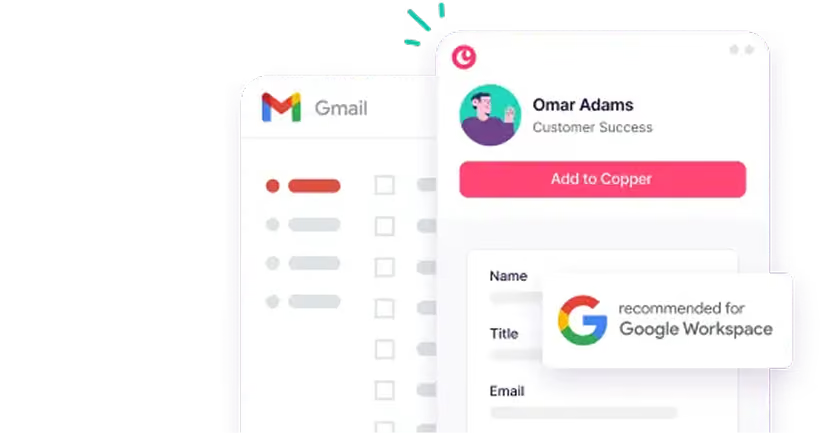
Copper takes a different approach. It’s built directly into Google Workspace, which means your CRM lives where your team already works — inside Gmail, alongside your calendar, and connected to your daily communication.
That changes everything.
Instead of asking your team to log activity manually, Copper captures it automatically. Emails, meetings, and interactions are recorded without extra effort, keeping your data accurate and up to date.
From there, everything stays aligned:
- Pipelines are fully customizable to match your real sales process
- Pipeline email automations trigger based on stage changes
- Website forms route inquiries to the right place instantly
- Integrations connect with hundreds of other tools
- And the interface stays clean, intuitive, and easy to adopt
This is how you prevent CRM issues before they start — by removing friction at every step… and if you want to see what that actually looks like in practice, you can try Copper for 14 days free.