











You know that feeling when your team is busy — like calendars are packed, deals are moving, Slack is buzzing — but when someone asks, “So… how are we actually doing?” the answer gets a little… vague?
Yeah. That’s the gap CRM reporting fills.
Because here’s the thing: activity doesn’t equal clarity. And if you’re running an agency or consultancy in a growth phase, you don’t just need to do more — you need to understand what’s working so you can do more of the right things (and quietly drop the rest).
That’s where CRM reporting becomes your not-so-secret advantage. It takes everything happening across your pipeline — every email, meeting, deal stage, and client interaction — and turns it into something you can actually see and use. Not buried in spreadsheets. Not scattered across tools. Just clear, visual, actionable insight.
And once you start using CRM reporting properly, something clicks. You stop second-guessing decisions. You stop relying on gut feel alone. You start spotting patterns, opportunities, and risks before they become problems (which, honestly, feels a little like having insider information).
So if you’ve ever thought, “We should probably be tracking this better,” — you’re exactly where you need to be.
What is CRM reporting
Let’s make this simple, because CRM reporting doesn’t need to sound complicated to be powerful.
CRM reporting is the process of taking all the raw data living inside your CRM — your deals, contacts, activities, emails, meetings — and transforming it into clear, visual insights. Think dashboards, charts, and reports that actually tell you what’s going on without requiring a deep dive or a data background.
Instead of jumping between tools or pulling numbers manually (we’ve all been there, and it’s not fun), CRM reporting centralizes everything. It connects the dots between your pipeline, your team’s activity, and your outcomes so you can see the bigger picture in seconds.
And the real magic? It makes your data usable.
Because it’s one thing to have data. It’s another thing entirely to understand it, trust it, and act on it confidently. CRM reporting bridges that gap by turning scattered information into something structured, visual, and — most importantly — actionable.
It also democratizes insight across your team. With the right setup, anyone can open a dashboard and immediately understand performance, pipeline health, or client trends without needing a walkthrough (which makes meetings way more productive, by the way).
At the end of the day, CRM reporting replaces guesswork with clarity. And clarity makes everything else easier — from forecasting revenue to deciding where your team should focus next.
Why CRM reporting improves sales strategy
This is where things really start to pay off (and where CRM reporting goes from “nice idea” to “we need this yesterday”).
Because CRM reporting doesn’t just organize your data — it actively shapes how you sell, how you prioritize, and how your team performs.
Improved forecast accuracy
Forecasting without CRM reporting is basically educated guessing (sometimes not even that educated). You’re relying on gut feel, anecdotal updates, or overly optimistic projections that don’t quite match reality.
With CRM reporting, you’re working from actual patterns. You can see how deals typically move through your pipeline, how long they take to close, and which ones are most likely to convert. That means your forecasts become grounded in data instead of hope — and suddenly planning ahead feels a lot less stressful.
Higher win rates through coaching insights
Every team has top performers. The question is — do you know exactly what they’re doing differently?
CRM reporting helps you answer that.
When you can track activities like outreach frequency, meeting-to-proposal ratios, and follow-up timing, patterns start to emerge. You can see what behaviors lead to wins and turn those into repeatable playbooks for the rest of your team.
And instead of vague coaching like “be more proactive,” you’re giving specific, data-backed guidance that actually moves the needle.
Faster deal velocity with real-time alerts
We’ve all seen deals stall. They sit in one stage a little too long, and before you know it, momentum is gone.
CRM reporting helps you catch that early.
With real-time visibility (and automated alerts, if you set them up right), you can spot when deals need attention and take action immediately. That might mean sending a follow-up, scheduling a call, or re-engaging a decision-maker before things go cold.
It’s a small shift, but it keeps your pipeline moving — and that adds up fast.
Stronger client retention
Here’s the part people sometimes overlook: CRM reporting isn’t just about closing deals. It’s about keeping clients, too.
When you’re tracking engagement, satisfaction signals, and account activity, you can spot early warning signs before a client churns. Maybe communication drops off. Maybe project timelines slip. Maybe feedback isn’t as strong as it used to be.
Instead of reacting after the fact, you can step in early, strengthen the relationship, and protect your revenue (which is always the goal).
7 Core CRM sales reports to track
If you’re wondering where to start with CRM reporting, this is your foundation. These are the reports that give you visibility into what matters most — revenue, performance, and client outcomes — without overwhelming you (because no one wants 47 dashboards they’ll never open again).
1. Pipeline health report
Your pipeline health report gives you a real-time snapshot of where every deal stands and how evenly your pipeline is distributed. It pulls directly from your CRM data to show you whether things are flowing smoothly or quietly getting stuck.
This is where sales teams start spotting patterns fast. Maybe too many deals are sitting in “proposal sent,” or maybe there’s a drop-off before the final stage. Either way, you’re not guessing — you’re seeing it clearly.
And once those bottlenecks are visible, you can actually fix them (instead of crossing your fingers and hoping things magically move forward).
2. Sales forecast report
This is your forward-looking view of revenue — and honestly, it’s one of the most important reports your sales teams will rely on.
With strong CRM reporting, your forecast isn’t based on vibes. It’s built on CRM data, historical performance, and weighted probabilities, giving you a much more realistic picture of what’s likely to close.
When your KPIs are tied into this report, it becomes even more powerful. You’re not just predicting revenue — you’re understanding how performance trends impact it, which makes planning ahead feel a lot more grounded (and a lot less stressful).
3. Lead-to-client conversion report
This report answers a deceptively simple question: where are you losing people?
By tracking how leads move through each stage — from initial contact to closed deal — CRM reporting highlights exactly where drop-off happens. And once you see that, everything changes.
Because now your sales teams can focus on optimizing specific stages instead of trying to fix everything at once. With the right CRM data and KPIs in place, you can measure improvements over time and actually see what’s working.
4. Activity tracking report
This is where effort meets outcome — and where things get really interesting.
Your activity tracking report shows how many calls, emails, and meetings your sales teams are logging, and how those activities connect to results. Over time, patterns start to emerge (and yes, some of them might surprise you).
When you layer in automation, this report becomes even more valuable. Activities are logged automatically, which means your CRM data stays accurate without adding extra work. And with clear KPIs tied to activity levels, you can start identifying what “enough” actually looks like for consistent performance.
5. Win-loss analysis report
Not every deal is a win — and that’s okay (as long as you’re learning from it).
This report digs into why deals are won or lost, whether it’s pricing, timing, competition, or overall fit. Instead of relying on assumptions, your sales teams get real insights backed by CRM data.
Over time, these patterns help refine your strategy. You can adjust messaging, improve qualification, and align your approach with what actually works — not what you think works.
6. Customer retention report
Retention is revenue (say it louder for the people in the back).
This report tracks renewals, satisfaction, and expansion opportunities, giving your team visibility into long-term client health. It’s not just about closing deals — it’s about keeping them.
With CRM reporting and automation working together, you can even flag at-risk accounts early based on key metrics like engagement or activity drops. That gives your team time to step in, strengthen the relationship, and keep things on track.
7. Revenue attribution report
And finally, the big one: Where is your revenue actually coming from?
This report connects your marketing and sales efforts directly to revenue outcomes using CRM data, so you can see which channels, campaigns, or referrals are driving real results.
For sales teams and leadership, this is where strategy gets sharper. You’re no longer spreading effort evenly — you’re doubling down on what works, guided by clear KPIs and backed by real numbers.
And once you have that level of visibility, your decisions start feeling a whole lot easier (and a lot more confident, too).
Must-have CRM reporting tools and features
Not all CRM reporting tools are created equal — and some end up adding more friction than clarity.
If you’re working inside Google Workspace, everything should feel seamless. No extra steps, no manual updates, and no jumping between tools just to understand what’s happening. Your CRM reporting should support your sales process, not interrupt it.
Because the easier it is to use, the more consistently your team will rely on it — and that’s where the real value shows up.
Google Workspace integration
This is where Copper really stands out.
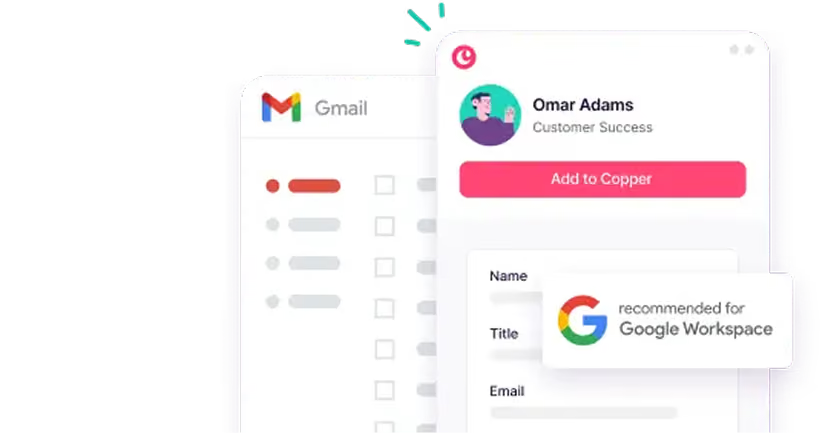
Since it’s built for Google Workspace, your emails and meetings are automatically logged from Gmail and Calendar. That means your CRM reporting is always based on complete, up-to-date data without your team needing to manually input anything.
When your CRM data is captured naturally as part of your sales process, everything becomes more reliable. Your reports reflect reality, your team stays focused on building relationships, and you get a clear view of performance without chasing updates.
Customizable filters and fields
Every business runs differently, so your CRM reporting should reflect that.
Custom fields and filters allow you to segment your data in ways that actually matter — whether that’s by client type, deal size, industry, or customer satisfaction. Instead of forcing your workflow into a rigid system, you’re shaping reporting around how your business operates.
You can also create templates based on these views, which makes it easier to standardize reporting across your team. Once your structure is set, everything becomes more consistent and easier to maintain.
Real-time data sync
Decisions are only as good as the data behind them.
With real-time syncing, your CRM reporting updates instantly as your team logs activities or moves deals forward. That means you’re always working with the most current information available.
For fast-moving sales teams, this kind of visibility is essential. It allows you to adjust quickly, respond to changes, and keep your pipeline moving without delays.
Visual dashboards and drill-downs
Strong CRM reporting isn’t just about collecting data — it’s about making it easy to understand.
Visual dashboards give you a clear, high-level view of trends like pipeline movement, revenue performance, and customer satisfaction. When something stands out, drill-down functionality lets you explore the details behind it.
This combination makes it easier to move from insight to action without getting lost in the data.
AI forecasting
AI adds another layer of intelligence to CRM reporting.
By analyzing patterns across your pipeline and sales process, it helps predict likely outcomes based on historical performance and current activity. This gives you a stronger foundation for planning and decision-making.
It doesn’t replace your judgment — it enhances it. You’re still in control, just with better context and clearer direction.
Real CRM report examples for agencies and consultants
This is where CRM reporting capabilities really starts to feel real (because theory is great, but seeing it in action? That’s where it clicks).
For agencies and consultants, it’s never just about your sales reps tracking deals. You’re managing relationships, juggling projects, and trying to grow client value over time — all at once. And when your CRM system is working properly in the background, it’s not just storing information… it’s helping you connect the dots in ways that actually move things forward.
These are the kinds of reports that make you pause mid-scroll and go, “Wait… this is actually useful.”
Retainer renewal tracker
This one is all about staying ahead (instead of scrambling at the last minute and hoping for the best).
A retainer renewal tracker helps you monitor contract end dates, utilization, NPS or CSAT, and even QBR notes — all in one place. So instead of realizing a renewal is coming up after it’s already urgent, you can see it weeks (or months) in advance and plan accordingly.
And here’s where it gets even better: when your CRM system tracks these metrics consistently, patterns start to show up and you’re better equipped to make data-driven decisions. You’ll notice which clients are highly engaged, which ones might need a little extra attention, and when the right time is to reach out.
That means your outreach isn’t rushed or reactive — it’s thoughtful, well-timed, and grounded in actual context (which, let’s be honest, makes you look incredibly on top of things).
Project delivery versus budget report
This is one of those reports that quickly becomes non-negotiable (because once you see it, you can’t unsee it).
By comparing estimated versus actual hours and costs by phase, your CRM system gives you a clear view of how projects are really performing. Not how you think they’re performing — how they actually are.
You’ll start to spot where projects are going over budget, where you’re under-utilized, and where certain phases consistently take longer than expected. And those insights? They’re gold.
Because now you’re not guessing when you scope new work. You’re using real metrics to refine pricing, improve resource planning, and avoid the same issues repeating themselves. It’s the difference between reacting after the fact and proactively building a more efficient, profitable process (which is a much nicer place to be).
Source-to-revenue report
And then there’s this one — the report that answers the question everyone’s quietly asking: “Where are our best clients actually coming from?”
A source-to-revenue report connects your revenue back to specific channels like referrals, events, or content. Instead of lumping everything together, your CRM system shows you exactly which lead source is bringing in high-LTV clients — and which ones tend to move through your sales process faster.
Once you have those metrics in front of you, your priorities start to shift. You’re no longer spreading effort evenly across every channel. You’re focusing on the ones that consistently bring in the right kind of business (and yes, it feels very satisfying to finally know this).
At this point, these aren’t just reports sitting quietly in your CRM system. They’re the reason your decisions feel clearer, faster, and a lot more confident.
They help you move from reacting to what’s happening… to actually shaping what happens next (and that’s where growth really starts to get interesting).
Take the next step with Copper CRM reporting
This is usually where things start to click.
CRM reporting shouldn’t feel like extra work layered on top of everything else your team is already doing. It shouldn’t rely on constant reminders, manual updates, or last-minute number pulling just to understand what’s going on.
Ideally, it runs quietly and streamlines in the background — supporting how your team already works.
That’s the shift Copper is built around. Because it lives inside Gmail and Google Calendar, your CRM data is captured naturally as your team communicates with leads and clients. Emails, meetings, follow-ups — it all feeds into your CRM reporting without requiring a second step.
So instead of maintaining your data, you’re actually using it.
And importantly, this isn’t just about tracking deals. It’s about understanding relationships over time — how prospects become clients, how clients stay engaged, and where opportunities for growth or risk start to show up.
With that visibility, you can start to see the bigger picture. How sales activities contribute to long-term customer satisfaction. Which lead source tends to bring in not just new business, but the right kind of business. Where your sales process supports strong relationships — and where it might need a little refining.
Copper helps bring all of that together in a way that feels manageable, not overwhelming. For example:
- Keeping pipelines aligned with your actual sales process so reporting reflects real relationship stages, not just transactions
- Keeping relationships and communications all in one place so your team members stay on the same page
- Tracking sales activities automatically so your CRM reporting stays accurate without extra admin
- Using simple automations tied to pipeline stages to keep communication consistent and timely
- Capturing new leads through website forms so every relationship starts organized from the beginning
- Filtering reports to understand performance by client type, deal size, or lead source — not just closed revenue
- Seeing how engagement and activity trends connect to customer satisfaction over time
None of this is about adding complexity. It’s about making your relationships — and the data behind them — more visible, so you can manage them intentionally.
Because when you can clearly see how your business is growing, who your best clients are, and where to optimize your approach, decisions start to feel a lot more straightforward.
If you’ve been looking for a better way to stay on top of your pipeline, your relationships, and your overall performance, this is a solid place to start.
If you’re ready to stop guessing and start seeing what’s actually driving your growth, give Copper a try for 14 days free.