










Choosing a customer relationship management (CRM) platform shouldn’t feel this confusing, but here we are.
(Why are there so many options and why do they all sound the same?)
If you’ve been comparing tools lately, you’ve probably run into this exact fork in the road: do you go with an industry specific CRM that’s built for your niche, or a generic one that promises to flex with your business?
Honestly, both sound great at first. One says, “I already understand your world.” The other says, “I’ll grow with you.” So now you’re stuck trying to predict your future while also just trying to get through this quarter. (Cool. Cool, cool, cool.)
Let’s break this down in a way that actually helps you decide — and not just now, but six months (and two pivots) from now.
What is a CRM and what makes one industry specific?
At its core, a CRM solution is where your entire relationship with customers lives. And I mean everything. Leads, emails, deals, notes, timelines, follow-ups. It’s all there. (Finally, one place. We love to see it.)
Because let’s be honest… trying to run your business off memory and vibes? That’s how things fall through the cracks. That’s how you wake up at 11pm like, “wait… did I ever reply to that email??” Not ideal.
And this is where a good CRM really changes things. It’s not just about storing info. It helps you actually optimize how you work day to day. You’re not chasing updates, digging through inboxes, or guessing what’s next. Everything just feels more under control. (Which, wow, what a concept.)
Now here’s where the split happens.
An industry specific CRM is built for one type of business. It comes loaded with CRM features, workflows, and language that match exactly how that industry already works. So when you log in, it feels super familiar right away. Like “okay wait… this actually makes sense.” Very comforting. Very easy.
But then there’s the generic CRM.
And this one’s more like, “tell me how you work and I’ll keep up.” It starts open and flexible, so you can shape the CRM features around your actual process. Not some default version of it. It might take a little more effort at the beginning, but it gives you way more freedom once things start changing. And they will change. They always do.
So the simplest way to think about it? One is ready for where you are right now. The other is ready for where you’re going next.
And if you’re even thinking about growth, new services, or doing things a little differently down the line… yeah. That second option starts looking real good.
Common industries that use industry specific CRMs
There are some industries where an industry specific CRM just clicks right away. Like, you log in and it already feels like it knows your job. (A little eerie, but also kind of amazing?)
Take real estate, for example. You’re juggling listings, showings, offers, and client follow-ups all at once. A specialized CRM can come pre-loaded with things like property tracking, deal stages that mirror the buying process, and reminders that keep everything moving without you having to build it from scratch.
Or nonprofits. Their world revolves around donors, fundraising campaigns, grants, and events — not traditional “sales pipelines.” So having a CRM that already understands donation cycles, recurring contributions, and volunteer coordination? Huge win. It saves time and mental energy right out of the gate.
You see this in healthcare, too, where you’re not just managing “contacts” — you’re managing patient information, appointments, care coordination, and a whole lot of compliance requirements that really can’t be messed up. Everything has to be structured, secure, and working together seamlessly.
In all of these cases, an industry specific CRM can feel like a shortcut in the best way. It speaks the language, follows the same rhythms as the work, and doesn’t ask you to translate your process into something else.
And honestly? That immediate “oh wow this fits” feeling is very compelling. (Like… do I even need to keep researching?)
Industry-specific CRM vs generic CRM: A head-to-head comparison
Here’s where things get real, because this isn’t about which one is “better.” It’s about functionalities. It’s about your business needs. And it’s about what trade-offs you’re willing to make.
Industry specific CRMs usually win on day one. You can log in and start using them almost immediately because everything is already set up for your type of work. No heavy lifting required.
Generic CRMs take a bit more setup, but that setup is actually the point. You’re building a system around how your business actually runs, not just how your industry typically operates.
When it comes to features, industry CRMs go deep in one area. They’re incredibly good at specific workflows. Generic CRM systems, on the other hand, tend to cover the entire customer journey—from first touchpoint to long-term relationship—which becomes more important as your business grows.
Reporting follows the same pattern. Specialized tools come with pre-built reports that match industry expectations. Generic platforms give you the freedom to track what you care about, your way.
Then there’s integrations. And this is a big one people underestimate.
Industry specific CRMs usually connect well with niche tools. But generic CRMs? They plug into everything. As your tech stack grows (and it will), that flexibility starts to matter a lot more.
And finally, adoption. Industry CRMs feel intuitive immediately. Generic CRMs might take a bit more onboarding, but once your team gets it, they can use it across roles, teams, and workflows without friction.
Pros of choosing an industry-specific CRM
It’s easy to see why people go this route early on. Like… very easy. Because when an industry specific CRM fits, it feels like you skipped a bunch of setup steps and went straight to “okay, we’re up and running.” And honestly, who doesn’t want that?
Faster time to value
This is the biggest win right out of the gate.
With an industry-specific CRM software, you’re not starting from scratch or trying to piece together your pipeline from memory. The structure is already there, which means you can log in and get moving almost immediately.
And that early sense of progress? It makes a huge difference. Your team adopts it faster, things start flowing, and you’re not stuck in setup mode for weeks.
Built-in industry workflows
This is where things start to feel really comfortable.
Everything is designed around how your industry already works. The terminology makes sense, the stages feel familiar, and your workflows don’t need to be rethought or renamed just to fit the system.
It’s one of those moments where you log in and think, “okay wait… this actually gets us.” And that kind of alignment makes onboarding and day-to-day use feel a lot smoother.
Industry-specific compliance features
And if you’re in a space where compliance matters, this is a big one.
An industry specific CRM often comes with built-in reporting and regulatory features, so you’re not trying to recreate those processes yourself. That means less manual work, fewer workarounds, and more confidence that everything is being handled properly.
Which, in those industries, is not just helpful. It’s necessary.
Drawbacks that can hold industry specific CRMs back
Here’s the catch (because there’s always a catch): your CRM tools’ limitations don’t show up on day one. They show up when your small business starts to evolve.
Maybe you expand your services. Maybe your sales process changes. Maybe forecasting gets harder. Maybe you start working with different types of clients. Suddenly, that perfectly tailored system starts to feel… less flexible.
Because it was built for one way of working, stretching it beyond that can get messy. Fast.
Integration options can also feel limiting over time. While niche tools are supported, broader ecosystems aren’t always as robust—which becomes a problem as your stack grows.
And then there’s switching. Moving away from a specialized system can be more complicated than expected. Data doesn’t always transfer cleanly, workflows need to be rebuilt, and your team has to learn something new all over again.
So while it feels simple at the start, it can become restrictive later.
(And yeah… that part usually isn’t in the demo.)
Pros of choosing a generic CRM that adapts to any workflow
A generic CRM flips the script in the best way.
Instead of forcing your small business to squeeze into some rigid, predefined system, it lets you build something that actually reflects how you work. And even better? It evolves with you. (Finally, a tool that doesn’t panic when you change things up.)
And that’s a big deal.
Because let’s be honest, most businesses don’t stay the same for long. Your services shift, your processes get more layered, and suddenly your once-simple setup has… a lot going on. A flexible CRM gives you the space to keep everything moving without breaking your system every time something changes.
Broad feature set from sales to project delivery
You get lead management that keeps your pipeline organized without things slipping through the cracks, plus document management that keeps files, notes, and client details connected instead of scattered everywhere.
And this is exactly where Copper stands out.
Not because it’s industry-specific, but because it’s built around what every business actually needs: better relationship management, without the friction.
With Copper, you can create customizable pipelines that match how you actually sell and deliver work. You can trigger pipeline email automations when deals move stages, so follow-ups happen without you having to chase them down. You can capture leads through website forms that automatically route inquiries to the right place.
Large community and support resources
Another underrated win here is the ecosystem around a generic CRM.
Because these platforms are used across so many industries, you’re not figuring things out on your own. There’s more documentation, more shared knowledge, and stronger customer support when you need help. (Which, let’s be real, you eventually will.)
And having that backup makes a huge difference when your team is moving fast and things need to keep working.
Easier to customize without code
And this is where things start to feel a lot more manageable.
You don’t need to rely on a developer every time something needs to change. Pipelines, stages, and workflows can be updated directly by your team, which means your system can actually keep up with how you work.
Most modern CRM platforms are built to be flexible without adding complexity, so adjustments feel like part of your normal workflow instead of a separate project.
Everything stays organized in one place, your data stays connected, and your team doesn’t have to go digging to find what they need.
And when you can make updates or check in from your phone, it makes staying on top of things that much easier.
The 5 factors to consider when deciding which CRM platform fits your business
Okay, if you’re still going back and forth, this is your moment to zoom out. Like, actually zoom out. (Lean back. Take a sip of coffee. We’re thinking long-term now.)
Because here’s the thing. Every CRM platform looks amazing in a demo. Everything feels smooth, everything looks organized, and you’re like “wow, this could fix my life.”
And then reality hits.
So instead of choosing based on what might feel right based on your specific needs, here are the five things that will actually tell you what’s going to work.
1. Complexity of your sales and delivery process
If your process is simple, honestly, you’ve got options. You can make most CRM systems work.
But if you’re juggling multiple stages, approvals, stakeholders, and ongoing client relationships, things get complicated fast. And that’s where flexibility stops being “nice to have” and starts being essential.
Because the last thing you want is to outgrow your own system while trying to manage your business inside it. (That’s a very specific kind of frustration.)
2. Need for cross-functional collaboration
Now think about how your team actually works.
If sales, delivery, and customer support are all involved in the same client relationships, you need everything connected. Otherwise, you end up with scattered information, duplicated work, and those dreaded “wait… who’s handling this?” moments that somehow always happen at the worst possible time.
An all-in-one CRM platform here just makes life easier. Full stop.
3. In-house technical resources
Okay, real talk. How much time and energy do you actually have to set this thing up?
If the answer is “not much,” a pre-built system can feel like a lifesaver in the beginning. You log in, things are already there, and you’re off to the races.
But if you can invest a little time upfront, a flexible CRM platform with easy-to-navigate dashboards give you way more control later. And more importantly, it won’t fight you every time your process changes.
Because it will change. It always does.
4. Growth and diversification plans
This one’s big. Even if things feel stable right now, ask yourself what the next year could look like. Are you expanding services? Trying new offers? Changing how you work with clients?
If the answer is even a “maybe,” you’re going to want a system that can keep up without forcing you to rebuild everything from scratch later.
Future you is either going to thank you for this decision… or be very annoyed. (Let’s aim for the first one.)
5. Budget and total cost of ownership
And finally, let’s talk money. But like… the real money.
Because it’s not just the monthly price. It’s onboarding, training, customization, integrations, and potentially switching later if things stop working.
That “affordable” option can get expensive fast if it doesn’t scale with you.
So instead of asking “can I afford this right now?” the better question is “will this still make sense a year from now?”
Because choosing a CRM isn’t just a purchase. It’s a commitment.
And you want one that actually grows with you—not one you’re already planning to replace.
Cost, Integration, and Scalability Checklist
Okay, this is the part where you want to slow down for a second and really think things through, because this is where a lot of “great” decisions start to fall apart later.
When you’re evaluating a CRM, you’re not just choosing what works today. You’re choosing what it’s going to feel like to run your business inside that system six months or a year from now, when your team has grown and your processes look a little different.
Upfront licensing and onboarding
At first glance, pricing can seem straightforward. There’s a subscription cost, and that feels like the main number to focus on. But getting started often involves more than that, especially when you factor in onboarding, implementation time, and data migration.
Moving your contacts, deals, and historical data into a new system can take real effort, and in some cases, additional cost. So when a CRM promises an easy setup, it’s worth thinking about what that actually looks like for your team and how much time you’ll need to get everything running smoothly.
Ongoing admin and customization
Once your CRM is up and running, it still needs ongoing attention. Someone has to manage the system, update workflows, train new team members, and make adjustments as your business evolves.
The experience here can vary a lot depending on how flexible the platform is. In a rigid system, even small changes can feel complicated and time-consuming. In a more adaptable one, those same updates feel manageable and part of your normal workflow. Over time, that difference has a real impact on how easy the system is to maintain.
Future add-ons and API costs
As your business grows, your needs will expand too. You may want to connect new tools, unlock additional features, or build more advanced workflows. This is where add-ons, integrations, and API access come into play.
Some platforms make this easy, while others introduce additional costs or limitations as you scale. What works well for a smaller team might not hold up in the same way as your operations become more complex.
That’s why it’s helpful to think beyond what you need today and consider how the system will support you as your business evolves. A CRM that can grow with you tends to reduce friction, unexpected costs, and the need to switch platforms later on.How Google Workspace integration changes the equation
Okay, let’s talk about something that quietly makes a huge difference: where your team actually works every day.
If you live in Gmail, Calendar, Docs, and Drive (hi, same), constantly switching between tools is a productivity killer. It doesn’t feel like a big deal in the moment — but multiply that by your whole team, every day? It adds up fast.
This is where Copper changes the game.
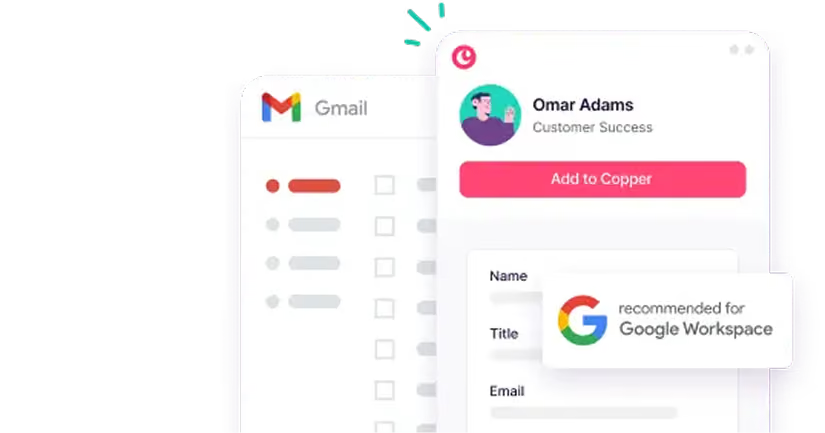
Instead of being “yet another tool,” it becomes your all-in-one system that lives right inside Google Workspace. You can manage relationships directly in Gmail and Calendar—no tab switching, no context loss, no “wait, where was that again?”
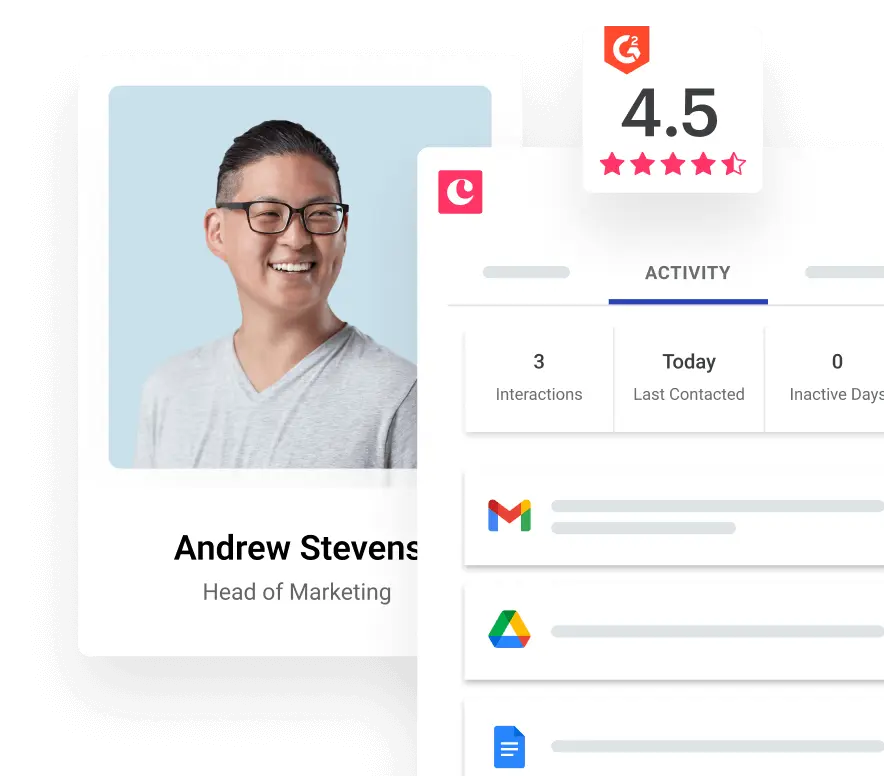
Customer data gets pulled in automatically from emails and meetings. Files in Drive are connected to contacts and deals. Everything stays organized without manual entry.
It just… works together. Seamlessly. (Yes, we love to see it.)
And when your CRM fits into your natural workflow like this, everything becomes easier to streamline — from sales to delivery to customer support.
How Google Workspace integration changes the equation
Okay, this is where things start to feel really different.
Because most CRM conversations stay focused on features. Pipelines, reports, dashboards. All important, sure. But what actually changes your day-to-day? It’s where you’re doing the work.
And if your team lives in Gmail, Calendar, Docs, and Drive (which… let’s be honest, you probably do), constantly jumping between tools gets old fast. It breaks your flow, slows you down, and turns simple tasks into way more effort than they need to be.
This is where Google Workspace integration completely changes the experience, and it’s exactly what Copper CRM is built around.
Zero-tab switching in Gmail and Calendar
With Copper CRM, everything happens right where you already are.
You can manage relationships, update deals, and track conversations directly inside Gmail and Calendar. It doesn’t feel like you’re switching between systems. It feels like everything finally lives in one place.
(And once you get used to that, there’s no going back.)
Automated data capture from Google Docs and Drive
Now imagine not having to log every email, attach every file, or manually update every record.
Copper CRM automatically connects your emails, meetings, and files to the right contacts and deals, so your team always has context without needing to chase it down.
Here’s what that looks like in real life:
- Emails and meetings are already tied to the right people
- Files in Google Drive stay connected to deals and accounts
- Your team always knows what’s happening without asking around
It’s one of those things that seems small… until you realize how much time it saves.
Single sign-on and security
And then there’s the part that just makes everything smoother behind the scenes.
With Copper CRM, your team signs in once and gets access to everything they need, without juggling multiple logins or trying to remember where things live. It keeps things simple, consistent, and way less frustrating to manage.
And when you’re away from your desk, the mobile app makes it easy to stay in the loop. You can check deals, update notes, and keep things moving without feeling like work is piling up while you’re out.
Pick the CRM that grows with you
Here’s the bottom line.
If your business is steady and your processes aren’t likely to change much, an industry specific CRM can work well. It’s fast to set up, and it’s built for a very specific use case.
But if you’re choosing between an industry specific CRM and a generic CRM, the real question is how much flexibility your use case will need over time.
Because as your business grows, your team changes, your services expand, and customer support becomes more connected to the rest of the customer journey, your CRM needs to keep up too. That’s where a generic CRM starts to make a lot more sense.
The best CRM isn’t the most specialized or the most feature-packed. It’s the one that supports your actual use case and helps you manage relationships across sales, delivery, and customer support without slowing you down.
That’s exactly what Copper is built for.
It’s flexible, intuitive, and designed to adapt as your workflow evolves, so you don’t have to rethink your system every time your business changes.
If you want a CRM that can actually keep up with you, try Copper free for 14 days. Thank us later!