











Searching for the best Insightly alternative usually doesn’t happen out of nowhere. It happens when your CRM starts feeling heavier than it used to.
Maybe reporting takes longer than it should. Maybe onboarding a new hire turns into a mini training program. Maybe you’re bouncing between Gmail and your CRM so often that you start questioning whether they’re supposed to work together at all.
Insightly works well for a lot of teams in the beginning. It gives you structure. It helps you get organized. It makes things feel official. But as your business grows — especially if you’re a service-based team living inside Google Workspace — what once felt helpful can start to feel limiting.
And that’s the turning point.
That’s when researching an Insightly CRM alternative shifts from “maybe someday” to “we should probably figure this out.”
If you’re here, you’re not looking for shiny CRM features. You’re looking for something that fits. Something your team won’t fight. Something that feels lighter, faster, and actually aligned with how you work.
Let’s talk about why teams make the switch.
Exit Design chooses Copper over HubSpot — and isn’t looking back
Why teams replace Insightly
Most teams don’t switch CRMs because something explodes — they switch because over time, things just start feeling harder than they should. Insightly works well in the early days, but as your team grows and your processes get more complex, it’s natural to start looking for an Insightly CRM alternative that fits how you actually work now.
Here’s where that shift usually starts to show up:
Hidden costs and tier limits
Pricing usually looks fine at first. You pick a plan, add your team, and everything feels reasonable.
Then your company grows. You add more users. You realize you need automation or better reporting. And suddenly the CRM that felt affordable starts creeping up in cost or you’re hitting limits that push you into a higher tier faster than you expected.
That’s why this is one of the biggest reasons people start searching for an Insightly CRM alternative. You’re not trying to cheap out. You just want pricing that makes sense as you scale, without feeling like every new hire comes with a surprise upgrade.
Steep learning curve for small business teams
A CRM isn’t helpful if your team needs a crash course just to use it.
If onboarding takes forever, or only one person knows how everything works, the rest of the team won’t touch it unless they absolutely have to. A lot of teams looking for an Insightly CRM alternative are really just looking for something that feels easier. Something your team can pick up quickly, actually enjoy using, and keep updated without someone chasing them down.
Limited Google Workspace integration
If your day-to-day life happens in Gmail and Google Calendar, your CRM needs to play nicely with that. Like, genuinely nicely.
Because when it doesn’t, you end up doing the same annoying dance all day: switching tabs, copy-pasting notes, manually logging emails, and trying to remember where the last conversation actually happened.
For Google Workspace–first teams, this is often the tipping point. They don’t just want a CRM that “integrates” with Gmail — they want an Insightly CRM alternative that feels like it belongs there, so tracking relationships doesn’t feel like extra work.
Best Insightly CRM alternatives
When evaluating an Insightly CRM alternative, the key is to focus on fit. The best option depends on your workflow, your team size, and how important Google Workspace is to your operations.
Here are the strongest contenders.
1. Copper CRM
If your team lives in Gmail (and you basically run your business out of your inbox), Copper is going to feel like the most obvious Insightly CRM alternative pretty quickly.
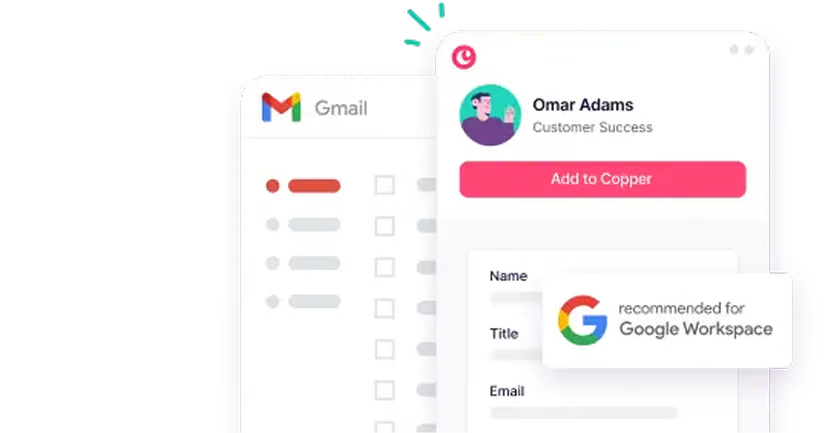
Copper was built specifically for Google Workspace teams, which means it doesn’t feel like “yet another tool you have to log into.” It works right alongside Gmail and Google Calendar, so your emails, meetings, and contact activity stay connected without your team doing a bunch of extra busywork. You’re not constantly copying notes, switching tabs, or trying to remember where that last conversation happened.
It’s also a great fit for agencies, consultants, and service-based businesses because Copper doesn’t just help you close deals — it helps you manage the relationship long after the contract is signed. With customizable Pipelines, you can match your sales process exactly, and with Pipeline email automations triggered by stage changes, you can keep follow-ups moving without manually nudging every lead. Add in website forms for sorting inquiries and integrations with hundreds of other apps, and you’ve got a CRM that supports the entire client journey instead of stopping at “closed won.”
If you’re looking for an Insightly CRM alternative that feels clean, modern, and built for how Google Workspace teams actually work, Copper is the natural upgrade.
2. HubSpot CRM
HubSpot is the “big toolbox” option.
If marketing automation is a major part of your strategy (think email campaigns, landing pages, lead nurturing, and all the analytics that come with it) HubSpot can be a really strong Insightly CRM alternative. It’s especially popular with teams that want sales and marketing under one roof.
That said, HubSpot has a reputation for starting off friendly and then getting expensive fast once you need advanced features, more users, or more automation. It can also feel like a lot of platform if what you really want is a straightforward CRM for tracking deals and managing relationships.
If you’re marketing-heavy, HubSpot’s worth a look. If you’re sales and relationships first, it might feel like more than you need.
3. Monday CRM
Monday CRM is a great option if your team thinks visually.
It’s built on Monday.com’s project management DNA, so it feels more like a workflow board than a traditional CRM. That can be a big win for teams that want deals, tasks, and collaboration to live in the same space, especially if you’ve already used Monday for project tracking.
The tradeoff is that it can feel less “CRM-native” than some other Insightly CRM alternative options. If your team expects a classic CRM layout and process, there may be a bit of a learning curve while everyone adjusts to the board-style setup.
If you want your CRM to double as a workflow engine, Monday CRM can be a solid pick.
4. Pipedrive
Pipedrive is for teams who want one thing: a clean pipeline and a CRM that doesn’t overcomplicate it.
It’s one of the most intuitive tools out there for deal tracking, and it’s great at keeping your sales team focused on moving opportunities forward. If you’re looking for an Insightly CRM alternative because you want something simpler, faster, and more sales-driven, Pipedrive makes a strong case.
Where it’s less strong is what happens after the deal closes. If your business is service-based and you need a CRM that supports project handoffs, client delivery, or long-term relationship management, Pipedrive can feel a little “sales-only.”
If your pipeline is the main event, Pipedrive is a great fit.
5. Zoho CRM
Zoho CRM is the “you can customize everything” option.
It’s packed with features, it’s generally affordable, and it plays well with a huge ecosystem of Zoho products and third-party integrations. For teams that want flexibility without paying enterprise-level pricing, Zoho is a common Insightly CRM alternative.
The downside is that Zoho can feel like a lot. Setup takes time, customization takes effort, and teams often need someone internally who’s willing to manage the system and keep it organized.
If you want control and you don’t mind complexity, Zoho can be a powerful choice. If you want plug-and-play simplicity, it might feel overwhelming.
6. Nutshell
Nutshell is the friendly, straightforward option.
It’s built for teams that want a CRM that’s easy to use, easy to learn, and doesn’t require a ton of setup to get value out of it. It also includes built-in email marketing, which is a nice bonus if you want some light marketing functionality without adopting a full marketing platform.
The tradeoff is that Nutshell may not offer the depth of customization or advanced workflows that larger teams need as they scale. But if you’re looking for an Insightly CRM alternative that feels approachable and practical, Nutshell is a strong contender.
Related: Best Nutshell CRM alternatives
7. Salesforce Essentials
Salesforce Essentials is a solid option if you want to tap into the Salesforce ecosystem without committing to the full enterprise beast right away. You still get a lot of what Salesforce is known for (think: deep customization, strong reporting, and a massive app marketplace) so it can make sense if you’re thinking long-term and you want a CRM that can grow with you for years.
That said, it’s still Salesforce, and Salesforce doesn’t exactly do “lightweight.” Setup takes time, and the learning curve is real. Even Essentials can feel like more CRM than some teams actually need, especially if you’re looking for something your team can jump into quickly without a bunch of training.
If you’re building toward more complexity and you don’t mind putting in the upfront work, it’s a strong Insightly CRM alternative to consider. If you’d rather your CRM feel simple, fast, and intuitive from day one, you might be happier with something a little more streamlined.
Related: Evaluating your CRM: How to set the right criteria with a detailed checklist
How to choose a replacement CRM
Choosing the right Insightly CRM alternative requires more than comparing features. It requires evaluating how each platform supports your daily workflow.
Here’s what to prioritize.
Integration with Google Workspace
If your business runs on Google Workspace, native integration matters. A CRM that operates inside Gmail and syncs automatically reduces manual entry and increases adoption.
True native integration means activity tracking happens automatically, calendar events sync seamlessly, and contact information stays up to date without constant oversight.
Ease of use and onboarding time
Adoption determines success. If your team resists using the CRM, its feature set becomes irrelevant.
Look for an Insightly CRM alternative that is intuitive, easy to navigate, and quick to onboard. Ask how long it typically takes teams your size to implement the platform effectively.
Sales to project handoff in one tool
For agencies and professional services teams, closing a deal is just the beginning.
A CRM that supports sales-to-delivery visibility prevents data silos and ensures client expectations are clear. Keeping relationship history, notes, and documentation centralized reduces miscommunication and strengthens client experiences.
Total cost of ownership over three years
Think long term. Consider add-ons, integration fees, training costs, and administrative time.
The most affordable Insightly CRM alternative upfront may not be the most sustainable over time. Choose a system that aligns with both your growth plans and your operational capacity.
Final thoughts
There is no single “best” Insightly CRM alternative for every business. The right choice depends on how your team works and what you value most.
If marketing automation is your priority, HubSpot may lead. If you want strong pipeline visibility, Pipedrive is compelling. If customization is key, Zoho might fit.
But if your team lives in Google Workspace and you want a CRM that feels like a natural extension of your daily workflow, Copper stands out. You can even try it for 14 days free!
Because the best CRM isn’t the one with the longest feature list. It’s the one your team actually uses.