











There’s a stage in every growing business where your inbox quietly becomes the center of everything. Client conversations live there. Deals live there. Follow-ups, notes, next steps — all of it tucked neatly into threads that feel organized enough to trust. And for a while, it works.
When you’re early on, managing clients in your inbox feels efficient. You know where things are, you can search quickly, and nothing feels too overwhelming. (Or at least, it feels that way.)
But then your business grows. You take on more clients, more deals start moving at once, and your inbox fills up faster than you can realistically keep up with. What used to feel simple starts to feel harder than it should be.
And that’s where things start to shift.
Because managing clients in your inbox doesn’t suddenly break one day. It starts breaking in small, easy-to-miss ways that add up over time.
1. The deals you’re losing aren’t obvious (and that’s the problem)
Most people think lost deals are obvious. A clear “no,” a rejection email, a clean ending. But that’s not usually what happens. Most lost deals just… fade.
When you’re managing clients in your inbox, there’s no real system tracking what’s active, what’s stalled, and what needs attention. Everything lives inside conversations, and conversations are incredibly easy to lose track of when your inbox is full.
Maybe you saw the reply and meant to respond later. Maybe it got buried. Maybe the conversation slowed down and nothing prompted you to follow up. None of these feel like big mistakes in the moment. But to your client, it feels different.
It feels like you’re slow to respond, like things are slipping or like they might need to follow up with you instead.
(And that’s not the impression you want to leave.)
Because when you’re managing clients in your inbox, dropping the ball doesn’t just affect organization, it affects trust. And once trust starts to slip, deals follow.
A lead that was ready to move forward starts second-guessing. A client who was excited starts exploring other options. A deal that should’ve closed quietly disappears.
That’s lost revenue. Not because your offer wasn’t strong, but because your system couldn’t support the process. And the hardest part is that you don’t always see it happening.
Follow-ups become “I’ll get to it later”
Follow-ups are one of the most reliable ways to move deals forward. But they only work when they’re consistent.
When you’re managing clients in your inbox, follow-ups tend to live in your head instead of in a system. You rely on memory, flags, or inbox features that were never designed to manage a pipeline.
Over time, that leads to a pattern that feels familiar:
- You plan to follow up later, but something else takes priority
- You revisit a thread and realize more time has passed than you thought
- You lose momentum with leads that were previously engaged
(We’ve all had that “I meant to reply to this days ago” moment.)
The issue isn’t effort. It’s that there’s no structure supporting your effort.
With a customer relationship management (CRM) platform, follow-ups are tied directly to your pipeline. Pipeline email automations triggered by stage changes ensure that your next step happens when it should, not when you happen to remember it.
That’s how you maintain momentum without relying on mental reminders.
2. Your team starts doing extra work (without realizing it)
As your team grows, managing clients in your inbox stops being just your problem — it becomes everyone’s problem.
Because inboxes weren’t built for teams. They were built for individuals trying to keep up.
So what happens? Things start getting messy in ways that feel small at first… and then very not small.
You’ve got two people reaching out to the same client (cue the awkward “just looping back again” email). Someone’s asking for info the client already shared last week. Half the context lives in email, the other half is buried in Slack, and the rest is… somewhere in someone’s brain.
(Which, let’s be honest, isn’t a reliable storage system.)
None of this is happening because your team isn’t good at what they do. It’s happening because managing clients in your inbox gives everyone a slightly different version of the truth.
And that’s where things start to slow down.
Instead of moving work forward, your team is piecing things together. Double-checking. Re-asking. Trying not to overlap. It’s a lot of effort just to stay aligned.
And over time, that turns into:
- Work getting duplicated
- Conversations getting confusing
- Time getting wasted on things that shouldn’t take that long
(It’s exhausting — for your team and your clients.)
When you move away from managing clients in your inbox and into a CRM, everything clicks into place. Now, everyone sees the same information, deal history, conversations, and next steps.
3. You feel busy… but you don’t actually have clarity
One of the biggest traps of managing clients in your inbox is that it creates a constant sense of activity. You’re replying to emails, keeping conversations going, and staying engaged. It feels productive.
But activity doesn’t always equal clarity.
If you needed a clear snapshot of your pipeline right now, would you have it? Would you know how many deals are active, which ones are close to closing, and where things might be stuck?
For most teams working out of their inbox, that answer is “not really.” Because inboxes show you conversations, not progress.
A CRM changes that by giving every deal a defined stage and making movement visible across your team. Instead of piecing things together, you can actually see what’s happening.
(Which makes decision-making a lot easier.)
4. You’re missing out on repeat business (without realizing it)
It’s not just new deals that slip through the cracks. Repeat business does too.
When you’re managing clients in your inbox, there’s no clear system reminding you to check back in with past clients. No visibility into when a project wrapped, no prompt to follow up, no easy way to spot opportunities to re-engage.
So what happens?
You move on to the next deal. And your past clients — the ones who already trust you, already know your work, and are often the easiest to sell to — quietly fall off your radar.
Not because you don’t value them. But because nothing in your system is telling you to reach out.
And that’s a missed opportunity. Because repeat business is one of the most efficient ways to grow.
With a CRM, those relationships don’t disappear after a deal closes. You can set reminders, track past interactions, and build simple follow-up workflows that keep you connected long after the initial project ends.
(Which means you’re not constantly chasing new leads when you could be building on relationships you’ve already earned.)
5. Your data is there… but it’s not helping you grow
As your business grows, your data should start working for you. But when you’re managing clients in your inbox, it doesn’t.
It’s all there, buried in threads, scattered across conversations, tucked into replies you half-remember. Technically it’s accessible, but not in a way that helps you make decisions.
And that becomes a real problem, because when you can’t clearly see your data, you can’t clearly see your business.
You don’t know which leads are actually worth your time. You don’t know what’s driving your best deals. You don’t know where your process is slowing down or leaking revenue.
So you end up guessing.
You spend time on the wrong opportunities. You repeat processes that aren’t working. You miss chances to double down on what is working because you can’t fully see it.
(And that’s where growth starts to stall — not from lack of effort, but lack of clarity.)
When you’re managing clients in your inbox, it’s not just that your data is messy. It’s that your decisions are less informed, your strategy is less precise, and your business is operating without a clear view of what’s actually driving results.
And that’s a much bigger cost than it seems.
6. The math behind “things slipping through the cracks”
It’s easy to think a missed follow-up here or a delayed reply there isn’t a big deal. But when you zoom out, it adds up fast.
For example: Say your team handles around 200 leads a month and maybe just 5% of those slip through the cracks because a follow-up gets buried, a reply is missed, or ownership isn’t totally clear.
That’s 10 missed opportunities.
Now let’s say your average deal is worth $5,000.
That’s $50,000 in potential revenue… gone. Every month.
And the wild part? It doesn’t feel like $50,000 when it’s happening.
It feels like:
- “I’ll reply to that later”
- “Wait, did anyone follow up on this?”
- “I thought you had that one”
Sales reps already spend a huge chunk of their time on non-selling work. When your process lives in your inbox, even more of that time gets eaten up by trying to stay organized instead of actually moving deals forward.
(Which is not what you hired them for.)
So the cost of managing clients in your inbox isn’t just messy workflows: It’s lost revenue you don’t see and time you don’t get back. And once you look at it that way, it’s a lot harder to ignore.
Why a CRM changes everything (and why Copper CRM makes it easy)
Your inbox has been doing a lot. Probably more than it should. And for a while, you make it work. But at some point, it starts to feel like you’re the system — not your system doing the work for you.
(And that’s when things start getting unnecessarily hard.)
Here’s the shift most growing teams don’t realize until later: companies that use a CRM see up to a 29% increase in sales and a 34% boost in productivity. Not because they suddenly became better at their jobs, but because they stopped relying on memory, inboxes, and scattered tools to run their process.
They got a system. And that’s what a CRM actually is.
Not just a place to “stay organized,” but a place where everything connects. And, if you’re realizing you may need one, that’s where Copper comes in.
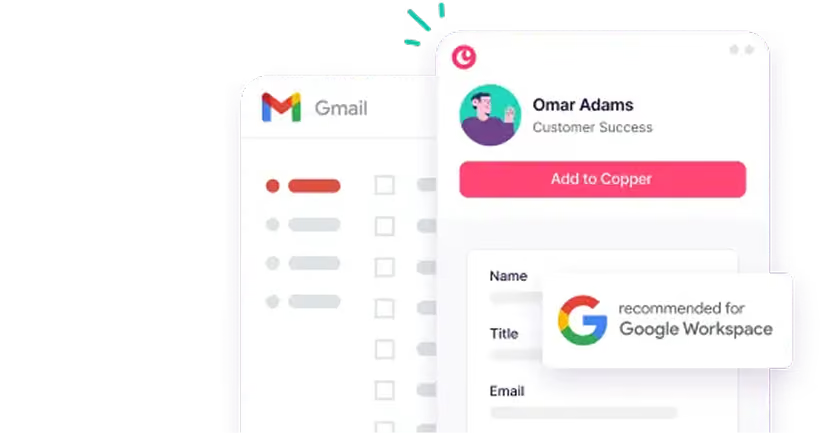
Instead of forcing your team into a brand new way of working, Copper fits right into what you’re already doing. It lives inside Google Workspace, so you can manage relationships directly from Gmail without bouncing between tools or learning something complicated.
(Which means your team actually uses it — big win.)
And behind the scenes, it brings everything together in a way your inbox never could.
Instead of juggling everything manually, you get:
- Customizable pipelines that reflect how your deals actually move (not some generic process you’re forcing to fit)
- Pipeline email automations triggered by stage changes, so follow-ups happen without you having to remember them
- Website forms that capture and organize incoming leads right from the start
- Integrations with hundreds of tools, so your workflow stays connected instead of scattered
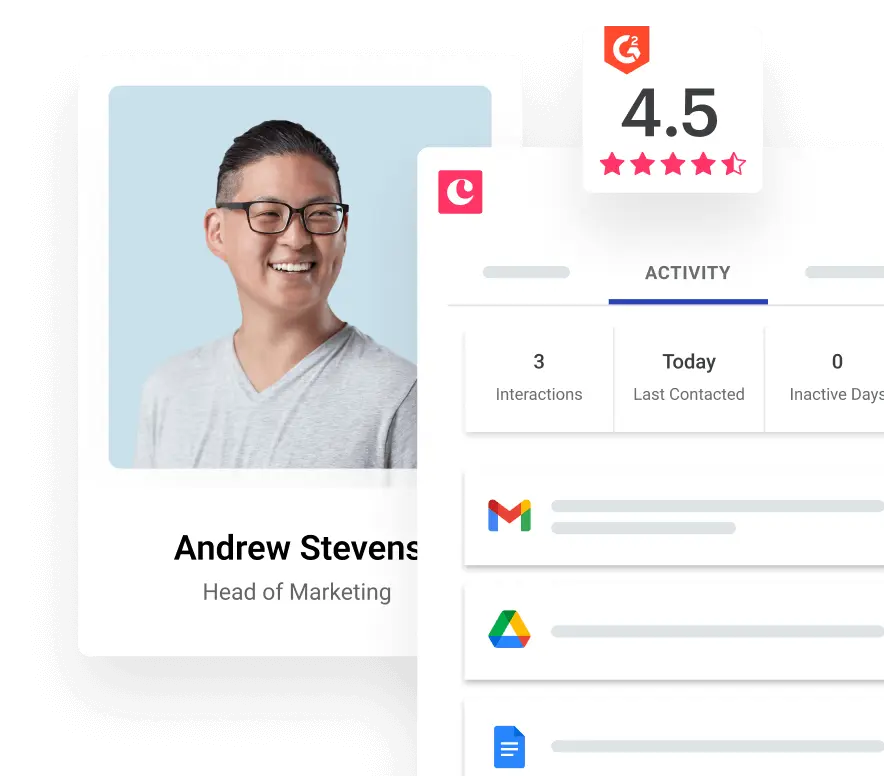
- A central activity feed that shows your team exactly what’s happening across deals and relationships (so no one’s left guessing or playing catch-up)
- Detailed People records with notes and history, so every interaction, update, and context point lives in one place (no more digging through threads trying to piece things together)
What this really does is take the pressure off you and your team. You’re not trying to remember who to follow up with. You’re not searching your inbox for that one email. You’re not wondering if someone already replied.
(And honestly, that mental load? It adds up more than people realize.)
A better way to move forward
Your inbox is familiar. It’s what you’ve always used. It’s where your work happens.
So of course it feels like the easiest place to manage everything.
But just because it’s what you’re used to doesn’t mean it’s the best way to keep growing.
At a certain point, “making it work” starts taking more effort than it should. You’re keeping track of too much, relying on memory more than you’d like, and putting in extra energy just to stay on top of things.
(And that’s usually the sign something needs to shift.)
There are better ways to do this — ways that don’t rely on you holding everything together, and don’t make growth feel heavier as you scale.
If you’re ready for something that actually supports how your business runs now, try Copper free for 14 days.
Because growth shouldn’t feel like you’re constantly trying to keep up — it should feel like you’re finally in control.