












Working in video production means wearing a lot of hats… and usually all at once. One minute you’re talking through a concept, the next you’re wrangling schedules, reviewing edits, answering client emails, and trying to remember which version is actually the latest.
Projects rarely move in a straight line. So it makes sense that more studios and agencies are searching for the best customer relationship management (CRM) tool for video production.

Why video production teams need specialized CRM solutions
Video production has a lot of moving parts. You’re juggling ideas, revisions, schedules, vendors, gear, budgets, and endless conversations — usually across way too many tools. The work is creative, technical, and constantly shifting, so staying organized isn’t just helpful… it’s the only way to survive a busy season.
That’s why so many teams end up looking for the best CRM for video production. When editors, producers, and clients are all chiming in from different directions, things can get confusing fast.
A specialized CRM gives everyone one spot to check what’s happening, what’s approved, and what still needs attention. It keeps the project grounded even when the creative process gets a little wild.

Unique challenges in video production client management
Video production looks glamorous from the outside, but inside it’s a maze of moving parts, shifting timelines, and competing priorities.
Video teams juggle a special kind of chaos. Managing clients means keeping track of shifting priorities, nonstop feedback, and piles of oversized media files — all while trying to keep everyone aligned. Here are the biggest pain points:
- Lots of stakeholders, means lots of opinions. Producers, editors, brand teams, legal teams, and execs all weigh in.
- Revisions on repeat. Versions pile up fast and rarely stay in one place.
- Huge files everywhere. B-roll, cuts, color passes, and audio mixes live across multiple folders and tools.
- Long timelines that change constantly. One script tweak or reschedule can shift the entire project.
- A mix of freelancers and vendors. Everyone works differently, making coordination tricky.
- Clients who are new to the process. You spend time explaining timelines and approvals along the way.
- Feedback scattered across apps. Email, Slack, review links, Google Docs — it’s easy to lose track.
A CRM designed for production helps keep all of this organized by pulling communication, files, and decisions into one place.

How CRM streamlines production workflows and client communication
A good CRM becomes the central hub for your entire production process — especially when you’re using the best CRM for video production for the way your team actually works.
Instead of chasing updates or digging through old threads, everything you need lives in one spot, which makes your whole workflow feel a lot lighter.
- Centralized communication: All your emails, notes, calls, and client feedback live with the project, so no one has to hunt for context.
- Clear project visibility: Pipelines make it obvious what’s in progress, what’s coming up, and what needs attention.
- Less guesswork: With decisions and files connected, your team isn’t asking for the “latest version” every other day.
- A smoother client experience: Clients get clearer updates, fewer surprises, and a more confident sense of where things stand.

Essential CRM features for video production teams
Finding the best CRM for video production means choosing a tool that understands how creative work really happens — fast feedback cycles, big files, multiple collaborators, and timelines that shift on a dime. Here are the features production teams rely on to keep everything moving smoothly.
Client communication and project tracking capabilities
Clear communication can make or break a production. With long timelines, multiple team members, and clients who give feedback from every direction, you need a CRM that keeps everyone in sync without the “Wait, who said that?” moments.
Look for a CRM that lets you:
- Keep all client conversations in one place (think: emails, calls, notes, everything!).
- Save important decisions so you don’t have to dig through old threads to remember what was agreed on.
- Assign and track tasks so everyone knows what they’re responsible for.
- View your full production pipeline from pre-pro to final delivery.
- Give your whole team shared visibility so no one’s left guessing.
It’s all about avoiding miscommunication and keeping projects moving.
File sharing and collaboration tools
Video teams deal with big files, lots of versions, and tons of supporting documents. When those assets live in random drives or hidden in email attachments, work slows down.
Your CRM should help you:
- Connect files directly to the right project
- Track which version is the most up-to-date
- Keep scripts, outlines, and storyboards organized
- Integrate with tools like Google Drive or Dropbox
- Make collaboration easy for editors, producers, and freelancers
When files and conversations live together, your team spends less time searching and more time creating.
Invoice and payment management features
Budgets shift. Scopes change. New deliverables get added halfway through. That’s production life — and your CRM should help you stay on top of it.
Look for features that let you:
- Track invoices and payment status in one spot
- Send reminders automatically
- See every client’s billing history at a glance
- Forecast upcoming revenue based on active projects
- Stay organized when scopes expand so nothing gets missed
Good financial visibility means fewer surprises for you — and a smoother relationship with clients.

Top CRM solutions for video production teams
There’s no one-size-fits-all tool for production work. Every studio has its own mix of clients, workflows, timelines, and creative chaos — which means the best CRM for video production really depends on what your team needs most.
Here are the top CRM options for teams in 2026, with a quick look at what each one does best and the type of teams they’re built for.
Copper: Google Workspace-native CRM for seamless video production management
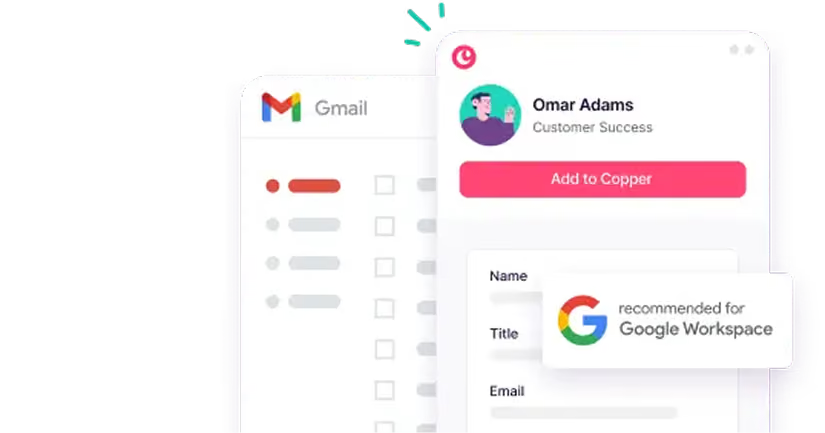
Copper is a natural fit for production teams already working in Google Workspace. With Gmail, Drive, and Calendar syncing automatically, your projects stay organized without anyone having to babysit spreadsheets or dig through old email chains.
It also makes it easier to stay on top of clients: you can instantly see when you last talked to someone, what was said, and what still needs attention. And because files and notes all live in one place, your team always knows where everything is.
Pros:
- Integrates seamlessly with Gmail, Drive, and Calendar
- Automatically logs communication so you know exactly when you last spoke to a client
- Keeps all files, links, and notes organized with the project
- Easy to stay on top of new inquiries and active jobs
- Simple, clear pipelines that match real production stages
- Generally mid-range pricing and easier for agencies to adopt
- Integrates with 100+ apps in most tech stacks
Cons:
- Best suited for teams using Google Workspace (less ideal if you’re not)
- Not as heavy on marketing tools as all-in-one platforms
Altogether, it’s a setup that helps agency and production teams stay focused on creating great work — not chasing down details.
HubSpot: Comprehensive platform for growing video businesses
HubSpot puts a lot under one roof: marketing tools, automation, pipelines, and a full CRM. It’s a great choice for mid-sized or growing production companies that want to manage clients and marketing in the same system. Smaller teams may find it a bit complex at first, but if you're planning to scale, the extra features can pay off.
Pros:
- Huge ecosystem of marketing and CRM tools
- Strong reporting and analytics
- Great for tracking leads and inbound interest
- Scales well for growing agencies and production companies
- Lots of integrations
Cons:
- Can feel heavy for small teams
- Pricing tends to skew higher, especially as you add features
- Setup and onboarding take more time
Pipedrive: Visual pipeline management for production workflows
Pipedrive is simple, visual, and easy to use. Its drag-and-drop pipelines make it easy to understand where every project stands without overthinking the system. Smaller and mid-sized teams love how intuitive it feels and how quickly they can get up and running.
Pros:
- Super visual pipeline, which are great for tracking many projects
- Easy-to-learn and set up
- Helpful reminders and activity tracking
- More budget-friendly than larger platforms
- Good fit for smaller or mid-sized production teams
Cons:
- Not designed for deep production workflows
- Fewer creative-team-specific features
- Limited marketing automation compared to HubSpot
Folk: Simple CRM designed for creative professionals
Folk is a lightweight CRM made for freelancers and small creative teams. It focuses on simple organization and easy contact management. While it’s not built for multi-stage video production, its clean interface is great for managing relationships, networking, and repeat clients.
Pros:
- Very simple and easy to use
- Clean interface with minimal setup
- Great for freelancers or very small shops
- Affordable compared to larger CRMs
- Ideal for relationship-focused work
Cons:
- Not built for complex productions
- Limited automation
- Smaller feature set than mid-range CRMs

How to choose the best CRM for your video production team
Choosing the best CRM for video production isn’t about finding the tool with the most features — it’s about finding the one that actually makes your team’s day run smoother. Every production team has its own rhythm (and its own brand of beautiful, messy creativity), so the right CRM should feel like it plugs into the way you already work… not a system you have to fight with.
Here are the three things that matter most when choosing a CRM for your production team.
1. Assessing your team size and project complexity
Start by taking a real look at how your team operates. A tiny two-person crew shooting quick-turn social videos? Totally different needs from a 20-person studio juggling long-form client projects and constant revisions.
It’s not really “How big are we?”
It’s “What does our team actually need to get projects across the finish line without losing our minds?”
A CRM should scale with you, not box you in. Smaller teams often need something lightweight and easy to adopt, while larger studios may benefit from automations, pipelines, and more advanced tracking as their project volume and complexity climb.
Try asking:
- How many people touch a project from start to finish?
- Are we cranking out fast-turn content, big multi-stage productions, or a mix of both?
- Are we managing a few large clients or lots of smaller ones?
- Do we need simple organization… or a CRM that adds real structure, accountability, and room to grow?
- Will our needs look the same six months from now or should the CRM be able to scale with a bigger team or more projects?
The clearer you are about how your team works right now — and where you're headed — the easier it is to choose a CRM that supports your workflow instead of slowing it down.
2. Integration requirements with existing tools
Video teams already use a lot of tools. Editing software, calendars, messaging apps, cloud storage, review platforms, call sheets… honestly, half the time it feels like your tabs have their own tabs. The last thing you need is a CRM that becomes yet another place to look for information.
A good CRM should fit into your current workflow without creating extra steps. It should connect to the editing suites your team relies on, play nicely with whatever cloud storage you use, and sync with the communication apps you already live in all day. The goal is to make your tech stack feel more connected — not more complicated.
Ask yourself:
- Will it play nicely with our cloud storage?
- Can editors and producers find files without clicking through 14 different places?
- Does it sync neatly with the tools we use every single day — like email, chat, or project docs?
- Is it built to work smoothly with Google Workspace or the platform our team already depends on?
- Will it support the way we move between editing tools and review platforms throughout the production cycle?
When your CRM actually integrates with your existing setup, your team spends a lot less time asking “Where is that file?” and a lot more time actually moving projects forward.
3. Budget considerations and pricing models
Think of CRM budgeting the same way you think of budgeting a shoot: the gear, the talent, the locations all matter — but the time you save is the real payoff.
Sure, pricing matters. But the true test is: Will this CRM save us headaches, time, and avoidable mixups?
CRMs all structure pricing differently. Some charge by feature, some by user, some by add-ons, and others save the good stuff for higher tiers. For video production teams — where projects shift, assets multiply, and multiple collaborators rely on the same tools — it’s worth taking a close look at what you’re actually getting for the cost.
Things to consider:
- Is the pricing fair for what we realistically need?
- Will we hit the limits of the basic plan too fast?
- Are must-have features hidden behind pricey upgrades?
- How much busywork will this actually remove from our week?
The right CRM shouldn’t just fit your budget — it should pay you back in clarity and time.
Video production businesses choose Copper
Production days move quickly, and your CRM should move just as fast. When scripts change, clients chime in, or timelines shift, the last thing you need is a system that can’t keep up with your pace.
That’s exactly why so many teams choose Copper when they’re looking for the best CRM for video production — it’s built for the way creative people actually work.
Ready to streamline your video production business? Try Copper for 14 days free and see how much smoother client management can be.