












When people hear the word “lead,” it can sound a little transactional, like a name on a spreadsheet, a number to chase, or a pipeline stage to move along.
But the best sales teams know something different: leads are relationships in progress.
Every inquiry, demo request, website form submission, or referral is a real person trying to solve a problem. And if your team is juggling sticky notes, inboxes, spreadsheets, and disconnected tools? Those relationships get messy fast. (And not in the charming “creative genius” kind of way.)
That’s where lead management in your customer relationship management (CRM) platform becomes essential.
A good CRM doesn’t just organize contacts. It helps your team build stronger relationships at scale — without losing the human touch that actually closes deals.
What is lead management in CRMs?
Lead management in a CRM is the process of capturing, organizing, qualifying, nurturing, and tracking potential customers throughout the sales journey.
At its core, it’s about helping your team build meaningful relationships from the very first interaction all the way through conversion and beyond.
A CRM gives your team one centralized place to manage every conversation, touchpoint, and next step. Instead of scattered information living across inboxes, spreadsheets, Slack messages, and someone’s memory (“I swear they mentioned budget on the call…”), everything stays connected and accessible.
Here are a few important terms you’ll hear often in lead management in CRM:
- Lead: Someone who’s shown initial interest in your business
- Prospect: A lead who appears to be a strong fit for your services
- Sales pipeline: The stages a relationship moves through before becoming a customer
The key thing to remember? These aren’t just labels. They represent people at different stages of getting to know your business.
And that’s why relationship-first CRMs matter so much. The goal isn’t to automate human connection out of sales. It’s to remove administrative chaos so your team has more time for actual conversations.
Why relationship-focused lead management drives revenue
Strong relationships aren’t just “nice to have.” They directly impact revenue, retention, and long-term growth.
That’s why effective lead management in CRM systems focus on helping teams understand and support people, and not just focused on tracking activities.
Improved conversion rates
Not every lead is the right fit. And honestly? That’s okay.
Good sales teams can see the relationships with the highest potential early on. A CRM helps surface meaningful signals like:
- Consistent engagement with your content
- Repeat website visits
- High-intent actions like requesting demos
- Strong alignment with your ideal customer profile
- Positive interactions with your sales team
Instead of chasing every inquiry equally, your team can prioritize the relationships most likely to succeed.
Efficiency gains through automation
Manual admin work is where momentum goes to die.
You know the stuff: copying contact info between tools, assigning leads one by one, digging through inboxes for follow-up notes, updating pipeline stages after every call. It’s repetitive, time-consuming, and somehow always expands to fill your entire afternoon.
That’s where lead management in CRM makes a huge difference.
A good CRM can automate the behind-the-scenes busywork that slows teams down, including:
- Data entry
- Lead routing
- Follow-up reminders
- Pipeline updates
- Stage-based email automations
So instead of spending half the day doing CRM housekeeping, your sales team can spend more time actually talking to people, building trust, asking better questions, and following up thoughtfully. You know… the stuff that actually helps close deals.
And honestly? That’s usually why people got into sales in the first place. Not because they had a lifelong passion for manually updating spreadsheets at 4:47 p.m.

Related: See how PlattPointe uses Copper to manage hundreds of deals and leads with a lean team.
Better decisions backed by data
Sales gets a lot easier when you stop guessing what’s working.
One of the biggest benefits of lead management in CRM is visibility. Your CRM helps you connect the dots between your relationship-building efforts and actual revenue, so your team can make smarter decisions without relying entirely on vibes and crossed fingers.
You can start spotting patterns like:
- Which marketing channels bring in your best customers
- Which follow-up sequences actually get replies
- Where leads tend to stall in the pipeline
- How long deals typically take to close
- Which reps are building the healthiest pipelines
And that kind of insight matters. Because when you know what’s creating strong customer relationships, you can double down on the strategies that are working instead of throwing time and budget at random experiments.
(Which, to be fair, is how a lot of “let’s try sponsoring a niche pickleball newsletter” decisions get made.)
The six-stage lead management process
Successful lead management in CRM follows a repeatable process that keeps relationships moving forward naturally.
Here’s how it works.
1. Capture and enrich leads
Every relationship starts somewhere when it comes to lead generation.
Maybe someone fills out a website form. Maybe they download a guide, book a demo, or message your company on LinkedIn.
Your CRM should automatically collect and organize that information the moment it comes in.
Modern lead management in CRM tools help teams:
- Capture leads from forms and landing pages
- Sync social media inquiries
- Import contacts automatically
- Enrich profiles with company and contact data
- Track engagement history
The goal is simple: give your sales team context before the first conversation even happens.
Copper CRM’s website forms and Google Workspace integrations make this especially seamless, since lead information flows directly into the CRM without extra manual work.
2. Qualify and score leads
Not every lead deserves the same amount of time and attention right away. And that’s a good thing.
A big part of successful lead management in CRM is figuring out which relationships have the strongest potential from the start, so your team can focus their energy where it’ll actually make an impact—instead of trying to follow up with everyone equally and slowly losing their minds in the process.
That’s where lead qualification and lead scoring come in.
Your CRM can help you evaluate leads based on signals like:
- Engagement level
- Company size
- Industry fit
- Website activity
- Buying intent
- Previous interactions with your business
Some teams also create a Client Fit Score directly inside their CRM to quickly spot which leads align best with their ideal customer profile. (Which is way easier than relying on vibes alone, tempting as that may be.)
A Client Fit Score helps your team prioritize the opportunities most likely to become great long-term customers, while filtering out the leads that maybe aren’t the right match (and that’s better for everyone involved). Because spending six weeks nurturing a lead that was never realistically going to convert? Character building, perhaps. Efficient? Not so much.
The goal here isn’t to reduce people to numbers on a spreadsheet. It’s to give your team better visibility so they can invest more time into the relationships that genuinely make sense for both sides.
Related: How to build a Client Fit Score in Copper for smarter lead qualification
3. Assign leads to the right owner
Relationships tend to go a lot better when the right person handles them from the start.
That’s why strong CRM lead management systems include automated routing and assignment rules that help streamline the entire process. Instead of manually sorting through inquiries or playing an accidental game of “Wait, whose lead is this again?”, your CRM software can automatically send leads to the person best equipped to help them.
That might mean assigning leads based on:
- Specific territories
- Industry specialists
- Existing account owners
- Round-robin queues
- Team workload
This helps optimize response times while creating a smoother experience for prospects right away. Because if someone reaches out with a super specific problem, they probably don’t want to explain their situation to four different people before finding the right contact.
And honestly? Automated lead assignment also saves teams from a shocking amount of internal chaos.
(No one misses the “I thought YOU were following up?” Slack message.)
4. Nurture with timely follow-ups
Most leads don’t convert after one interaction. Or two. Sometimes not even after seven.
People need time to research, compare options, get internal buy-in, forget about your email, remember your email, revisit your pricing page at 11:38 p.m., and then suddenly book a demo three weeks later. Buying journeys are weird like that.
That’s why one of the biggest parts of lead management in CRM is building systems that help you consistently nurture leads without sounding like a robot who learned sales from a LinkedIn post.
With the right CRM software, teams can use marketing automation to stay connected with prospects through thoughtful, well-timed touchpoints that actually feel useful.
This might include:
- Educational email sequences
- Follow-up reminders
- Personalized check-ins
- Relevant content sharing
- Event or webinar invitations
- Pipeline-triggered automations
The goal isn’t to overwhelm people with “Just checking in!” emails every 48 hours until they disappear forever. It’s to stay helpful, relevant, and visible while the relationship develops naturally.
Good nurturing feels personal. Your CRM just helps streamline the process so your team and sales reps can stay organized and consistent, even when things get busy and everyone has 37 tabs open.
5. Convert leads to deals
At some point, the relationship shifts from “maybe” to “okay, let’s actually do this.”
That’s when a lead officially becomes an opportunity.
This stage of lead management in CRM is all about helping sales teams keep momentum going while staying organized behind the scenes. Because once deals start moving, things can get messy fast without a clear process in place.
Your CRM software helps optimize this stage by keeping everything visible and connected in one place, including:
- Pipeline tracking
- Deal stages
- Forecasting
- Task management
- Collaboration across teams
Visual pipelines make it much easier to see where every opportunity stands and what needs attention next. You can quickly spot stalled deals, overdue follow-ups, or opportunities that are moving along nicely and just need one final nudge.
(Or, occasionally, five nudges and a calendar invite.)
Copper’s customizable Pipelines are especially helpful here because teams can tailor stages to match how their actual sales process works—not how some generic template thinks sales should work. And honestly, that flexibility matters a lot when you’re trying to build relationships instead of forcing every deal into the exact same box.
6. Measure and refine performance
The best lead management systems constantly improve over time.
Your CRM should help you analyze:
- Conversion rates
- Lead source performance
- Pipeline velocity
- Win/loss trends
- Rep performance
- Nurturing effectiveness
This is where lead management in CRM becomes a true growth engine.
Instead of guessing what’s working, your team can continuously refine the process based on real customer outcomes.
7 of the best practices for sales lead management
Even the best CRM software won’t magically fix broken processes overnight.
(If only. Honestly, every sales team would be thriving by Friday.)
The most successful companies use lead management in CRM intentionally and consistently. They create systems that help sales and marketing teams stay aligned, streamline communication, and build stronger relationships without everything feeling chaotic behind the scenes.
Here are seven best practices that make the biggest difference.
1. Keep data clean and synced
Messy CRM data creates messy customer experiences. There’s really no way around it.
Duplicate records, outdated contact information, disconnected tools, and missing notes make it much harder for teams to have smooth conversations. Nothing says “we are definitely organized” quite like emailing someone who left the company eight months ago.
Good data hygiene means:
- Regularly cleaning duplicate contacts
- Keeping integrations updated
- Standardizing fields
- Logging interactions consistently
- Syncing communication history automatically
When your CRM stays clean and connected, everyone from sales reps to marketing teams has access to the same accurate information. That makes collaboration easier and helps create a much smoother experience for prospects and customers alike.
Copper’s integrations with Gmail, Google Calendar, Docs, and hundreds of other apps also help streamline relationship management across your workflow so important context doesn’t end up scattered across inboxes, sticky notes, and “I swear I wrote that down somewhere” energy.
2. Align marketing and sales touchpoints
Nothing breaks trust faster than disconnected communication.
If your marketing team promises one thing and your sales team says something completely different two hours later, prospects notice immediately. Suddenly your customer journey feels less “streamlined buying experience” and more “group project where nobody checked the shared doc.”
Strong CRM lead management helps marketing teams and sales reps stay aligned across every stage of the relationship.
That includes coordinating messaging across:
- Ads
- Email campaigns
- Website content
- Sales outreach
- Follow-up sequences
When everyone’s working from the same CRM software and dashboards, prospects get a much more consistent experience. And consistency matters more than people think. It makes your business feel trustworthy, organized, and actually attentive to customer needs.
Which, surprisingly, people tend to like.
3. Follow up within one hour
Speed matters. A lot.
Research consistently shows that leads contacted quickly are significantly more likely to convert into customers. Because when someone reaches out, they’re actively interested in solving a problem right then. Not three days later after your team finally notices the notification buried under 46 unread emails.
Fast responses communicate:
- Professionalism
- Attentiveness
- Reliability
- Respect for the prospect’s time
With lead management in CRM, automated notifications, task reminders, and marketing automation tools help your team respond faster without scrambling to figure out who owns the lead.
And honestly, even a quick personalized response can make a huge difference. People remember businesses that are responsive because sadly, responsiveness is still weirdly rare.
4. Personalize every outreach
Nobody wants to feel like they’ve been copied and pasted into a generic sales sequence.
The best lead management in CRM strategies use automation to support personalization, not replace it.
A CRM gives your team valuable context that helps conversations feel more relevant and human, including:
- Previous interactions
- Company information
- Shared connections
- Content engagement
- Meeting history
- Pain points
This visibility helps sales reps tailor outreach around what prospects actually care about instead of sending the same recycled template to every good lead in the pipeline.
Because people can absolutely tell when an email was written specifically for them versus blasted out to 700 contacts at once. Instantly. Usually by sentence two.
5. Use lead source management to double down on winners
Not all lead sources are created equal.
Some channels consistently bring in high-quality prospects who become amazing long-term customers. Others generate lots of clicks, lots of excitement, and somehow absolutely zero revenue.
A good CRM helps you optimize your strategy by showing:
- Which sources drive the most conversions
- Which leads close fastest
- Which customers stay longest
- Which channels create the strongest partnerships
Using dashboards and reporting tools inside your CRM software, teams can quickly identify where their best leads are coming from and where they should focus more time and budget.
And yes, sometimes this process involves realizing your “viral social campaign” generated a ton of engagement but not a single qualified lead.
Character building. Truly.
6. Review pipeline weekly with your team
Pipelines need regular attention or things start slipping through the cracks very quickly.
Weekly reviews help teams stay proactive instead of reactive by making it easier to:
- Spot stalled deals
- Prioritize follow-ups
- Remove blockers
- Share context
- Improve forecasting accuracy
Consistent pipeline reviews are a huge part of effective CRM lead management because they help make sure no promising opportunity quietly disappears into the void after one missed follow-up.
(We’ve all seen the mysterious “hot lead” that somehow hasn’t been contacted in 19 days. A modern workplace classic.)
Shared dashboards also make collaboration much easier since everyone can quickly see priorities, updates, and where deals may need extra attention.
7. Iterate based on closed-loop feedback
The best sales processes are never fully “finished.” Strong teams constantly review what’s working, what’s not, and what they can optimize moving forward.
That means regularly reviewing both won and lost deals to better understand:
- Which qualification criteria work best
- Which nurturing tactics resonate
- Which objections appear most often
- Where deals stall
- What successful customers have in common
Over time, those insights help sales and marketing teams improve how they qualify leads, nurture leads, and build stronger customer relationships overall.
Because the more you learn from real customer behavior, the smarter your entire lead management process becomes. And honestly, that’s what separates a decent sales process from one that consistently drives growth.
Get started today with a CRM that automates lead management
The best CRM software doesn’t make relationship-building feel harder. It helps your team stay organized behind the scenes so they can focus on the people (the prospects and existing customers) in front of them.
That’s why service-based business teams love Copper.
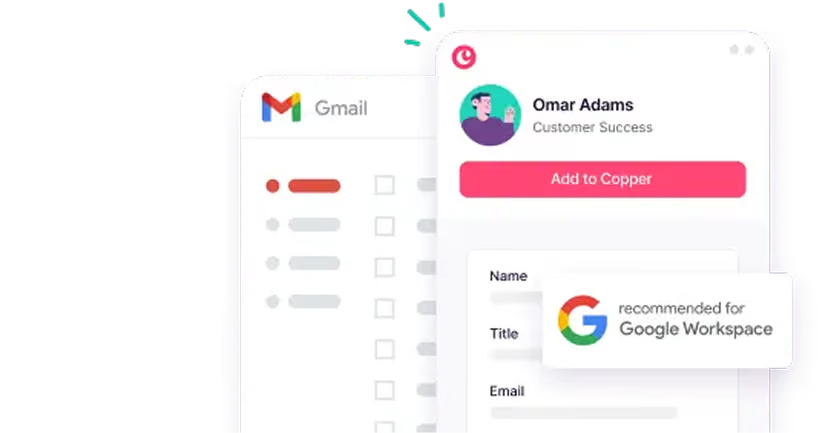
Copper was built for small businesses that want powerful lead management in CRM features without the overwhelming complexity. It works directly inside Google Workspace, so your emails, meetings, contact information, and pipelines stay connected in the tools your team already uses every day.
That means less time digging through tabs and updating records, and more time nurturing leads, building trust, and actually moving deals forward.
Because great sales isn’t about managing spreadsheets. It’s about building relationships.
If you want a simpler, more relationship-focused way to streamline your sales process, try Copper for 14 days free.