










UniVicoustic (formerly Vicoustic) has built its name on one thing: making sound better inside a space. From recording studios and auditoriums to open-plan offices and restaurants, their acoustic solutions are designed to improve how people experience sound.
As a global manufacturer based in Portugal, they work with architects, designers, and commercial teams across multiple markets. And they do it sustainably, too, transforming plastic waste into acoustic panels that last for decades.
But while they were refining sound for their customers, internally, things weren’t nearly as smooth. Their CRM was getting in the way.
Their CRM felt more like a system to maintain than a tool to use
For four to five years, UniVicoustic used Salesforce Enterprise. It had the power, but it also came with a level of complexity that didn’t match how the team actually worked.
Every update felt heavy. Every improvement required time, budget, or outside help. Even simple adjustments turned into projects.
“Cost was just getting to a point where we felt that this wasn't really making sense for the way we used Salesforce,” says Per Larsen, Vice President of Commercial Operations.
And that friction didn’t just stay at the leadership level. It showed up in how the team interacted with the CRM every day.
“It always felt with the commercial team that it was more of a must to fill out all these things and keep everything updated,” Larsen said.
And that’s the moment a CRM starts losing its value: When it becomes something you maintain instead of something you rely on, adoption drops. Automation gets ignored. And the system ends up sitting beside the work instead of supporting it.
They knew productivity had to improve before anything else
At the same time, UniVicoustic wasn’t rushing into a change. They were watching how AI was evolving in the CRM space and asking themselves if it made sense to wait. But the more they looked at their current setup, the clearer it became that waiting wouldn’t solve their immediate challenges.
“The number one criteria was to increase productivity for both our commercial team and also our marketing team,” Larsen said.
They didn’t need more features or complexity, just something their team would actually use for work.
Copper fit into how they already worked instead of forcing change
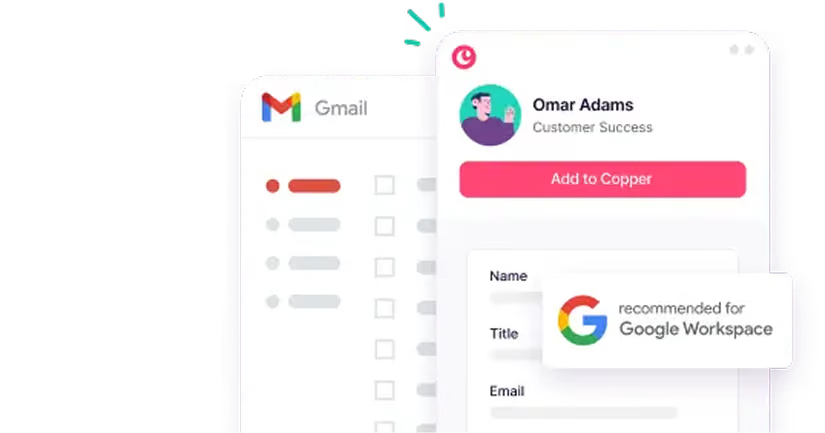
Copper stood out quickly, especially because UniVicoustic already runs entirely on Google Workspace.
That meant no disruption, no clunky integrations, and no need to rebuild workflows from scratch. It fit into what they were already doing. And the buying experience reinforced that feeling.
“There was very little of the normal ‘sales talk’” says Larsen. “It was very much focused on the solution and how ‘we can help you get what you want,’” Larsen said.
That clarity made the decision easier. And once they made the switch, the onboarding process followed the same pattern — smooth, straightforward, and faster than expected.
They built a system that reflects how their business actually operates
One of the biggest differences with Copper is how flexible it is in practice. UniVicoustic didn’t have to force their processes into a rigid system. Instead, they shaped Copper around how their business actually works.
Today, they use around eight to ten Copper licenses across the company. The core users are their commercial team — six people plus Larsen — with additional shared access for marketing and a dedicated seat for their quality department to support processes and internal improvements.
It’s not a massive rollout. It’s a focused one. And that’s part of why it works.
1. They use multiple pipelines to match different workflows
Their business isn’t one-size-fits-all, so their CRM isn’t either. They’ve built several pipelines to reflect different types of work, including general sales, large architectural projects, and marketing activities.
“Today, I think we have five or six different pipelines,” Larsen said.
That’s a big shift from their previous setup. Now, each team can manage work in a way that actually fits what they’re doing.
2. They use opportunities to stay on top of complex B2B sales
UniVicoustic operates in a layered sales environment. They sell through distributors and resellers while also marketing directly to end clients.
Copper’s opportunity tracking gives them visibility into each stage of the process, helping the team stay aligned without losing track of what’s happening.
3. Tasks help the team plan their day instead of just track data
This is where the shift becomes really noticeable. Instead of using the CRM just to log information, the team uses Copper’s task manager to organize their day-to-day work.
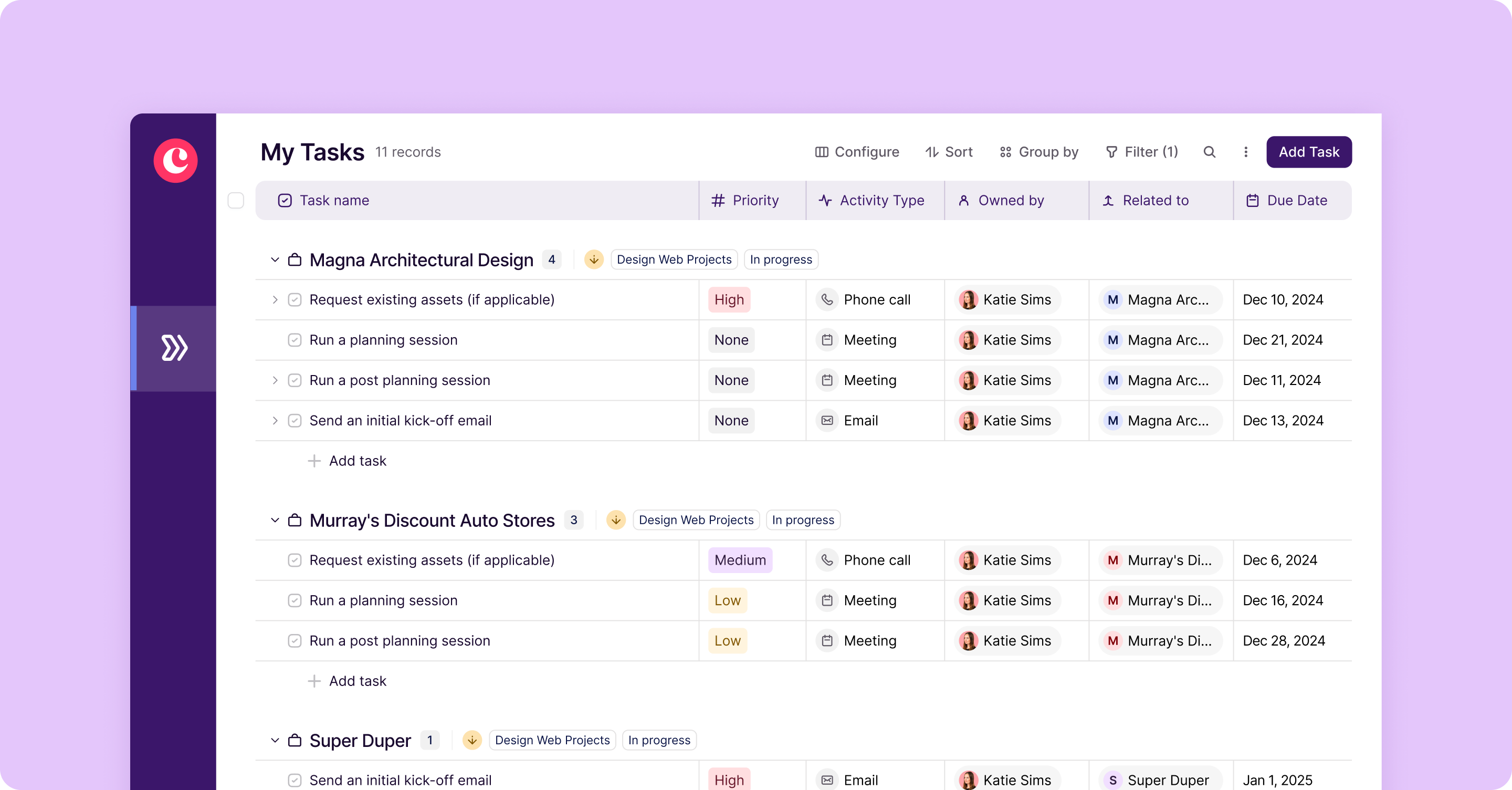
“People are good with both using the pipelines and opportunities, but also using the tasks and really using the task manager as a way of helping you to plan,” Larsen said.
That’s the difference between a CRM that stores information and one that actively supports how work gets done.
4. Pipeline email automations reduce manual follow-up
With leads coming in from multiple sources, including their website and e-commerce platform, keeping everything organized is critical.
Copper helps them centralize customer data so their team always has context, without digging or piecing things together.
As UniVicoustic expands into B2C, they’ve started using pipeline email automations to streamline communication.
When a customer places an order via Shopify, data flows into Copper through Zapier and triggers follow-up emails automatically. It’s a simple setup that saves time and ensures consistency.
The biggest change was how the team feels using the CRM
After just a few months, the impact was clear.
“We are so much more productive today after just a few months compared to how we used Salesforce,” Larsen said. But what stood out even more wasn’t just productivity. “It’s a tool that also increases the joy of the team members to do their work.”
That’s not something you hear often about a CRM. And it comes down to one simple shift.
“Instead of a must, it becomes a tool which is actually usable for me,” Larsen said.
When your CRM finally clicks, everything else moves faster
There’s a point where a tool stops being something your team tolerates and starts being something they rely on. That’s what UniVicoustic found with Copper.
Not because it added more complexity, but because it removed it.
When your pipelines reflect how your business actually runs, when your automations quietly handle the repetitive stuff, and when your CRM lives inside the tools you already use (hi, Google Workspace), work just… flows better.
And that’s the real takeaway here. You don’t need a heavier system. You need one your team will actually use.
If your current CRM feels more like a chore than a shortcut, it might be time to try something different.
You can start with Copper for free. Take it for a spin for 14 days and see what it feels like when your CRM actually helps you get work done.