












Buying a customer relationship management (CRM) platform is easy. Justifying it? That’s where things get interesting.
Whether you’re running a 10-person agency or scaling a professional services firm, sooner or later someone asks the question: “Is this actually worth what we’re paying for it?”
That’s why understanding how to track or calculate return on investment (ROI) of a CRM isn’t optional. It’s strategic. It’s financial. And frankly, it’s how you protect your budget. The good news? You don’t need a finance degree or a 40-tab spreadsheet to do it right.
In this guide, we’ll walk through:
- What CRM ROI actually means
- A step-by-step framework for how to track/calculate ROI of CRM
- The revenue drivers that increase return
- Practical ways to improve CRM ROI quickly
- Tracking ROI faster with automation
By the end, you’ll have a clear model you can use internally — and defend confidently.
What is CRM return on investment
CRM return on investment (ROI) sounds like something your finance team would put in a slide deck with a lot of tiny numbers.
But really? It’s much simpler than that.
CRM ROI measures the financial value your CRM generates compared to what it costs you to run it. That’s it. It answers one very practical question:
Is this thing actually paying for itself?
At its simplest, ROI tells you whether your CRM covers its own cost — and how much value it creates beyond that. When people search for how to track/calculate ROI of a CRM, they’re usually not looking for a textbook definition. They’re trying to settle a real-world debate:
- Is our CRM worth renewing?
- Should we double down and invest more deeply in it?
- How do we prove its value to leadership without hand-waving?
These are totally fair questions. But, to answer them, you need to understand what actually goes into CRM ROI.
Ultimately, it comes down to two big buckets: money you make and money you save.
First, revenue gains. This is where your CRM helps you sell smarter and keep clients longer. Think:
- Higher close rates because no leads fall through the cracks
- Larger average deal sizes because you can see expansion opportunities
- Faster sales cycles thanks to clear, customizable Pipelines
- Improved retention because communication history is centralized and proactive
Then there are the cost savings. This includes:
- Reduced administrative time from automatic email and activity logging
- Fewer overlapping software tools because your CRM integrates with hundreds of other apps
- Less manual reporting thanks to live dashboards
- Fewer errors and escalations because everyone sees the same client history
Now, compare those total benefits to what your CRM actually costs you:
- Subscription fees
- Implementation and onboarding
- Training time
- Ongoing administration and maintenance
That’s the heart of how to track/calculate the ROI of a CRM. If your benefits exceed your costs, you’ve got positive ROI. If they significantly exceed your costs, your CRM isn’t just “software” anymore. Then, it’s a growth engine.
And that’s a very different conversation in your next budget meeting.
Why CRM ROI matters to service businesses
Service businesses operate differently than product companies: You’re managing relationship-based selling, multi-touch buying cycles, retainers, renewals, and expansion opportunities. Your CRM doesn’t just influence sales, it impacts operations, delivery, forecasting, and client experience.
Understanding how to track/calculate ROI of CRM helps you:
- Justify budget to leadership
- Secure funding for improvements
- Identify underused features
- Align sales and marketing processes
- Improve forecasting accuracy
And here’s the key: measuring ROI doesn’t just prove value. It improves value.
When you analyze what’s driving results (like customizable Pipelines, Pipeline email automations triggered by stage changes, website forms that automatically sort inquiries, and seamless Google Workspace integration), you uncover optimization opportunities.
Step-by-step formula to calculate ROI for CRM
Here’s the foundational formula: ROI = (Benefits – Costs) / Costs.
Let’s walk through exactly how to track/calculate ROI of CRM in a structured, business-ready way.
1. Identify your timeframe and baseline
Start with a measurement window (typically 12 months).
Then establish baseline metrics from before implementing or optimizing your CRM:
- Close rate
- Average deal size
- Revenue per rep
- Sales cycle length
- Retention rate
- Hours spent on admin
Without a baseline, you’re guessing. With a baseline, you’re measuring incremental improvement — which is the core of how to figure out your ROI calculation accurately.
2. Capture incremental revenue gains
Now identify revenue improvements directly influenced by your CRM.
Look for measurable changes in:
- Close rate increases
- Deal size growth
- Faster deal velocity
- Repeat and upsell revenue
- Retention improvements
For example, if your close rate improves from 22% to 26% after implementing structured Pipelines and automated follow-ups, that incremental lift translates into significant annual revenue.
Website forms that automatically route leads ensure faster response times. Stage-based automations prevent stalled deals. Clear Pipeline ownership improves accountability.
These changes drive real, measurable revenue — which becomes the “Benefits” side of how to track/calculate ROI of CRM.
3. Quantify cost savings from efficiency
Revenue gets attention. Efficiency protects margin.
Measure:
- Time saved from automatic email logging
- Hours reduced in reporting
- Tools eliminated due to CRM consolidation
- Fewer customer service escalations
When your CRM integrates seamlessly with Google Workspace, reps stop manually logging every interaction.
If each rep saves 4 hours per week and you have 10 reps, that’s roughly 2,000 hours annually.
Convert those hours into salary value and now you’re not estimating ROI — you’re calculating it.
4. Add up total CRM investment
Now calculate your true CRM cost. Include:
- Annual subscription fees
- Implementation costs
- Data migration
- Onboarding and training time
- Admin or system management time
- Customization or integration costs
Be realistic. Underestimating costs weakens credibility when presenting ROI findings.
Related: CRM data migration: What are the best practices for a clean database?
5. Apply the ROI formula
This is the moment of truth. You’ve done the math on benefits and costs. Now let’s plug in the numbers and calculate how to track/calculate ROI of CRM in real dollars.
Your total CRM system cost should account for:
- Annual subscription fees
- Implementation and onboarding
- Data migration
- Internal training time
- Ongoing admin management
- Integrations and customizations
Clean accounting builds trust. If you gloss over costs, finance will discount your entire ROI argument.
For example:
Annual revenue gains: $450,000
Annual cost savings: $75,000
Total benefits: $525,000
Annual CRM cost: $150,000
ROI = (525,000 – 150,000) / 150,000
ROI = 375,000 / 150,000
ROI = 2.5
That’s a 250% return!
6. Validate assumptions with stakeholders
Before you present this to leadership, pressure-test it.
Review your inputs with:
- Sales leadership
- Marketing
- Finance
- Operations
Alignment strengthens credibility. It also ensures everyone agrees on how CRM performance will be measured going forward.
Because CRM ROI isn’t just about proving value once.
It’s about building a repeatable system for tracking impact year after year.
Revenue gains that drive CRM ROI
If you want to understand how to track/calculate ROI of CRM, start here: Revenue growth doesn’t happen by accident. It happens when your team has structure.
CRM implementation isn’t just setting up software. It’s setting up better habits. When your system makes it easier to follow up, stay organized, and see opportunities clearly, revenue follows.
Here are the main revenue drivers your CRM should improve — and the ones you should measure.
1. Higher close rates
Most service businesses don’t struggle with getting leads.
They struggle with following up.
Without a clear system:
- Leads sit in inboxes.
- Emails get missed.
- No one knows who owns the deal.
- Opportunities slowly fade away.
A strong CRM implementation fixes this fast.
Customizable Pipelines create clarity. Every deal has a stage. Every stage has an owner. Everyone knows what happens next.
Pipeline email automations triggered by stage changes make sure follow-up actually happens. Website forms automatically send new inquiries to the right rep, so no one waits days for a response.
And here’s why this matters when you track/calculate ROI of CRM:
Even a small increase in close rate can add serious revenue over a year. A few more deals per month adds up quickly.
Higher close rates are one of the clearest ways to prove CRM ROI.
2. Larger average deal size
Deals get bigger when your team has full visibility. When your CRM stores past projects, proposals, notes, and email history in one place, it becomes easier to spot new opportunities.
Without that visibility, upsells happen by chance.
With it, upsells happen on purpose.
Your team can see:
- What the client already bought
- What they asked about before
- Where they might need more support
Growing deal size often improves ROI faster than chasing more leads. You’re building on relationships you already have.
If you want to track/calculate ROI of CRM accurately, measuring average deal size growth is essential.
3. Repeat and upsell revenue
Winning a new client takes time and money.
Keeping and growing that client is where profit really improves.
With seamless Google Workspace integration, every Gmail conversation and calendar meeting syncs automatically into your CRM. Nothing gets lost. No one has to dig through inboxes for context.
That makes it easier to:
- Start renewal conversations early
- Suggest additional services at the right time
- Stay consistent with outreach
This kind of steady follow-up improves repeat revenue and upsells — both of which should be included when you track/calculate ROI of CRM.
If you only measure new sales, you’re missing half the story.
4. Improved customer retention
Retention may be the strongest long-term driver of CRM ROI.
Clients rarely leave because of one big mistake. More often, they leave because of slow responses, confusion, or feeling ignored.
A well-planned CRM implementation creates:
- Clear account ownership
- Shared communication history
- Easy access to contract details
When everyone can see the full picture, mistakes decrease and clients feel supported.
Even small improvements in retention can greatly increase lifetime value — especially for service businesses that rely on retainers.
If you want a complete view of how to track/calculate ROI of CRM, retention must be part of your numbers.
Because keeping clients is often more profitable than finding new ones.Cost savings that boost ROI in CRM
Revenue increases are powerful. Cost reductions stabilize profitability.
Operational gains compound quietly over time.
5. Reduced manual data entry
No one joins a sales team because they love typing notes into a system. Manual CRM updates eat up hours and slowly drain morale. A strong CRM system changes that.
With seamless Google Workspace integration, contacts, emails, and calendar activities log automatically. Your team doesn’t have to copy and paste information after every call.
- Less typing.
- Fewer mistakes.
- More time selling.
If each rep saves just a few hours per week, that adds up fast across an entire team. Over a year, those saved hours equal real payroll value.
Time saved isn’t just a nice benefit. It’s measurable cost savings — and it belongs in your ROI calculation.
6. Lower software redundancy
If your team uses one tool for email tracking, another for reporting, and another for contact management, you’re paying for overlap.
CRMs that integrate with hundreds of apps help reduce that tool sprawl.
Instead of juggling disconnected systems, everything works together inside one platform — from website form routing to Pipeline tracking to reporting.
Fewer subscriptions.
Fewer systems to manage.
Less confusion about where data lives.
When you track/calculate ROI of CRM, reducing software costs should be part of the equation. Cutting unnecessary tools directly improves your return.
7. Less time spent on reporting
Reporting shouldn’t feel like a monthly cleanup project.
With live dashboards, your Pipeline metrics update automatically. Forecasts stay current. Leaders can see performance at any time without waiting for someone to build a report.
No more spreadsheet chaos.
No more outdated numbers.
No more last-minute scrambles before meetings.
Time saved equals money saved — and better visibility often improves performance, too.
If you want to track/calculate ROI of CRM accurately, include reporting time savings in your model.
8. Fewer customer service escalations
Many customer issues start with simple miscommunication. When client history is scattered across inboxes and documents, details get missed. A well-implemented CRM gives everyone shared visibility into:
- Past conversations
- Agreements and contract terms
- Project history
When the full picture is easy to access, misunderstandings decrease.
Fewer escalations mean:
- Less time spent fixing preventable problems
- Lower support costs
- Stronger client trust
- And stronger retention
Because ROI isn’t just about earning more, it’s also about protecting what you’ve already built.
Five ways to improve CRM and ROI fast
If your ROI isn’t where you want it to be, the answer usually isn’t a better spreadsheet: iIt’s a better system.
Here are five practical ways to make that happen.
1. Increase user adoption with clear guidance
A CRM can’t deliver results if people aren’t using it consistently.
Strong CRM implementation starts with clear Pipeline stages, shared definitions, and simple rules everyone understands. Your team should know what each stage means, when a deal should move forward, and what information needs to be logged.
In-app coaching, repeatable onboarding, and short refresher trainings help turn the CRM into part of your team’s routine instead of something they avoid.
Usage drives insight, and insight drives ROI.
2. Automate data capture from email and calendar
If your team has to manually log every email and meeting, they won’t do it consistently.
That’s where seamless Google Workspace integration makes a real difference. When Gmail conversations and calendar events sync automatically, your CRM stays up to date without extra effort.
Automatic syncing reduces mistakes, fills in gaps, and keeps records complete. It also removes friction, which makes adoption easier.
The more accurate your data is, the easier it is to track/calculate ROI of CRM without guessing.
3. Build dashboards that show what actually matters
If your CRM is full of data but no one looks at it, you’re missing the point.
Create dashboards that focus on actionable KPIs like:
- Pipeline velocity
- Stage conversion rates
- Average deal size trends
- Retention metrics
When leaders and reps can see performance clearly, accountability increases. When accountability increases, results improve.
Clear visibility also makes it easier to track/calculate ROI of CRM because you’re measuring progress in real time instead of trying to piece it together later.
4. Align sales and marketing processes
ROI improves when your teams stop operating in silos.
Use CRM workflows to manage lead handoffs and lifecycle stages so nothing slips through the cracks. Make sure website forms route inquiries to the right people. Align qualification criteria so sales isn’t chasing leads that were never a fit.
When sales and marketing share the same definitions and process, conversion rates improve and reporting becomes more reliable.
That alignment strengthens performance and makes how you track/calculate ROI of CRM much clearer.
5. Review ROI metrics quarterly and adjust
You can’t calculate ROI once and assume it’ll stay accurate forever.
Revisit how you track/calculate ROI of CRM every quarter. Review your assumptions. Look at revenue changes, cost savings, and retention trends. Identify what’s working and where workflows can improve.
As your team grows and your processes evolve, your CRM setup should evolve with it.
When measurement becomes a habit instead of a one-time task, ROI becomes easier to improve year after year.
Track ROI faster with smart automation
The faster your CRM captures clean, accurate data, the easier it is to track/calculate ROI of CRM without chasing numbers at the end of the quarter.
Smart automations — like the ones in Copper CRM — keep your system up to date in the background. Real-time dashboards make performance visible while your team is still working deals, not weeks after the fact. That combination shortens the gap between action and insight, which makes improving ROI much faster.
Automate data capture from email and calendar
Manual data entry slows teams down and creates gaps in reporting.
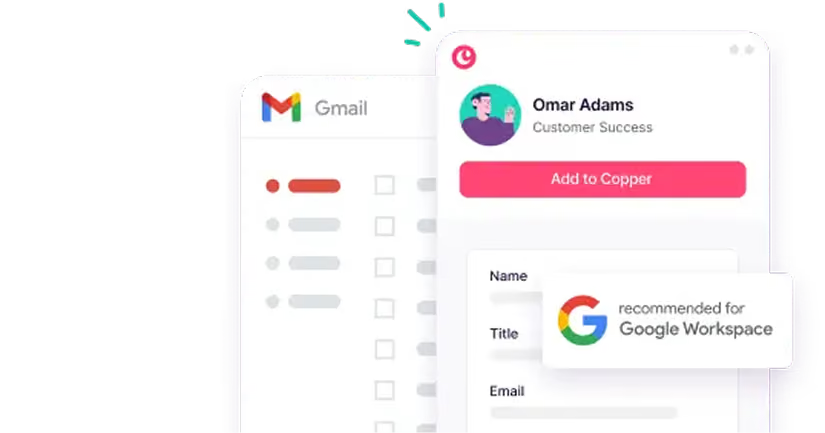
With seamless Google Workspace integration, contacts are created automatically, emails sync instantly, and meetings log themselves to the right records. Your team doesn’t have to stop selling to update the system.
That time savings adds up quickly across a full team, and it keeps your data accurate. When your data is accurate, it becomes much easier to track/calculate ROI of CRM without second-guessing the numbers.
Build live dashboards that show real results
If ROI lives in a spreadsheet no one opens, it won’t drive decisions.
Live dashboards make performance easy to understand at a glance. Close rates, deal size trends, pipeline velocity, and retention metrics update in real time, so leaders always know where things stand.
When ROI metrics are simple to read and easy to share, your team can act on them quickly instead of reacting months later.
Create team-wide transparency
ROI improves when everyone can see the same numbers. Shared dashboards and clear reporting create transparency across sales, marketing, and leadership. Reps understand expectations. Managers spot trends early. Leaders see progress without asking for manual reports.
Make ROI part of how you operate
ROI shouldn’t feel like a finance exercise you dread every quarter. It should feel like a natural result of how your team works every day.
When your CRM logs activity automatically, keeps Pipelines moving, and shows live dashboards your team actually checks, performance becomes visible without extra effort. That kind of visibility builds momentum. Reps know where they stand. Managers can spot trends early. Leaders can make faster decisions with confidence.
If you want a CRM that works inside Google Workspace, keeps your data clean, and makes automation feel simple, Copper’s worth a look. (You can even try it for 14 days free!).
Because, when your system fits the way your team already works, tracking and improving ROI doesn’t feel complicated. It just makes sense.