










You've got a proposal out, three active client projects running, a follow-up you keep forgetting to send, and a team that swears they checked in with that account last week (but can't prove it). So you start googling tools. And very quickly you end up in a weird rabbit hole comparing CRM vs project management software, wondering if these two things are the same, different, both, or neither.
Here's the short answer: they're different tools built for different jobs. But for a lot of professional services teams, the real answer is even more useful than that.
Key differences between a CRM and a project management tool
Before we get into which one is right for your business, it helps to understand what each tool actually does (and who it was built for in the first place).
A CRM handles everything before and around the sale. A project management tool handles everything after it.
Who each tool is built for
A customer relationship management (CRM) platform is designed for the people managing client relationships (think sales reps, account managers, business development leads, anyone whose job is to get and keep clients happy). It's built around lead generation and relationship management at its core, with data-driven insights baked right in so you know exactly where every client and deal stands.
A project management tool, on the other hand, is built for the people managing work output, like project managers, operations teams, internal delivery teams. It comes with its own set of collaboration tools, but the focus is getting things done and making sure the right people are doing the right things by the right deadline.
Same team, different jobs. That's why a lot of businesses end up with both.What each tool tracks
When you're comparing CRM vs project management functionality, the clearest difference shows up in what each tool actually captures day to day.
A CRM tracks:
- Contact details and relationship history: Who you've talked to, when, and what was said
- Conversations and communication: Emails, calls, and meetings logged against the right contact or deal
- Deal stages and sales pipeline: Where each opportunity is in the process
- Client history: The full context behind every relationship, from first touch to current status
- Tasks and follow-ups: Reminders and next steps tied to specific contacts or deals
- Notes and file attachments: Context and documents living right on the client record
A project management tool tracks:
- Task management and deadlines: Who's doing what and when it's due
- Assignees and ownership: Clear accountability across the team
- Project milestones: The bigger checkpoints that tell you if delivery is on track
- Resource allocation: Who has bandwidth and who's maxed out
- Notes and file attachments: Project docs, briefs, and updates in one place
- Team communication: Comments, mentions, and status updates on active work
While they have different data and a different purpose, ultimately both matter when it comes to your business, and ultimately your customer experience.
Where CRMs and project management tools overlap
If you've been staring at both options thinking "wait… aren't these kind of the same thing?" Honestly, fair. The overlap is real.
Both tools can do task tracking, notes, team collaboration, file storage. A CRM might let you assign follow-up tasks. A project management tool might let you log client info. It's genuinely confusing in the middle, and no, you're not missing something obvious.
But here's the thing: similar features don't make them the same tool. The purpose is completely different, even when the functionality looks identical on the surface.
- CRM software is built around lead management and the full customer journey (basically, everything that happens before and during the relationship).
- Project management tools are built around getting the actual work done.
Same feature set, totally different jobs.
And for most professional services teams? Those two phases aren't even cleanly separated.
It's one continuous experience for you and your client, which means the customer experience suffers the second these tools stop talking to each other. Marketing automation falls flat, follow-ups slip, and customer satisfaction takes the hit. So trying to cover both with two disconnected tools that don't talk to each other is, predictably, kind of a nightmare.
Related: Torn between HubSpot and Copper? Here's an honest breakdown of when each one makes sense.
When a CRM is the right choice for your business
If your business is fundamentally about relationships, having CRM software isn't optional — it's foundational.
A CRM is the right starting point when:
- Your work is relationship-driven: Consulting, coaching, agencies, professional services — if you win and keep clients based on how well you know them and communicate with them, a CRM is the engine that makes that scalable.
- You need visibility across email, calls, and meetings: Without a CRM, that customer data and context lives in individual inboxes and fades fast. With one, it's all in one place and accessible to everyone who needs it.
- You want a real pipeline, not a spreadsheet: Knowing where every deal is, what's been said, and what needs to happen next is the difference between growing intentionally and hoping for the best.
- Follow-ups keep slipping: If potential clients are going cold because nobody sent the fifth email, that's a CRM problem — not a people problem.
For small professional services teams especially, a CRM pays for itself pretty fast just by not letting warm relationships go cold and by providing the tools for customer satisfaction.
When a project management tool is the right choice
There are absolutely situations where a project management tool is the right call.
A project management tool makes sense when:
- You manage complex, multi-phase projects: If your delivery involves a lot of tasks that build on each other across a long timeline (think: multiple workstreams, a big team, a lot of moving parts), you need a tool that's actually built for that.
- Multiple team members collaborate on deliverables: When handoffs happen constantly between people and departments, a shared task board is what keeps everyone aligned (and stops things from falling into a black hole).
- Your main challenge is internal coordination: If the real problem is "who's working on what" more than "who talked to the client last," a project management tool is solving the right pain.
- You need serious task tracking with deadlines and dependencies: Some workflows need way more control over sequencing and blockers (a basic task list is just not going to cut it here).
But here's the honest truth for most professional services businesses: the project management problem is secondary. You don't have a delivery coordination crisis. You have a client relationship visibility gap (leads going cold, context getting lost, follow-ups that nobody sent because nobody knew they were supposed to).
Jumping straight to a project management tool means solving the wrong problem first... and still wondering why clients are slipping away.
Benefits of combining CRM and project management in one tool
What if you just... didn't have to choose?
Some tools (nudge, nudge, we're talking about Copper CRM here) give you both. And for professional services teams, that's not just a convenience thing. It genuinely changes how your whole operation runs, from lead management all the way through project planning and beyond.
That's the real win here: a combined tool follows the entire customer journey, not just one slice of it. Lead management lives right next to project planning, so nothing gets lost in the gap between landing a client and actually doing the work for them.
Fewer tools and lower software costs
Every tool you bolt onto your stack costs money, takes forever to learn, and creates one more login someone will absolutely forget at the worst possible moment. Keeping CRM and project management under one roof means fewer bills, way less tab-switching, and an actually painless "here's what we use" conversation when someone new joins the team. Bonus: it sets you up for real scalability, because you're not adding a third or fourth tool every single time the business grows.
Smoother handoffs from sales to delivery
You know that moment when a deal closes and the delivery team has zero idea what was promised, what the client cares about, or why they even signed in the first place? Brutal.
When CRM and project management live together, all of that context (every email, every meeting note, every "the client mentioned they hate Tuesdays" detail) travels with the project automatically. With Copper's Pipelines, a deal moves straight from an Opportunity Pipeline into a Project Pipeline without anyone copy-pasting a single note. The kickoff call starts from a place of actually knowing the client, not scrambling to catch up. Your customer success team walks in already in the loop, instead of starting from scratch.
One source of truth for client and project data
When everyone on the team (whether they're selling or delivering) sees the same client history and the same project status, the "wait, what did we agree to?" conversations just... stop happening.
The account manager knows exactly where the project stands. The project manager knows the full relationship history. Nobody's working off a different version of reality. Even your email marketing gets sharper, since outreach is grounded in real project status instead of someone's best guess.
Better collaboration across your team
Sales and delivery teams naturally end up in their own little silos when their tools don't talk to each other. One team lives in the CRM, the other lives in the project tool, and important context gets lost every single time something moves between them.
When both live in the same place, that gap just disappears. No more "can you forward me that email thread?" No more re-explaining the client's whole backstory from scratch. Copper's email automations keep follow-ups running quietly in the background, so nothing slips through while a deal hands off from one team to the next. And when everyone's working off the same info, customer retention gets a whole lot easier, because nobody's out here trying to build relationships in a vacuum.
Related: Need more collaboration tips for your team when using Google Docs?
Manage clients and projects in one place with Copper
Here's the honest truth: stitching together a CRM and a separate project tool and hoping they talk to each other is a recipe for dropped context, frustrated teams, and clients who feel like nobody knows what's going on. (You've probably been there and it's not fun).
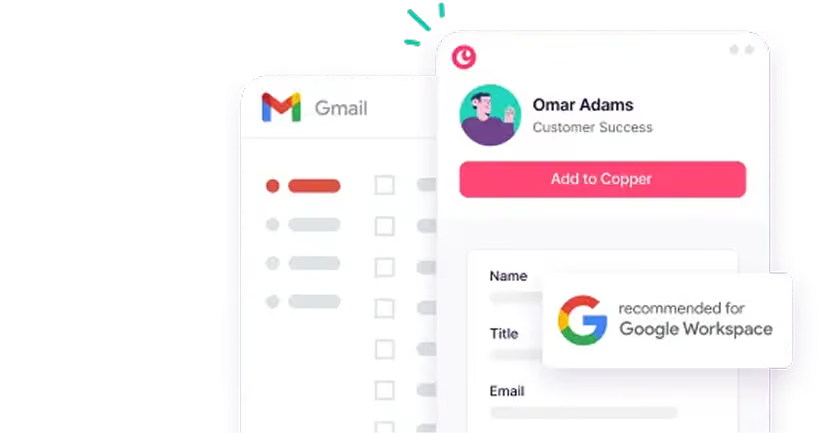
Copper is a CRM built specifically for professional services teams who live in Google Workspace — and it's the only CRM with Recommended for Google Workspace status. That means it shows up right inside Gmail, syncs with your Calendar, and fits into the way your team already works (no new logins, no new habits, no "okay everyone we're switching tools again" energy).
With Copper, you get Opportunity Pipelines for managing deals before they close and Project Pipelines for managing everything after — both linked to the same client record, in the same place. The context travels with the client. The handoff is smooth. And the whole CRM vs project management debate just... resolves itself.
For relationship-driven businesses, it was never supposed to be either/or.
If your team is tired of playing telephone between two tools, or simply can’t decide which one to get, stop deciding… try Copper free for 14 days instead (did we mention no credit card needed, and you'll be set up in days, not months?!).