











Attio promised flexibility, and it delivered. But somewhere between customizing your fifteenth field and waiting for that integration to sync, you started wondering if there's a simpler way.
Because for a lot of teams, the issue isn’t whether a CRM can do something — it’s how much time you have to spend configuring, maintaining, and explaining it before anyone actually uses it consistently. A powerful CRM should help your team move faster, not quietly become another operational project sitting on someone’s plate.
This guide breaks down five Attio alternatives that offer faster setup, tighter integrations, and workflows that don't require a dedicated admin to maintain.
Key Takeaways
- Teams leave Attio due to configuration overhead, limited integration depth, and scaling costs: Smaller teams often want CRMs that work on day one without dedicated admin time.
- Copper is the only CRM "Recommended for Google Workspace" status: It combines CRM with project management directly inside Gmail, Calendar, and Drive for agencies and consultants.
- Sales reps lose time to manual CRM data entry: Native integrations that reduce tab-switching and automate logging deliver measurable productivity gains.
- CRM adoption depends more on ease of use than feature count: 38% of CRM challenges stem from people issues like slow adoption, making trial testing with your actual team essential before committing.
Why teams are looking for an Attio alternative
The top Attio alternatives in 2026 are Copper for Google Workspace users, Folk for relationship-focused teams, HubSpot for scaling businesses, Pipedrive for visual pipeline management, and Streak for simple Gmail-based tracking. Teams typically move away from Attio when they want deeper integrations, faster setup, or built-in project management.
Attio is a modern, data-driven CRM built around customization. You can shape it into almost anything, which appeals to teams with specific workflows and the time to configure them. But that flexibility comes with a tradeoff: setup takes effort, and not every team has the bandwidth for it.
So what pushes people to look elsewhere?
- Configuration overhead: Attio's open-ended design means you're building your own system from scratch. Smaller teams often want something that works on day one.
- Integration depth: Attio connects to plenty of tools, but teams who live in Google Workspace sometimes find the connection isn't as tight as they'd like.
- Cost as you grow: Pricing can climb quickly once you add users and unlock advanced features.
- Onboarding time: Without a dedicated admin, getting Attio set up the way you want can take longer than expected.
If any of that sounds familiar, you're in good company. Let's walk through five alternatives worth considering.
The 5 best Attio alternatives for sales and client management
Copper
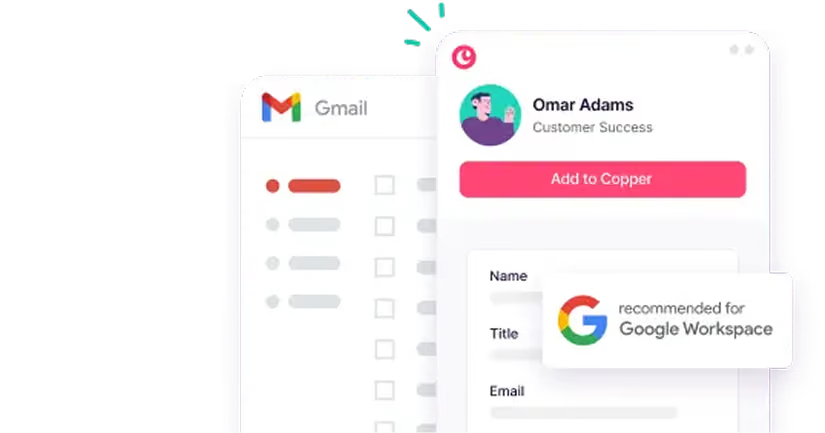
Copper is the only CRM that's a Recommended for Google Workspace app. It shows up directly inside Gmail, Calendar, and Drive, so you're not bouncing between tabs to log a call or update a deal.
For agencies, consulting and advisory firms, and professional services teams, Copper does something most CRMs skip: it includes project management. That means you can track a client from the first conversation through project delivery without bolting on extra tools.
- Best for: Teams that live in Google Workspace and handle both sales and ongoing client work.
- Pros: Contacts and activities log automatically, projects live alongside deals, everything stays in Gmail.
- Cons: Built specifically for Google Workspace, so Microsoft 365 teams won't get the same experience.
If your inbox is where real work happens, Copper fits into that rhythm by helping you build stronger client relationships instead of pulling you out of the flow.
Bajillion Agency, a full-service marketing agency, put this to the test when they moved into the Google Workspace environment and went looking for a CRM that could keep up. According to founder Jarrod Guth, while legacy CRM systems took up to two weeks to get running, implementing Copper took less than a day.
The team mapped their entire 13-step business process into Copper pipeline stages, with automated tasks triggered at each stage to assign follow-ups and send reminder emails — so no one has to manually chase their colleagues to move a deal forward.
"We no longer need to constantly remind each other to follow up with clients," Guth says. The result? At least a couple of hours saved per week, and cleaner data than they'd ever had before.
"Contacts are set up in such a way that I never have to clean data like I was doing with some of the other CRMs in the past.”
Folk
Folk approaches CRM differently. Instead of centering everything on sales pipelines, it's built around relationships. Think investors, partners, collaborators, or anyone you want to stay connected with over time.
The interface is clean and collaborative. Teams can share contacts, add notes, and stay aligned without stepping on each other's toes. folk also enriches contacts automatically, filling in job titles and company details so you don't have to.
- Best for: Teams focused on partnerships, fundraising, or networking rather than traditional deal flow.
- Pros: Simple to set up, strong LinkedIn integration, designed for collaboration.
- Cons: Limited reporting and no real project management features.
Folk works well when the relationship itself is the goal, not just a step toward closing a sale.
HubSpot
HubSpot combines sales, marketing, and service tools into one platform. It's a popular choice for teams that want everything under one roof and plan to grow into more advanced features over time.
The free tier is genuinely useful. You get core CRM functionality without paying anything, which makes it easy to start. However, once you want automation, custom reporting, or advanced workflows, costs rise quickly.
- Best for: Growing teams that want sales and marketing working together in one system.
- Pros: Generous free plan, marketing automation, lots of integrations.
- Cons: Gets expensive as you scale, and smaller teams may find the learning curve steep.
HubSpot makes sense if you're planning for growth and want a platform that can expand alongside your team.
Pipedrive
Pipedrive is built for salespeople who think visually. The drag-and-drop pipeline makes it easy to see where every deal stands and what needs attention next.
The mobile app is solid, which matters if your team spends time on the road. Pipedrive focuses on the sales process itself: moving deals forward, forecasting revenue, and keeping reps accountable.
- Best for: Sales-driven teams that want clear pipeline visibility and deal tracking.
- Pros: Intuitive visual interface, good mobile experience, strong integrations.
- Cons: No built-in project management, and Google Workspace integration isn't as deep as dedicated tools.
If your main goal is closing deals and you want a clear view of your pipeline at all times, Pipedrive delivers on that.
Streak
Streak takes a very different approach to CRM software: instead of pulling you into another platform, it turns Gmail itself into your workspace.
There’s no separate dashboard to learn and no constant tab-switching. Your inbox is the CRM. You can track deals, organize pipelines, manage email sequences, and keep customer conversations moving without ever leaving Gmail.
For freelancers, solopreneurs, and small teams, that simplicity is a huge selling point.
Sometimes you don’t need a deeply customized sales machine, you just need a cleaner way to stay on top of conversations and follow-ups.
- Best for: Individuals or small teams that want lightweight CRM functionality inside Gmail.
- Pros: Fast setup, minimal learning curve, native Gmail experience, free plan available.
- Cons: Limited functionality beyond email management, fewer advanced automation features, no built-in project management.
Streak works especially well if you’re new to CRM software or tired of platforms that feel overloaded from day one. But as your sales process grows more layered (think: multiple pipelines, reporting needs, or cross-functional collaboration) you may eventually hit its limits.
How to choose the right Attio alternative for your team
1. Map your client and sales workflow
Before you compare features, pricing, or shiny automation demos, ask yourself one thing: what does your team actually need to manage every day?
Because there’s a big difference between “we need somewhere to track deals” and “we need to manage the entire client relationship after the contract is signed.”
If your work ends when the deal closes, a lightweight sales CRM might be perfect. But if your team immediately shifts into onboarding, project delivery, approvals, client communication, and ongoing account management? That’s where a lot of CRMs start showing cracks fast.
Agencies, consultants, and service-based businesses usually need more than a pipeline. They need a system that can handle both winning the work and managing it afterward. So, ixf you're only managing a sales pipeline, a simpler tool might be enough.
2. Check integrations with your existing stack
The best CRM is one that fits into how you already work. If your team lives in Gmail and Google Calendar, now home to more than 10 million businesses, look for tools with native Google Workspace integration.
CRMs that require constant tab-switching or third-party connectors for basic functions add friction. Many sales reps lose time to manual CRM data entry, that friction compounds over time and slows everyone down.
3. Compare pricing against long-term value
Sticker price doesn't tell the whole story. Look at what's included in each tier and whether you'll hit upgrade triggers as your team grows.
Onboarding time matters too. A cheaper tool that takes weeks to configure might cost more in lost productivity than a slightly pricier option with built-in sales automation that works right away.
4. Test ease of use with your team
Free trials exist for a reason (and no, it’s not just so you can click around for 20 minutes and forget your password later).
A CRM can have the world’s fanciest features, but if your team avoids using it like it’s mandatory corporate training, none of those features matter. The real test is simple: does your team naturally keep using it once the novelty wears off?
According to Forrester, 38% of CRM challenges come down to people issues like slow adoption and poor training. Translation: the biggest CRM problem usually isn’t the software itself. It’s getting humans to consistently open the thing.
So during your trial, don’t just test features. Watch behavior.
- Are people logging notes without being chased down?
- Are reps updating deals naturally, or only after reminders?
- Does the CRM fit into existing workflows, or does it feel like “extra work” everyone quietly resents?
Those small signals matter more than any feature comparison chart. Because the easier a CRM feels to use on a busy Tuesday afternoon, the better your data (and your long-term adoption) will be.
Find a CRM that fits the way you already work
The best Attio alternative isn't necessarily the one with the most features. It's the one that works with your team's habits instead of against them.
For Google Workspace users managing both sales and client projects, Copper offers a seamless experience without the complexity. Everything happens inside the tools you're already using. No extra tabs, no duplicate data entry, no learning curve that slows you down.