










Somewhere between your third Zapier workaround and the moment you realized your team has a dedicated Notion doc just to track what folk CRM is supposed to be tracking, a thought crept in: maybe this isn't the right tool.
(P.S. we know it’s a lowercase ‘f’ but to reduce confusion, roll with the capitalization here moving forward!)
That's not a knock on Folk. It does contact management well. It's approachable, it looks good, and getting your team to actually open it isn't a battle (which, honestly, is more than most CRMs can say).
But "easy to adopt" and "built for how we actually work" aren't the same thing, and at a certain point the gap between them starts costing you.
If your team is scaling, your Google Workspace is doing most of the heavy lifting, or you're managing work that doesn't end when a deal closes, Folk starts to show its limits fast.
Here's what those limits actually look like… and five alternatives worth considering instead.
Why teams outgrow folk CRM
Folk earns its spot as an entry point. It's flexible enough to get started without a three-week implementation, and it won't overwhelm a small team that just needs a place to keep contacts organized. But a customer relationship management (CRM) platform that fits well at 10 people often fits poorly at 30 — and the gaps show up faster than you'd expect!
1. folk CRM gives you Limited pipeline and project tracking
Folk covers the basics, but if you're managing active deals and the projects that follow after a deal closes, you're probably duct-taping it to three other tools just to keep up. A client relationship doesn't end when someone signs the contract. That's actually when the real work starts. A CRM that only covers pre-sale is only half a CRM.
2. Rising costs as your team scales
Folk's pricing can become harder to justify as headcount grows, especially when you're not getting meaningfully more capability alongside the higher bill. At some point you look at the invoice and think, "We're paying this for...what, exactly?"
3. Lack of native Gmail and Google Workspace integration
This is a big one if your team lives in Google. When your CRM isn't actually built for Google Workspace, you're constantly toggling between tabs: check Gmail, switch to the CRM, update a note, switch back, look something up in Drive, switch again... it adds up to a surprisingly exhausting day. A tool that's actually built for Google fixes this entirely.
Top 5 folk CRM alternatives
Copper
Searching for a folk CRM alternative that actually fits how your team works? Start with Copper… especially if Google Workspace is where your team lives.
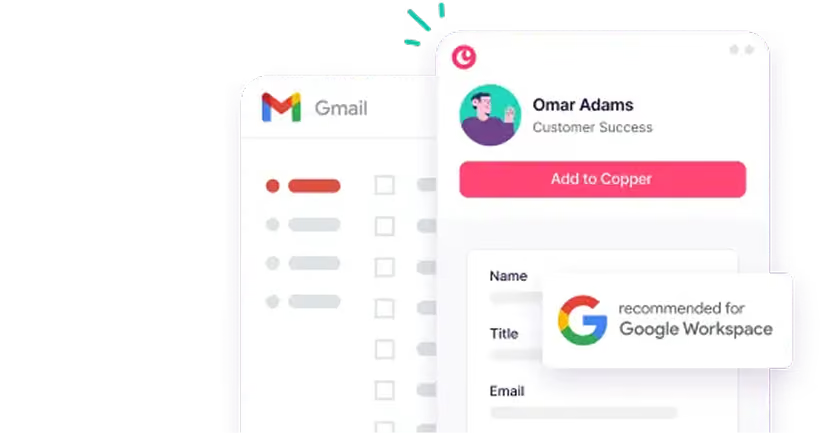
Here's the thing about Google Workspace CRMs: a lot of them say they integrate with Google. Copper is the only one Google has actually put its name behind. It’s a Recommended for Google Workspace app, a Chrome Enterprise Partner, and a Google-backed company. That's a pretty different thing from "yeah we have a Gmail plugin."
What that means for your team day-to-day: no more toggling, no more tab-switching, and no more "wait did I log that or just think about logging it?"
Copper shows up right inside Gmail, syncs with your Calendar, pulls in Drive, and tracks activity automatically. Your Opportunity Pipeline handles everything from first hello to closed deal. Your Project Pipeline takes it from there and manages delivery.
It all lives where your team is already working, so actually getting people to use it isn't the uphill battle it is with most CRMs.
Best for: Agencies, consultancies, professional services teams, and any relationship-focused business that runs on Google Workspace.
Standout features:
- Full lifecycle pipelines: Visual Opportunity Pipelines and Project Pipelines show exactly where every deal and project stands at a glance (including what's stalled, what's moving, and which project came from which deal)
- Gmail and Google Workspace integration: Copper’s Chrome Extension surfaces CRM data right in your inbox and actively suggests new contacts from emails you're already sending
- Workflow and email automations: When a deal hits a certain pipeline stage, Copper can automatically fire off a follow-up email, create a task, or update a record… without you doing anything
- Copper GPT: A ChatGPT integration is built right in for summarizing your pipeline activities
Notable limitations: Copper is built for Google Workspace teams, full stop. If your team is living in Outlook and Microsoft 365, you'd basically be ignoring everything that makes Copper worth using — and honestly, something else on this list is probably a better call for you.
Pipedrive
As a folk CRM alternative, Pipedrive is the one to look at if your main bottleneck is deal visibility. It's a sales-first customer relationship management (CRM) platform built entirely around visual pipeline management — drag-and-drop stages, clear deal ownership, and a constant answer to the question "where does this stand and who's on it."
It's been doing that one thing well for a long time, and the product shows it. Where Folk keeps things loose and flexible, Pipedrive is more opinionated about how a sales process should be structured (which is either exactly what you need or a bit too rigid, depending on your team).
Best for: Sales-driven teams whose primary need is moving deals through a structured process and tracking rep activity.
Standout features:
- Highly customizable deal pipelines with drag-and-drop stage management
- Activity-based reminders that keep reps accountable between touchpoints
- Solid reporting on deal progression and win rates
- Large integration ecosystem for connecting to the rest of your stack
Notable limitations: Pipedrive is built for the pre-sale motion and doesn't have much to offer once a deal closes. If you manage ongoing client relationships, project delivery, or anything post-"closed won," you'll be reaching for other tools to fill the gap.
HubSpot
If Folk felt too light, HubSpot is about as far in the other direction as you can go. As a folk CRM alternative, it's the pick for teams who don't just want a CRM: they want a whole platform. Sales pipelines, marketing automation, customer service ticketing, content tools... HubSpot has a hub (pun intended) for basically everything, and it all lives under one login.
If you're starting to think beyond just contact management and into "how do we also run campaigns and handle support," it's worth a serious look. Just go in knowing what you're signing up for.
Best for: Teams with a clear plan to eventually tie together sales, marketing, and customer service… and the time to actually set it all up properly.
Standout features:
- Covers way more ground than most CRMs (your sales, marketing, and service all in one place)
- You get a free tier that's actually useful for getting a feel for the platform before spending anything
- Marketing and service hubs connect natively to the CRM, so you're not duct-taping integrations together
Notable limitations: The breadth that makes HubSpot exciting is also what makes it a project. It's a big platform, and configuring it for your specific workflow takes real time (some teams switching from HubSpot to Copper have said the difference is days of setup versus months).
And the pricing has a way of sneaking up on you: the free tier feels generous until you realize the features you actually need are behind a paywall. It's not a bait-and-switch exactly, but it's close.
Close
Close knows exactly what it is as a folk CRM alternative, and that's actually kind of refreshing. It's built for inside sales teams who live on calls, run email sequences, and spend their day working through outreach lists. If that's your team's whole deal, Close is genuinely great at it.
It's not trying to do everything. It's trying to make high-volume outbound sales as fast and frictionless as possible… and it delivers on that.
Best for: Inside sales teams doing high-volume outreach who need calling, sequencing, and follow-up tracking all in one place.
Standout features:
- Built-in calling with a power dialer so reps aren't jumping between tools mid-outreach
- Multi-step email sequencing that keeps follow-ups moving without manual effort
- Activity tracking built for teams that are logging a lot of touchpoints every single day
Notable limitations: Close is really good at one thing: transactional, outbound sales where you're moving fast and working a list. But if your business is more about nurturing long-term client relationships, managing project delivery, or staying close to a small number of high-value accounts over time (it's just not built for that). Agencies, consultancies, anyone in professional services... Close will probably feel like the wrong gear for the road you're on.
Streak
Streak's whole pitch as a folk CRM alternative is that it doesn't ask you to change anything. No new platform to learn, and no separate login to remember! It just installs as a Chrome extension and starts showing up inside Gmail. Your pipelines live in your inbox. (Yes, that's kind of it!)
For someone who wants to feel more organized without fully committing to a CRM, that's honestly pretty appealing.
Best for: Solo users or very small teams who want basic pipeline tracking inside Gmail and aren't ready to go all-in on a standalone platform yet.
Standout features:
- Pipelines live directly inside Gmail and you never have to open another tab
- Almost no setup required, so you're up and running fast
- Free plan that covers the basics for individual use
Notable limitations: The thing that makes Streak easy is the same thing that makes it limited. It's a browser extension, not a real platform. So the moment your team grows or your workflows get more complex, it starts to creak. And if you're a Google Workspace shop, it doesn't actually run deep with the tools you use every day the way Copper does. You're getting Gmail with some extra columns, not a CRM built for how Google Workspace teams actually operate.
Make the switch to a CRM that works the way you do
Outgrowing folk isn't a bad thing, it just means your team is moving faster than your tools can keep up with. The contact list got longer, the workflows got messier, and somewhere along the way "it's fine" stopped being fine. Totally normal. That's why you're here.
Every tool on this list has its moment. Pipedrive if structured sales pipelines are your whole thing. HubSpot if you're ready to go big and have the runway to set it up properly. Close if your team lives on calls and outbound sequences. Streak if you just want something lightweight in your inbox while you figure out the rest.
And if your team runs on Google Workspace and you're managing relationships that go well past the close — client work, project delivery, ongoing accounts — Copper is worth a serious look. It's the only CRM Google has actually put its name behind, and 30,000+ companies use it to run their whole client lifecycle without ever leaving the tools they already have open.
(The free trial is 14 days and we won’t ask for your credit card! Just sign up and see how it feels.)