











You know that moment right before a client call where you think, “Wait… what did we last talk about again?”
And suddenly you’re opening five tabs, scanning emails, checking Slack, maybe even searching your calendar like it’s going to magically tell you a story (it won’t, but we try anyway).
Now imagine the opposite: You open one place and instantly see everything, like past conversations, current status, key stakeholders, and what needs to happen next.
You didn't have to dig, you didn't have to guess, and you didn't have to quietly mumble “I hope I’m remembering this right.”
That’s relationship intelligence. And once you have it, your business starts to feel a lot less chaotic… and a lot more on purpose.
Quick summary (...if you’re skimming)
- Relationship intelligence helps you understand and act on customer relationships
- It removes guesswork by capturing real interactions automatically
- Using a CRM like Copper makes it easier to manage relationships at scale
What is relationship intelligence?
Relationship intelligence is the ability to capture and understand the interactions, connections, and engagement patterns between your business and the people you work with.
It turns everyday communication (like emails, meetings, and follow-ups) into actionable insights so your team can build stronger, more informed relationships over time.
That context is what allows your team to make better decisions. You can see when a relationship is gaining momentum, when it might be at risk, and what the right next step should be — without relying on memory or guesswork.
Over time, that adds up to more consistent communication, stronger client experiences, and fewer missed opportunities.
Or, in other words, it’s the difference between hoping you know what’s going on… and actually knowing.
(And once you have that level of clarity, it’s very hard to operate without it.)
How relationship intelligence works
At a high level, relationship intelligence follows a simple flow:
- Capture: Collect interactions like emails, meetings, and touchpoints automatically
- Organize: Bring that data into one place so it’s easy to access
- Analyze: Identify patterns, engagement levels, and relationship strength
- Act: Use those insights to guide next steps and personalize outreach
(You’re already doing most of this — the difference is whether your system is actually helping you connect the dots.)

Why most teams only have part of the picture
Here’s the tricky part: relationship intelligence already exists in your business.It’s in your inbox. Your calendar. Your conversations. Your team’s memory. But without the right system, it’s scattered... and once it’s scattered, it’s fragile.
That’s when you start hearing things like:
- “Did someone follow up with them?”
- “Wait, weren’t they interested last month?”
- “Who owns this account again?”
(We’ve all been in that meeting. It’s not a strong meeting.)
And this isn’t just anecdotal. Research shows that 76% of organizations say less than half of their CRM data is accurate and complete, which makes it harder for teams to trust what they’re working with.
At the same time, teams are dealing with increasing complexity and fragmentation. Studies show that teams spend around 60% of their time on coordination work — things like searching for information, switching between tools, and trying to stay aligned across teams.
So you end up in a frustrating loop.
The system is incomplete, so people stop relying on it. And because people stop relying on it, it becomes even more incomplete.
(Which is how a CRM quietly turns into something everyone avoids.)
So the issue isn’t that teams don’t have relationships.
It’s that they don’t have a reliable way to capture, connect, and actually use what’s happening inside them.
Why agencies feel this problem more than anyone
If you’re in an agency, this hits a little harder. You’re not just managing deals. You’re managing ongoing client relationships across multiple stakeholders, services, and timelines. You’re also handling prospects becoming clients, clients expanding into new services, and multiple conversations happening at once across your team.
And somehow, it all has to feel seamless on the client side.
(No pressure. Truly.)
Modern buying decisions involve more stakeholders than ever, which makes it harder to track who’s engaged, what’s been said, and where the relationship actually stands. And without strong relationship intelligence, things start to fray.
Why relationship intelligence is what makes your CRM actually useful
Without relationship intelligence, a CRM quickly turns into a static database filled with outdated notes and partial activity, which makes it harder for teams to trust what they’re looking at (and once that trust is gone, people stop using it altogether).
When a CRM is built to support relationship intelligence, it becomes something entirely different. Instead of piecing together context before every interaction, your team has a clear, reliable view of what’s already happened, who’s involved, and where things stand. It’s the difference between walking into a call hoping you remember everything and walking in knowing exactly where to pick things up.
That continuity changes how your team shows up in a way that clients can actually feel.
Outreach becomes more relevant because it reflects real conversations, not templates. Follow-ups happen at the right time because they’re based on actual engagement. Conversations move forward naturally instead of restarting from scratch, and decisions are grounded in what’s really happening instead of what someone thinks is happening.
And internally, things get noticeably easier. Your team spends less time chasing updates or asking who owns what, and more time acting on information that’s already there. There’s less back-and-forth, fewer dropped details, and a much clearer sense of momentum across deals and accounts (which, let’s be honest, is where a lot of teams start to feel stuck).
When your system is consistently capturing and organizing relationship data, your team can focus on the work that actually drives growth — building stronger relationships, spotting opportunities inside existing accounts, and moving deals forward with confidence instead of guesswork.
How to improve relationship intelligence using your CRM
If relationship intelligence is the goal, the question becomes: How do you actually build it into your day-to-day workflow? Here’s where the right system makes all the difference.
1. Capture interactions automatically so nothing gets lost
Here’s the thing, relationship intelligence falls apart the second it depends on memory.
And it's not because your team isn’t capable, but because they’re busy. And “I’ll log that later” has a very low success rate (we’ve all been there). When interactions aren’t captured in real time, your CRM slowly turns into a highlight reel instead of a full story. A note here, an email there, and a lot of missing context in between.
That’s why automatic capture isn’t just helpful, it’s non-negotiable.
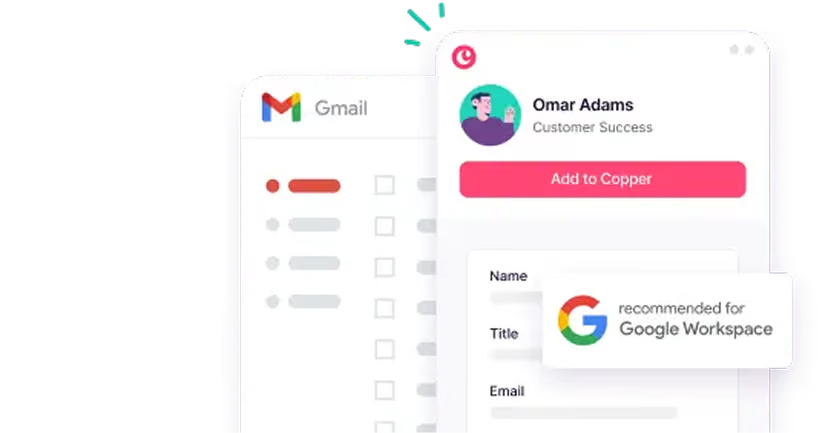
Copper CRM lives inside Google Workspace, which means emails, meetings, and contacts are logged in the background and connected to the right people without anyone lifting a finger. Over time, that builds a complete, reliable timeline of every relationship.
And that’s where things start to click.
Instead of scrambling before a call, you open a contact and instantly see what’s been discussed, what matters, and where things left off. You’re not piecing things together — you’re picking things up.
(Which is a much better way to start a conversation.)
Even better, your team actually trusts the system, because it’s not relying on them to keep it updated. It just… stays accurate.
And that’s what makes relationship intelligence sustainable, not just aspirational.
2. Bring everything into one place so your team can actually use it
Capturing data is great. Hunting it down across five different tools? Not so much.
When information is scattered across inboxes, spreadsheets, Slack threads, and project tools, your team ends up doing detective work before they can do actual work. And that’s where details slip, time gets wasted, and conversations lose momentum.
Relationship intelligence only works when the full picture is easy to see.
Copper pulls everything into one place and connects it to the relationships that matter. Because it integrates with hundreds of tools, it doesn’t force your team to change how they work — it just makes everything they’re already doing visible and connected.
So instead of asking, “Where was that again?” your team can open a contact and get the full story in seconds — recent emails, meeting history, deal status, and next steps.
No digging around hundreds of emails, having to guess for minutes on end, and especially no Slack message that starts with “quick question…”
(You know the one.)
That clarity shows up immediately in how your team communicates. Conversations feel smoother, more relevant, and a lot less like you’re starting from scratch every time.
3. Use your pipeline to understand relationship momentum
Most pipelines are treated like a checklist (This deal exists. That deal exists. Cool.).
But a good pipeline isn’t just tracking deals — it’s showing you how relationships are moving.
Each stage represents a shift in the relationship, from initial interest to real engagement to decision-making. When those stages actually reflect your process, your pipeline becomes a lot more than a status tracker. It becomes a way to understand momentum.
Copper’s customizable Pipelines let you build stages that match how your team actually works, so you’re not translating your process into something generic. And once that’s in place, you can start to see patterns.
You can spot where things are progressing smoothly, where they’re slowing down, and where they might be at risk of stalling. That visibility gives you a chance to step in early, instead of reacting later.
Because let’s be honest, most deals don’t disappear. They just… fade out. (Which is somehow worse.)
This is where pipeline email automations come in handy. When a deal moves stages, Copper can trigger follow-ups, notify your team, or kick off the next step automatically. So instead of relying on someone to remember what comes next, your process keeps moving by default.
And that consistency is what keeps relationships from losing momentum.
4. Turn relationship insight into better conversations and growth
This is where relationship intelligence stops being a concept and starts showing up in real conversations.
When your team has full visibility into a relationship, they communicate differently. They’re not guessing what the client cares about or rehashing old ground. They’re building on what’s already there.
They reference past conversations. They follow up with context. They show up like they actually know the client (because they do).
And clients notice that.
That consistency builds trust over time, which is what keeps clients around in the first place. When interactions feel connected and intentional, clients don’t have to repeat themselves or question whether your team is aligned. Everything just feels… handled.
(And in a world where switching vendors is easier than ever, that feeling matters a lot.)
But it doesn’t stop at retention. This is also where growth starts to happen more naturally.
Because when relationship data is connected across your team, you start to see opportunities that weren’t obvious before. Maybe a client has mentioned a new challenge in passing that aligns with another service you offer. Maybe engagement is increasing with a different stakeholder who has influence over budget. Maybe another team member already has a strong relationship with someone you haven’t formally met yet.
Without visibility, those signals stay buried in individual conversations.
With relationship intelligence, they start to connect.
And that’s what makes upselling and cross-selling feel less like selling and more like responding.
Instead of pushing a service, your team can introduce it at the right moment, grounded in what the client has already shared. The conversation feels relevant, the timing makes sense, and the recommendation feels like a natural next step rather than an interruption.
(Which is exactly how you want it to land.)
Over time, that shift does two things at once. It helps you retain clients because the relationship feels strong and consistent, and it helps you grow accounts because you’re expanding based on real needs, not assumptions.
And that’s the real power of relationship intelligence.
It doesn’t just help you manage relationships better. It helps you turn them into long-term, growing partnerships.
Relationship intelligence only works if your system supports it
Most teams already have the relationships.
What they’re missing is a reliable way to capture, understand, and actually use what’s happening inside them.
That’s what relationship intelligence gives you.
And that’s why your CRM matters — not as a place to store information, but as the system that makes that intelligence usable at scale.
When it works the way Copper does, it doesn’t feel like extra work or another tool your team has to manage. It just feels like everything finally clicking into place, with clearer visibility, better conversations, and stronger momentum across your relationships.
(Which, if you’ve ever dealt with a messy CRM, you know is a pretty big shift.)
If you want to see what that actually looks like in practice, Copper offers a 14-day free trial so you can experience how much easier it is to understand and manage your relationships when everything is connected and up to date.
Because once you see the full picture, it’s very hard to go back.