








You spent two days on the takeoff. You sharpened the number, triple-checked the exclusions and hit send on Tuesday. It's now the following Thursday, and your inbox has gone quieter than a jobsite on Christmas morning.
Ask around any estimator forum and you'll hear the same complaint: bidding feels like throwing numbers into a black hole. The fix isn't more bids. It's a better follow-up. Below you'll find when to send one, what to put in it and 10 construction bid follow-up email templates you can copy, tweak and send today.
Key takeaways
- Follow up two to three times per bid. Once to confirm receipt, once to add something useful, and once to close the loop.
- Make every email about the project, not about you. Name the job, recap one or two strengths, and ask one clear question.
- Use a subject line they can search for. Project name and bid number beat "Checking in" every time.
- Track every bid in one place. A follow-up only works if someone remembers to send it.
Why following up on construction bids wins you more jobs
Most contractors submit a bid and wait. Meanwhile, the GC or owner on the other end is juggling a dozen bid packages, an addendum that just dropped and a superintendent asking where the drawings went. Your number isn't being ignored. It's being buried.
A short follow-up puts it back on top of the pile. It also tells the reader something your bid can't: you're organized, you're paying attention and you'll be easy to work with once the job starts. That counts for a lot when two numbers are close.
And if you're worried about sounding needy, don't be. One well-timed email that references the project and offers help reads as professional. Five emails that say "any update?" read as needy. The difference is in what you send, not whether you send it.
When to send a construction bid follow-up email
There's no universal schedule. A tenant improvement with a two-week award window moves faster than a public school job with a board vote. Use the bid due date and the award date (if you know it) as your anchors, and space your follow-ups around them. Here's the general rhythm.
1. The initial follow-up after submitting your bid
Send a quick check-in within the first week, usually a couple of days after the bid is due. Confirm they received it, say you're still interested and ask if anything needs clarifying. Friendly, short, done.
2. The second follow-up when you haven't heard back
If a week or so passes with nothing, send a gentle nudge. This is where you add value instead of just asking "did you decide?" Answer a question they might have, flag a scope item, or confirm your crew availability for their start date.
3. The final follow-up before closing the file
A couple of weeks after that, send one last email. The goal is a clear yes or no, or a graceful exit. Let them know you're closing the file on your end, and leave the door open for the next one. A little urgency, zero pressure.
What to include in every bid follow-up email
Every good follow-up has the same five parts. Get these right and the templates below do the rest.
- Subject line: name the project so it's easy to find.
- Opener: reference the job, the address or your last conversation.
- Recap: remind them of one or two things that make your bid strong.
- Ask: one clear question or next step.
- Sign-off: full contact details so replying takes zero effort.
A clear and specific subject line
"Following up" tells them nothing, and it disappears in a crowded inbox. Put the project name, address or bid number up front so they can search for it later. For example:
- Bid follow-up: Westlake Middle School, mechanical (Bid #2417)
- Northgate Medical Office: electrical bid and schedule question
- Riverside Apartments framing bid: still a fit for your timeline?
A friendly opener that references the project
Skip "just checking in." Mention the specific project, the property address or something from your last call or site walk. It proves you're not blasting the same email to every GC in the county.
A quick recap of your bid highlights
One or two lines on what sets your bid apart: your schedule, your approach, a similar job you finished last year. They shouldn't have to dig through attachments to remember why you're worth a call.
A direct ask or clear next step
Make replying easy. Ask one specific question ("Is the March 3 start still the plan?") or propose an action ("Happy to walk the scope with your PM on Thursday"). One ask per email. Two is a questionnaire.
A professional sign-off with contact details
Full name, title, company, cell and email. If they want to call you from the jobsite, don't make them hunt for your number.
10 construction bid follow-up email templates that work
Copy these, swap in your details and adjust the tone to fit the relationship. Anything in [brackets] is yours to fill in. Pro tip: save your favorites as Gmail templates so you're not retyping them at 9 p.m.
1. The polite check-in after submitting a bid
Your first follow-up. Confirm they got it, say you're interested and offer to answer questions.
Subject: [Project name] bid: received OK?
Hi [Name],
Quick note to confirm you received our bid for [project name] on [date]. We're interested in this one and would be glad to work with your team on it.
If anything in our scope or exclusions needs clarifying, I'm happy to walk through it.
Thanks,
[Your name]
[Title], [Company]
[Phone] | [Email]
2. The second follow-up when you still haven't heard back
They're busy. Acknowledge it, offer something useful and ask about timing.
Subject: [Project name]: anything else you need from us?
Hi [Name],
I know bid week is a lot, so I'll keep this short. Following up on our [trade] bid for [project name].
If it would help your review, I can send a breakdown by [phase/floor/system] or confirm crew availability for your [start date]. Do you have a sense of when you'll be making a decision?
Thanks,
[Your name]
[Phone]
3. The follow-up after a verbal "maybe" or "we're still deciding"
They haven't said no. Respect their process, ask about the timeline and show you can flex.
Subject: [Project name]: timeline and options
Hi [Name],
Thanks for the update on [project name]. Totally understand you're still working through the numbers.
So I can hold the right crew, is [date] still the target for a decision? And if it would help, we can look at [alternate material, phasing option, value engineering idea] to bring the number closer to budget.
Best,
[Your name]
[Phone]
4. The follow-up that adds new value or information
Use this when you actually have something new: updated availability, a similar job you just finished or a heads-up on material lead times.
Subject: [Project name]: updated availability
Hi [Name],
Wanted to pass along an update on [project name]. A crew just freed up, so we can now start as early as [date], which gives your schedule some breathing room.
We also wrapped [similar project] last month. Happy to send photos or a reference if that's useful.
Thanks,
[Your name]
[Phone]
5. The follow-up after a site visit or project walkthrough
Reference the walk while it's fresh. Mention something specific you saw or discussed so they know you were paying attention.
Subject: Thanks for the walk at [project address]
Hi [Name],
Thanks for walking [project address] with us on [day]. Good to see the [existing condition, access issue or tie-in point] in person, since it changes how we'd sequence the work.
Based on what we saw, our bid accounts for [specific scope item]. If you'd like us to price [option you discussed] as an alternate, I can have that to you by [date].
Best,
[Your name]
[Phone]
6. The follow-up when you know you're competing against lower bids
Don't chase the low number and don't trash the competition. Point to what's included and what it saves them later.
Subject: [Project name]: what's included in our number
Hi [Name],
I know you're comparing several numbers on [project name], so I wanted to spell out what's in ours.
Our bid includes [cleanup, permits, a dedicated foreman, warranty term, closeout docs], and we've held our schedule on our last [number] jobs with [GC name or similar client]. If it would help to line our scope up against the others, I'm happy to go through it item by item.
Thanks,
[Your name]
[Phone]
7. The final follow-up before moving on
Close the loop. Make it easy for them to give you a quick yes or no.
Subject: Closing out our bid for [project name]
Hi [Name],
I haven't heard back on [project name], so I'm guessing the timing or fit didn't line up. No problem at all.
I'll close the file on our end this [day]. If you're still deciding, a one-word reply works: "still deciding," "awarded" or "pass." Either way, we'd love to bid your next one.
Thanks,
[Your name]
[Phone]
8. The follow-up after losing the bid
Short and gracious. Ask for feedback if the relationship allows it. This is the email most contractors skip, which is exactly why it gets noticed.
Subject: [Project name]: thanks for considering us
Hi [Name],
Thanks for letting us know about [project name]. We appreciate the chance to bid.
If you have two minutes, I'd value any feedback on where we landed, whether it was price, schedule or scope. It helps us sharpen the next number we send you.
Looking forward to the next one,
[Your name]
[Phone]
9. The follow-up to stay on their radar for future projects
For GCs you want to work with but haven't won with yet. Light touch, no ask, just useful.
Subject: [Trade] availability for Q[number]
Hi [Name],
Hope [recent project] is wrapping up well. Quick heads-up that we have [trade] crews opening up in [month], in case you have anything coming to bid.
We also just finished [notable project], which had a similar [scope or challenge] to [their type of work]. Happy to share what we learned.
Best,
[Your name]
[Phone]
10. The follow-up after winning the bid
You got it. Now start the relationship right: confirm next steps, set expectations and get the paperwork moving.
Subject: [Project name]: next steps and kickoff
Hi [Name],
Thanks for awarding us [project name]. We're glad to be on the team.
To get rolling, we'll need [contract, insurance certificate requirements, schedule, submittal log]. On our side, [PM name] will be your day-to-day contact and will send a submittal schedule by [date].
Would [day and time] work for a quick kickoff call?
Thanks again,
[Your name]
[Phone]
How to track your construction bid follow-ups so nothing slips through
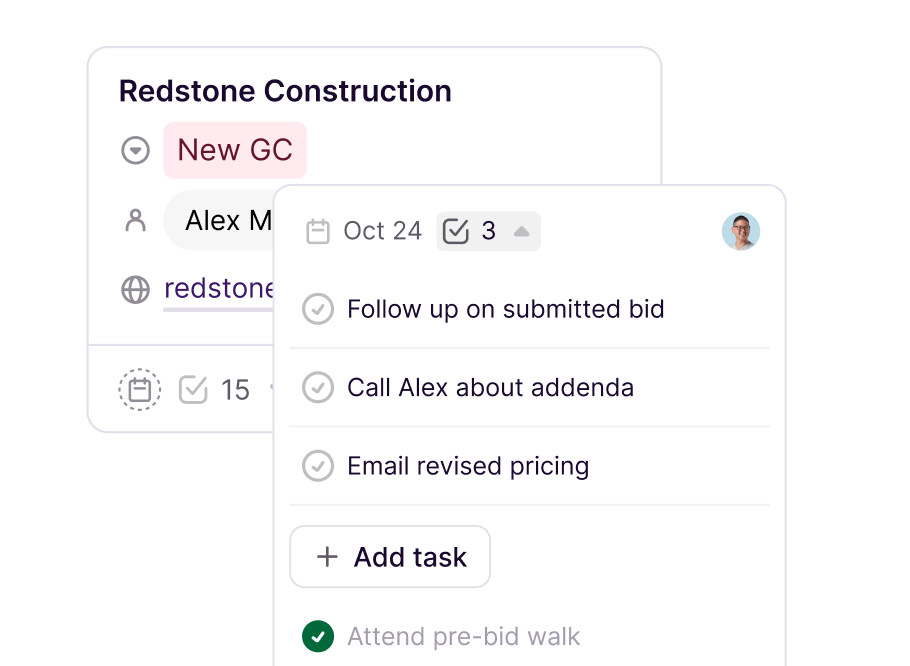
Writing a good follow-up is the easy part. Remembering to send it, across 30 open bids, five estimators and a dozen GCs, is where most teams fall apart. The bid log lives in a spreadsheet one person updates. The emails live in three different inboxes. And the follow-up reminder lives in someone's head, right next to their truck's oil change date.
Whatever you use to track bids, it should show you this for every job:
- Project name and bid amount: a quick reference for each opportunity.
- Key contact and their role: so you know who actually makes the call.
- Submission date: the anchor for your follow-up timing.
- Follow-up history: what you sent and when.
- Next action and date: what happens next, and when.
- Status: pending, won, lost, or nurturing for the next one.
A spreadsheet can hold that for a while. Once you're bidding to several GCs a week, a CRM does it better, because it fills itself in from the emails you're already sending.
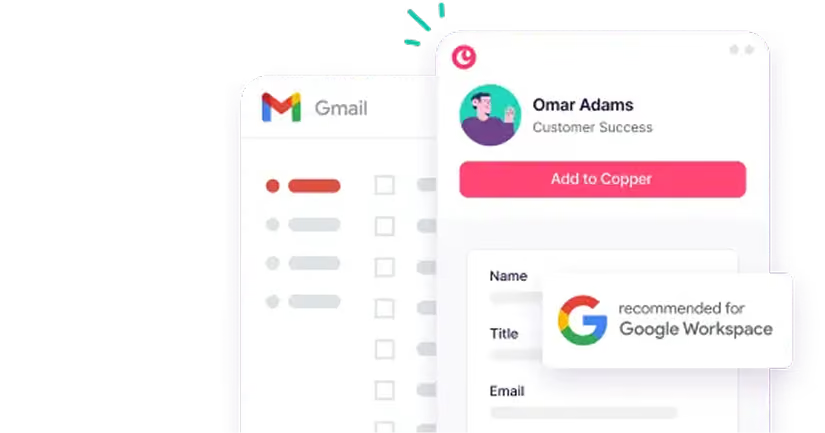
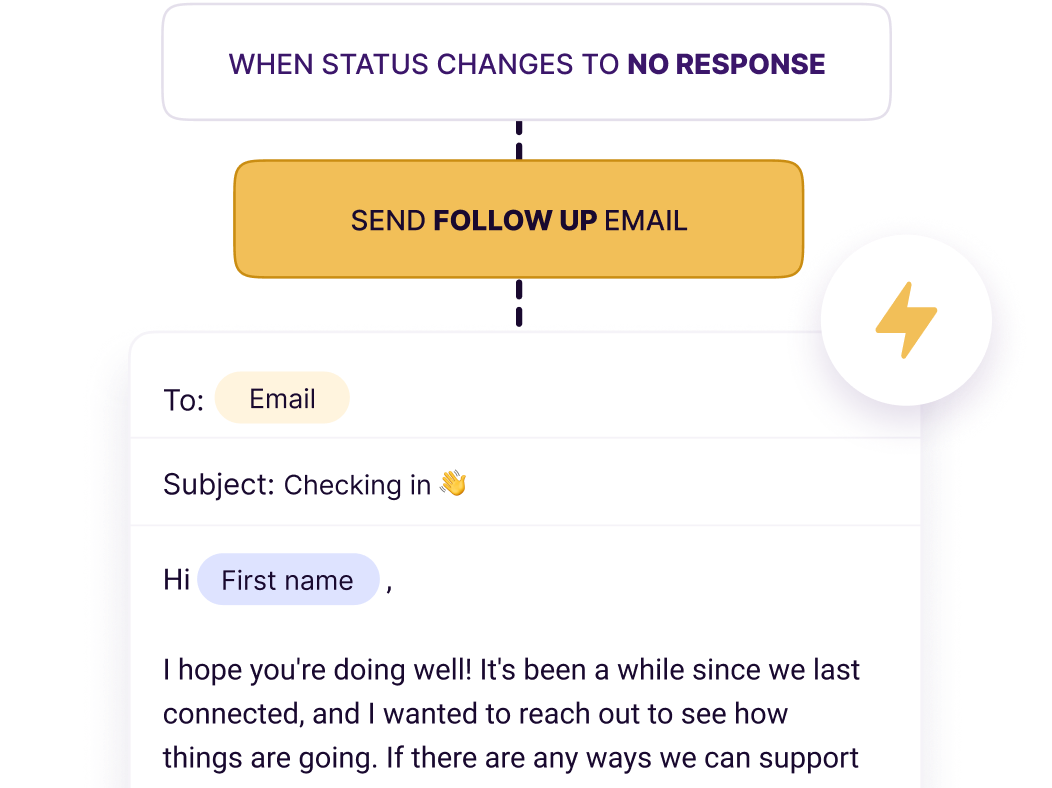
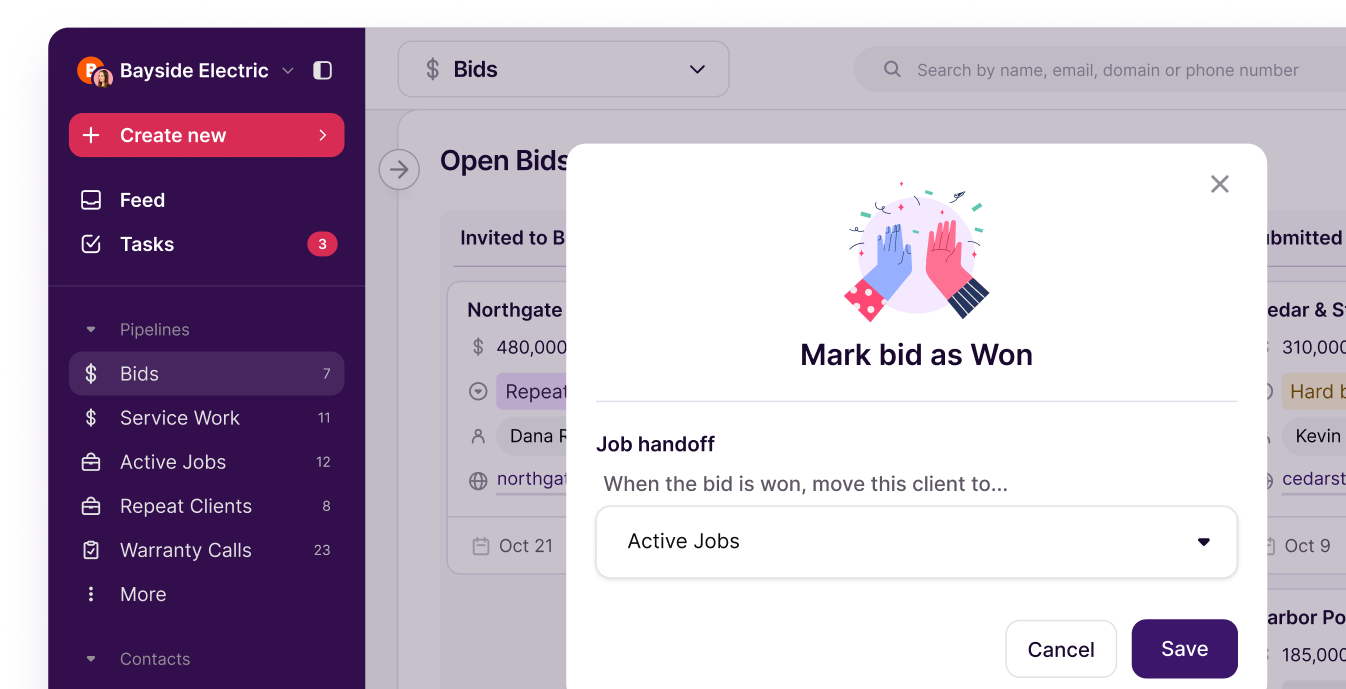
Copper works inside Gmail, so you can track every bid without switching tabs. Open an email from a GC and you'll see your full history with them in the sidebar: past bids, emails, calls and meetings. Set a follow-up reminder right from your inbox, or set a bid stage to send a follow-up email on its own when a bid goes quiet.
Here's how construction teams use it today:
- One process per trade or division. Egan Company, a specialty contractor with electrical, mechanical, glazing and other groups, gives each group its own pipeline in Copper while leadership sees every bid in one place.
- A clean handoff when you win. Expose Designs moves won jobs straight into project tracking, so the details from the bid don't get lost on the way to the build team.
- History that stays when people leave. Because emails and meetings save to the client record automatically, the GC relationship stays with the company, not in one estimator's inbox.
"The team adopted it really, really quickly. I've had no pushback." Craig McArdell, Head of Sales, Expose Designs
Your follow-up emails are only as good as the system that reminds you to send them. Keep the templates. Retire the bid spreadsheet.