











So you’re searching for Copper CRM alternatives.
First of all, we respect the research energy. Choosing a customer relationship management (CRM) platform is kind of a big deal. This thing ends up holding your deals, your contacts, your email history, your pipelines, and sometimes the fate of your sales team’s sanity (...we know, no pressure).
But here’s something we’ve noticed about people who start Googling Copper CRM alternatives: a lot of them expect to discover a magical unicorn CRM that does everything better. And then they start looking. And looking.
So let’s walk through some of the most common Copper CRM alternatives, what they’re actually good at, and how to figure out which one fits your team.
(And if you end up realizing Copper was already doing the job beautifully, we promise not to say “we told you so.”)
Why look for an alternative to Copper?
People usually start researching Copper CRM alternatives for one of two reasons.
Either they’re comparing CRMs before choosing one, or they’re currently using Copper and doing a little “what else is out there?” exploration. (Totally normal. Software curiosity is real.)
The key thing to understand is that Copper was built with a very specific type of team in mind: companies running on Google Workspace.
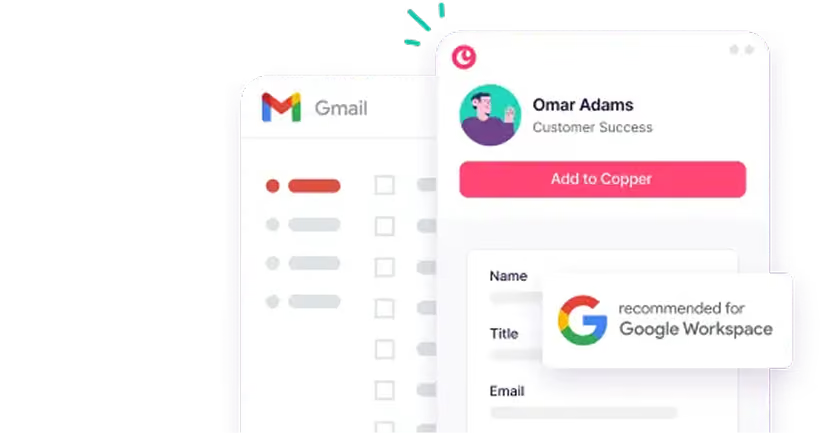
If Gmail is basically your company headquarters, Copper makes a lot of sense. Emails automatically attach to contacts, meetings sync with timelines, and new leads can be captured directly from your inbox without copying information into another system. It’s all designed to remove the little bits of admin work that make CRMs feel like homework.
But if your organization doesn’t rely heavily on Google Workspace, or if your workflow leans more toward marketing automation or outbound sales operations, it makes sense to explore Copper CRM alternatives that match those needs.
The important thing is choosing a CRM that fits how your team already works. Because the fastest way to make a CRM fail is forcing people to use it in ways that feel unnatural. (That’s how you end up with a very expensive spreadsheet.)
Exit Design chooses Copper over HubSpot — and isn’t looking back
Quick comparison of the best Copper CRM alternatives
If you’re researching Copper CRM alternatives, you probably want the quick overview first.
Different CRMs tend to specialize in different things. Some are built for outbound sales teams that spend all day calling prospects. Others are focused on marketing automation or client management.
Here are a few Copper CRM alternatives that tend to show up on comparison lists and what they’re known for.
1. Close
Close is a CRM built for teams that spend a lot of time selling over the phone (like, the kind of teams where headsets are practically part of the uniform).
If your sales team lives in call queues and outbound outreach campaigns, Close often comes up when people start researching Copper CRM alternatives. The platform centers heavily around communication tools, so reps can call, text, and email prospects without bouncing between a dozen tabs.
The big appeal is that everything happens inside the CRM: calling, SMS, and email sequences are all built in. That can make life easier for teams running high-volume outbound sales operations (especially if your team measures success in calls per day).
The trade-off? Because Close is so focused on phone-heavy sales workflows, teams that rely more on relationship-based selling or longer deal cycles sometimes find it less flexible for broader CRM needs.
Key features include:
- Built-in calling and SMS
- Automated email outreach sequences
- Sales activity tracking and reporting
- Pricing usually starts around $49 per user per month.
For teams running high-volume outbound sales operations, Close can be a practical option among Copper CRM alternatives.
2. Dubsado
Dubsado is a bit of a different creature compared to many CRM alternatives.
Instead of focusing purely on sales pipelines, it leans heavily into client management. That’s why it’s popular with creative agencies, freelancers, consultants, and other service-based businesses that manage projects alongside client relationships.
The platform includes contracts, invoices, onboarding workflows, and project tracking tools… essentially helping businesses manage the entire client lifecycle from inquiry to delivery.
That said, because Dubsado tries to do a lot in one place, some teams find the setup process takes a bit of time (there’s a learning curve if you want to automate everything).
Key features include:
- Contract and invoice management
- Client portals
- Workflow automation for onboarding
- Project management tools
- Pricing typically starts around $40 per month.
3. GoHighLevel
GoHighLevel often shows up in conversations because it combines CRM functionality with heavy-duty marketing automation (and it doesn’t do this halfway).
It’s especially popular among marketing agencies that manage campaigns and leads for multiple clients. Agencies can build funnels, capture leads, automate follow-ups, and track contacts from a single dashboard.
The platform also includes white-label features, which means agencies can brand the system as their own when working with clients (which, yes, is a big selling point for agency owners).
The flip side is that GoHighLevel packs in so many tools that it can feel overwhelming at first. Teams looking for a simple CRM sometimes find it a bit more complex than they expected.
Key features include:
- Funnel builder for lead generation
- Marketing automation tools
- Multi-client account management
- White-label features for agencies
- Pricing usually starts around $97 per month.
4. Nutshell
Nutshell is often described as a simple, affordable CRM designed for small and mid-sized teams (and it leans hard into the “simple” part).
It focuses on usability and pipeline management while still offering automation features and reporting tools. Companies researching Copper CRM alternatives sometimes gravitate toward Nutshell because it’s relatively straightforward to learn and implement.
That simplicity can be a real advantage — especially for teams that don’t want a complicated setup process. On the other hand, some growing businesses eventually wish it offered deeper customization or more advanced functionality.
Key features include:
- Visual pipeline management
- Sales automation tools
- Reporting dashboards
- Email marketing capabilities
- Pricing typically begins around $16 per user per month.
Related: Best Nutshell CRM alternatives
5. HubSpot
HubSpot is probably the most widely recognized name that appears when people start searching for Copper CRM alternatives.
The platform offers a free CRM alongside a huge ecosystem of marketing, sales, and service tools. Companies can start with basic contact management and gradually add more advanced capabilities as they grow.
That flexibility is one of HubSpot’s biggest strengths. Businesses can build an entire revenue stack inside the platform if they want to. The trade-off is that pricing can increase quickly as more hubs, seats, and advanced features are added (something many teams discover once they start scaling).
Key features include:
- Free CRM tier
- Advanced marketing automation tools
- Sales and customer service hubs
- Large integration ecosystem
6. Pipedrive
Pipedrive focuses heavily on visual pipeline management (it’s kind of the star of the show).
Sales teams can see exactly where deals sit in the pipeline and set activity reminders to keep opportunities moving forward. That clarity is a big reason Pipedrive often comes up when teams compare Copper CRM alternatives.
The interface is designed to make deal tracking simple and easy to understand, which many sales teams appreciate.
That said, while Pipedrive is excellent at pipeline visibility, some businesses find they need additional integrations or tools if they want deeper marketing automation or broader CRM functionality.
Key features include:
- Visual deal pipeline interface
- Activity reminders and scheduling
- Workflow automation tools
- Sales performance reporting
- Pricing typically starts around $14 to $24 per user per month.
How to choose the right alternative for your team
Once you start researching Copper CRM alternatives, you’ll quickly notice something: there’s no shortage of options.
The real challenge isn’t finding a CRM. It’s figuring out which one actually fits how your team already works (instead of forcing everyone to relearn their entire workflow).
Before making the switch, here are a few things worth thinking about.
Fit with Google Workspace
If your company spends most of its day inside Gmail, Google Calendar, and Google Docs, your CRM shouldn’t feel like a separate system you have to constantly jump into.
Many Copper CRM alternatives offer Google Workspace integrations, but they often rely on browser extensions or syncing tools that sit on top of Gmail rather than inside it.
Copper was built specifically for Google Workspace, which means teams can manage contacts, deals, and emails directly from Gmail (no extra tabs, no constant switching). For many companies exploring Copper CRM alternatives, that seamless workflow ends up being the deciding factor.
Because when your CRM lives where your conversations already happen, adoption tends to take care of itself.
Sales and project management balance
Another big difference between Copper CRM alternatives is how they balance sales management and project work. Some platforms focus purely on sales pipelines. Others try to combine CRM, project management, invoicing, and client portals into one system.
That can be useful for some businesses. But it can also make the CRM feel heavier than it needs to be (especially if your main goal is tracking leads and closing deals).
For many growing teams, a focused CRM that handles sales really well ends up being the simpler and more effective choice.
Automation and integrations
One of the biggest benefits of a CRM is saving your team from repetitive work.
Copper CRM includes customizable pipelines, pipeline email automations triggered by stage changes, website forms that automatically sort new inquiries, and integrations with hundreds of other apps your team may already use.
So when you’re evaluating Copper CRM alternatives, it’s worth taking a close look at how each platform handles automation. The right CRM should quietly take tasks off your plate (instead of adding more steps).
Pricing and scalability
Pricing can vary quite a bit across Copper CRM alternatives. Some platforms start with very low pricing but increase quickly as you add users, automation tools, or reporting features. Others keep things simpler with pricing that scales more predictably as your team grows.
That’s why it helps to think beyond the first few months. The goal isn’t just to find the cheapest CRM today — it’s to find one that will still make sense a year or two from now as your team and pipeline expand.
Why Copper CRM is still the best fit
After comparing a bunch of Copper CRM alternatives, a lot of teams end up having the same moment: wait… why was this so complicated before?
Copper works because it doesn’t try to hijack your workflow. It lives right inside Gmail and Google Workspace, where your conversations are already happening. So instead of jumping between tabs and manually updating records, your CRM just quietly keeps everything organized in the background (as it should).
You still get all the good stuff — customizable pipelines to track deals, email automations triggered by pipeline stage changes, website forms that automatically sort incoming leads, integrations with hundreds of tools, and deep connections with Gmail and Google Calendar.
Want to see what the hype is about? Try Copper free for 14 days and see how easily it fits into your workflow. Sometimes the easiest way to compare Copper CRM alternatives is just giving Copper a spin.