











For many consulting firms, Google Workspace isn't just a productivity suite—it's where client relationships actually happen. Gmail, Calendar, Drive, and Meet contain the conversations, decisions, and context that move deals forward. The challenge is that most CRMs still live somewhere else.
Google Workspace is where the work happens. It's where client relationships live (think: in email threads, in calendar invites, in shared documents). The problem is that none of those tools were designed to give you a relationship view of a client.
They're communication tools, not relationship tools.
Which is why most consultants end up with their customer relationship management (CRM) platform in one window and Gmail in another, manually logging interactions, copy-pasting email addresses, and doing the kind of tab-switching that makes you question your life choices on a Tuesday afternoon.
There's a better way.
Where the actual relationship data lives (hint: it's not in your CRM)
Here's a fun game: think about the last five meaningful things that happened with a client. Where did they actually happen?
- An eight-email thread where you hashed out the scope change on the Meridian account.
- A calendar invite where the pre-call notes for Thursday's check-in are buried.
- A proposal you sent last Wednesday with three flagged concerns you're still working through.
- A follow-up you sent last Tuesday that they've gone radio silent on (cool, cool, totally fine).
Every single one of those is sitting in Gmail and Google Calendar right now.
Your CRM, meanwhile, has a pipeline stage someone updated two months ago and a notes field with the word "call went well."
So that's fun.
The problem isn't your team, it's the tab.
Here's what happens when your CRM lives somewhere other than Google: you finish a client call, open a new tab, navigate to the record, try to remember what was said, type a summary that's already 40% fiction, update the pipeline stage, and tab back to Gmail.
Multiply that by every email, every meeting, every touchpoint across every client, every week.
That gap — between where work actually happens (Google) and where it's supposed to be recorded (the other tab) — is exactly where your CRM data goes to die.
And it’s not because your team doesn't care. Because the friction is just wide enough that things fall through. One busy week and suddenly your pipeline is full of records that have no relationship to reality.
A CRM that lives outside of Google isn't just inconvenient. It's structurally set up to fail you.
The hidden cost of using a CRM outside Google Workspace
The problem with keeping your CRM separate from Google Workspace isn't that it's annoying. It's that every extra step between doing the work and recording the work has a real, measurable cost.
Research puts it plainly:
- Poor CRM data quality costs organizations 15 to 25% of their annual revenue
- Sales reps waste 27% of their working hours (roughly 550 hours a year, per person) dealing with incomplete or inaccurate data
- Between 30 to 60% of CRM implementations fail because of adoption issues alone
That's more than a full day every week spent not selling, not building relationships, not doing the work that actually moves the business forward.
And when your team is manually logging emails and switching between tools to piece together client history, the CRM slowly becomes less reliable than the people trying to use it.
The flip side is worth noting too. Companies that achieve high CRM adoption report:
- 300% increases in conversion rates
- 29% revenue growth
That's what happens when the tool actually fits the workflow.
A CRM that lives inside Google Workspace removes the gap that causes all of this. The emails, meetings, contacts, and documents your team already works with every day become part of the customer record automatically. No extra steps, no manual logging, no hoping someone remembered.
Because the best CRM data isn't data someone remembered to enter. It's the data that got captured while the work was happening.
What a Google Workspace CRM actually looks like in practice
There's a version of "Google Workspace CRM" that means the CRM has a Gmail plugin.
A sync that runs every few hours. A Zapier workflow someone set up in 2022 that may or may not still be working (nobody's checked). It’s technically connected (maybe, probably) and it still feels like two separate tools passing notes to each other across a gap, hoping nothing gets lost in transit.
And then there's a CRM that actually lives inside Google Workspace. It’s the CRM that shows you the full relationship picture inside the email you're already reading, not in a tab you have to go find. It’s the CRM that captures activity automatically, so "did anyone log that call?" stops being a thing your team has to ask.
That's where Copper stands apart. While most CRMs connect to Google Workspace through integrations and plugins, Copper was built specifically for Google Workspace from day one. Instead of moving between systems, your CRM works where your client relationships already live.
If you're in consulting, agency work, or professional services (where the client relationship is the work), that difference isn't a nice-to-have. It's the whole thing
Related: Looking for a CRM that works seamlessly with Gmail? Here's how to choose the best CRM for Gmail.
Why Copper is the go-to CRM for Google Workspace teams
Copper isn't a CRM that was built and then adapted for Google Workspace. It was designed from day one to live inside it — which makes it the only CRM that's a Recommended Google Workspace app, a Chrome Enterprise Partner, and a Google-backed company (all three, yes).
And that native integration is one of the reasons companies like Aux Mode chose Copper as they scaled. Founder Adam Rumanek wanted a CRM that fit seamlessly into the tools his team already used every day.
“It was the only one that integrated into an ecosystem I was already in. I'm a huge fan of Google,” he says.
And that difference shows up the moment you open Gmail. Here's what it actually changes day-to-day:
Your interaction history captures itself
Every email and meeting is automatically captured, giving your team a complete record of every client interaction without relying on manual updates. That means more accurate pipeline reviews, smoother account handoffs, and fewer surprises.
A CRM for Google Workspace stays current because it's pulling from Google in real time, not waiting for someone to remember to update it.
You get the full relationship picture inside Gmail, not behind it
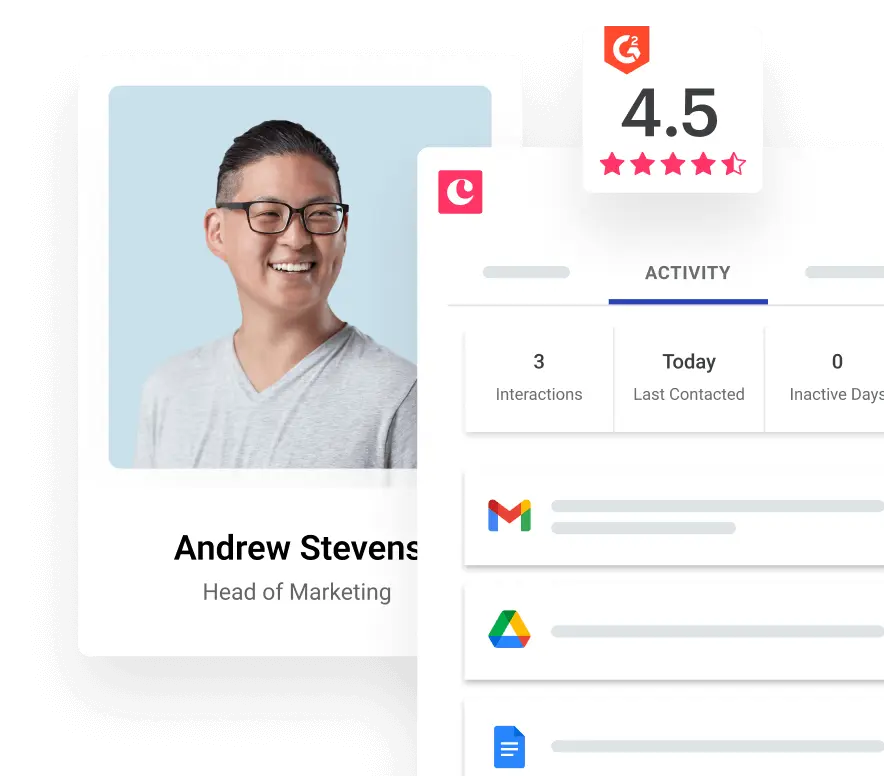
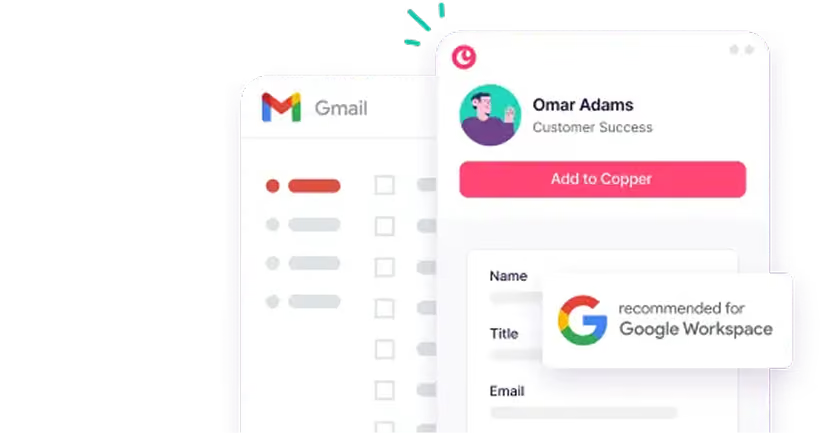
Open an email in Gmail from a client and a Copper sidebar shows you everything — their record, recent activity, open opportunities, notes, tasks — right there in the same window.
You're not switching contexts to find context.
Google Contacts and Copper stay in sync automatically
Two-way sync means no duplicate management, no address book drift, no quarterly "okay who has the real list" conversation.
Client files live on the relationship, not floating somewhere in Drive
Proposals, contracts, briefs — linked directly to the client record via Google Drive, right next to the emails and meetings. No more "which folder was that in" scramble at 9 a.m. before a client call (or the even more fun version: asking three people and getting three different answers).
And your whole workspace comes with you
Copper's Linked Pages feature lets you embed the tools your team already lives in — think dashboards, reporting hubs, proposal builders, onboarding docs, even that Google Sheet you use to triage leads that aren't quite pipeline-ready yet (you know the one) — directly into Copper's navigation.
So instead of playing browser tab roulette every time you need to do something, everything is just... there, right next to the client it belongs to.
When the CRM lives inside the tools your team already uses every day (and those tools live inside the CRM right back), the data problem largely solves itself.
Nobody has to build new habits. Nobody has to remember to log anything. The work and the record of the work are just in the same place — and honestly, how is that not the default everywhere?
Here's why your team will actually use this one
Here's a truth nobody in the CRM industry likes to say out loud: adoption is a lot easier when the tools are actually easy to use.
Plus, tools that are already where you work get used.
Tools that require you to stop what you're doing, open a new tab, navigate somewhere, and then log the thing you just did? They get quietly, consistently skipped — not because your team doesn't care, but because they're busy and the friction is just high enough to make "I'll do it later" feel totally reasonable (and we all know how "later" goes).
When the CRM is already inside Gmail, there's no trip to make. The data fills in because the tool is there when the work is happening. Your team doesn't have to remember anything new or change how they work. They just... keep working. And somehow (almost magically) the pipeline is actually up to date.
Try Copper and see how working in Google Workspace gets easier
Your client relationships live in Google Workspace. The only question is whether your CRM is connected to it, or sitting in a separate tab waiting for someone to bridge the gap manually (between all the other things on their plate, of course).
If your business runs on Google, and if you're in consulting, agency work, or professional services, it almost certainly does, a CRM that lives outside of Google is working against you by default.
Copper is built for the way you already work. 30,000+ companies use it. Yours could be next.
Why not try it today for 14 days free? You can thank yourself later!